Nick Turk-Browne Lab · Research
Research site for a Yale cognitive neuroscience lab
Web Design · Content Strategy
Case Study · Research Web Design
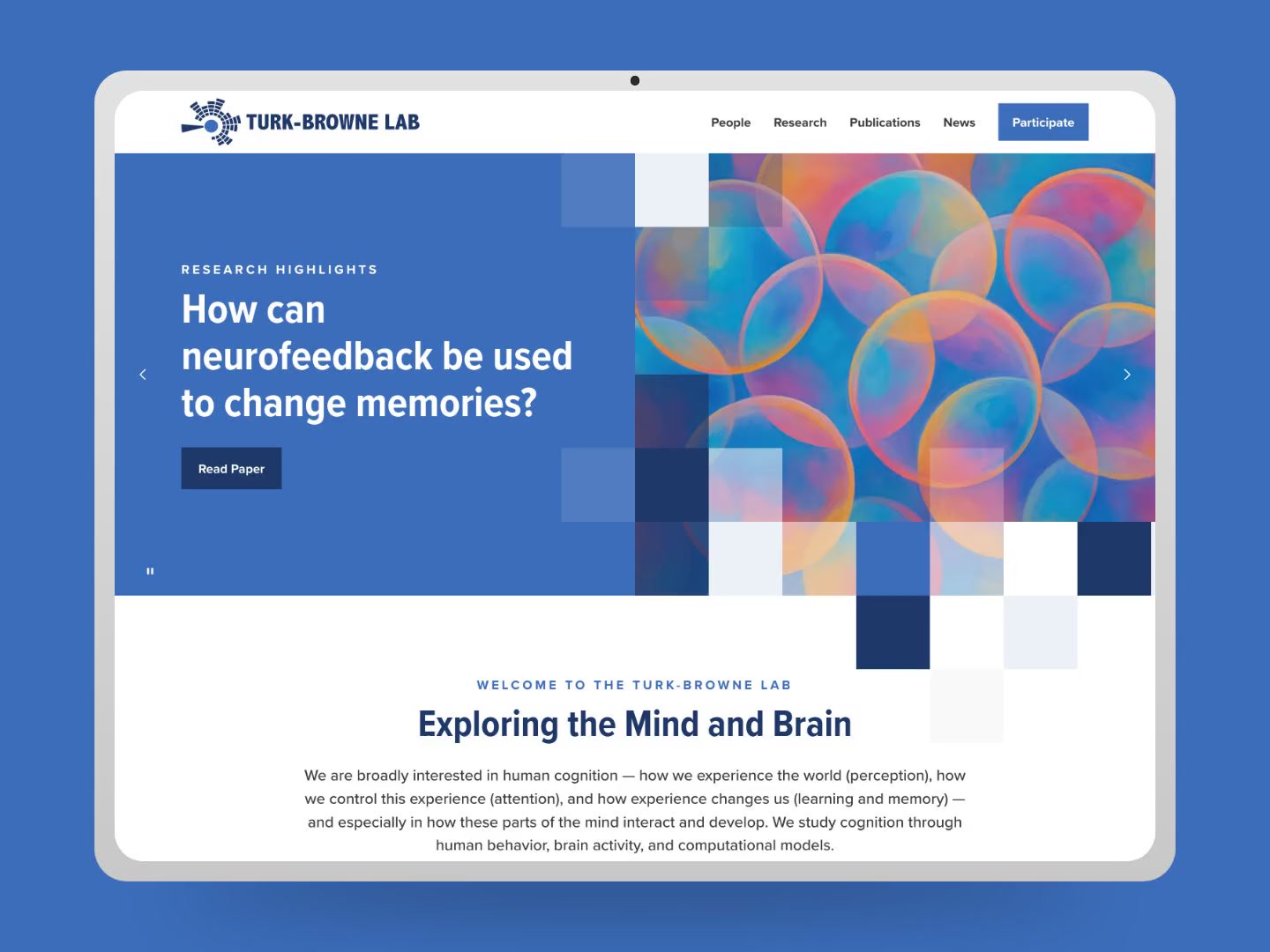
How memory works, on the web
The Turk-Browne Lab at Yale studies how the human brain learns, remembers, and predicts — combining functional MRI, computational modeling, intracranial recordings, and real-time neurofeedback to answer fundamental questions about cognition. Why do we remember so little from when we were babies? How does attention shape memory? What can predictive coding tell us about consciousness?
Nick Turk-Browne, who joined Yale's Department of Psychology faculty after eight years at Princeton, won the National Academy of Sciences' Troland Research Award in 2025 — the kind of distinction that arrives with new attention from prospective grad students, postdoc applicants, journalists, and collaborators worldwide.
The lab's site had to keep up with that traffic — and represent the work with the seriousness it deserved.
At a glance
- Institution: Yale University, Department of Psychology and Wu Tsai Institute
- Principal investigator: Nicholas Turk-Browne, PhD (Yale, 2009)
- Research focus: Statistical learning, infant cognition, memory, predictive coding
- Methods: fMRI, computational modeling, intracranial recordings, real-time neurofeedback
- Funding: NIH, NSF, CIFAR
- Recent honor: Troland Research Award, National Academy of Sciences (2025)
The challenge: science at recruiting speed
A research lab's website has more jobs than a marketing site. It has to:
- Recruit graduate students and postdocs (the highest-stakes audience)
- Communicate research to peers and funders
- Welcome study participants — including infants and parents
- House the lab's publications, news, and team
- Present the science in a way that's accurate, current, and not boring
University-template lab sites usually fail one or more of those audiences. Default templates lean academic-bureaucratic; custom builds lean personal-blog. Neither matches the gravity of a Yale lab pulling top-tier NIH funding and competing with Princeton, MIT, and Berkeley for the same recruits.
The solution: a lab site that recruits
We designed and built a site that does the four jobs above, organized around how the lab actually operates.
Research highlights, not press releases
The homepage rotates through research highlights — accessible-language summaries of the lab's recent papers ("Why do we remember so little from when we were babies?") with a link to the full paper. It's the front door for journalists, prospective students, and collaborators alike.
People, presented seriously
Profiles for the PI, postdocs, graduate students, undergrads, and staff — with research interests, training, and contact information. The team page reads as a roster, not a directory: this is who you'd be working with.
Publications, organized
A current, filterable publication list. Topics, years, and author cross-links. PDFs where rights allow, links to journal pages where they don't. Fast to scan for peer reviewers, search committees, and prospective postdocs evaluating fit.
Participate
A clear, parent-friendly Participate section — including the infant-cognition studies that depend on community recruitment. Site language meets parents where they are, not where psychology PhDs assume they are.
News and recognition
A News section that surfaces awards, talks, new papers, and lab milestones — keeping the site's perception aligned with the lab's actual trajectory. The 2025 Troland announcement landed on a homepage that was ready to receive the traffic.
The outcome
The Turk-Browne Lab now has a digital presence that matches the science. Prospective grad students arrive and stay. Postdoc applicants self-qualify against the actual research program before they reach out. Parents searching for "Yale infant memory study" find a Participate page that respects their time. And when the next major paper drops — or the next major award lands — the site is ready.
A lab site is rarely the thing a PI wants to spend cycles on. We made it the thing they don't have to.
A research site that recruits, communicates, and represents the science — without making us think about it.
More research work
Other research projects
Let's work together
Ready to take your
business further?
Tell us about your project and let's create something extraordinary together.