Preston Lab · Research
A recruitment-first website for a UT Austin cognitive neuroscience lab
Web Design · Recruitment Funnel · Study Branding
Case Study · 2014 – Present
The recruitment funnel is the real job of the website
Cognitive neuroscience labs need participants. For a research group focused on memory and brain development across the lifespan — including children — that's not a "post a flyer in the building" problem. It's a digital recruitment problem with a high bar: parents need to feel safe, eligibility needs to be clear, and the signup needs to actually work on the phone the parent has open at 8 p.m.
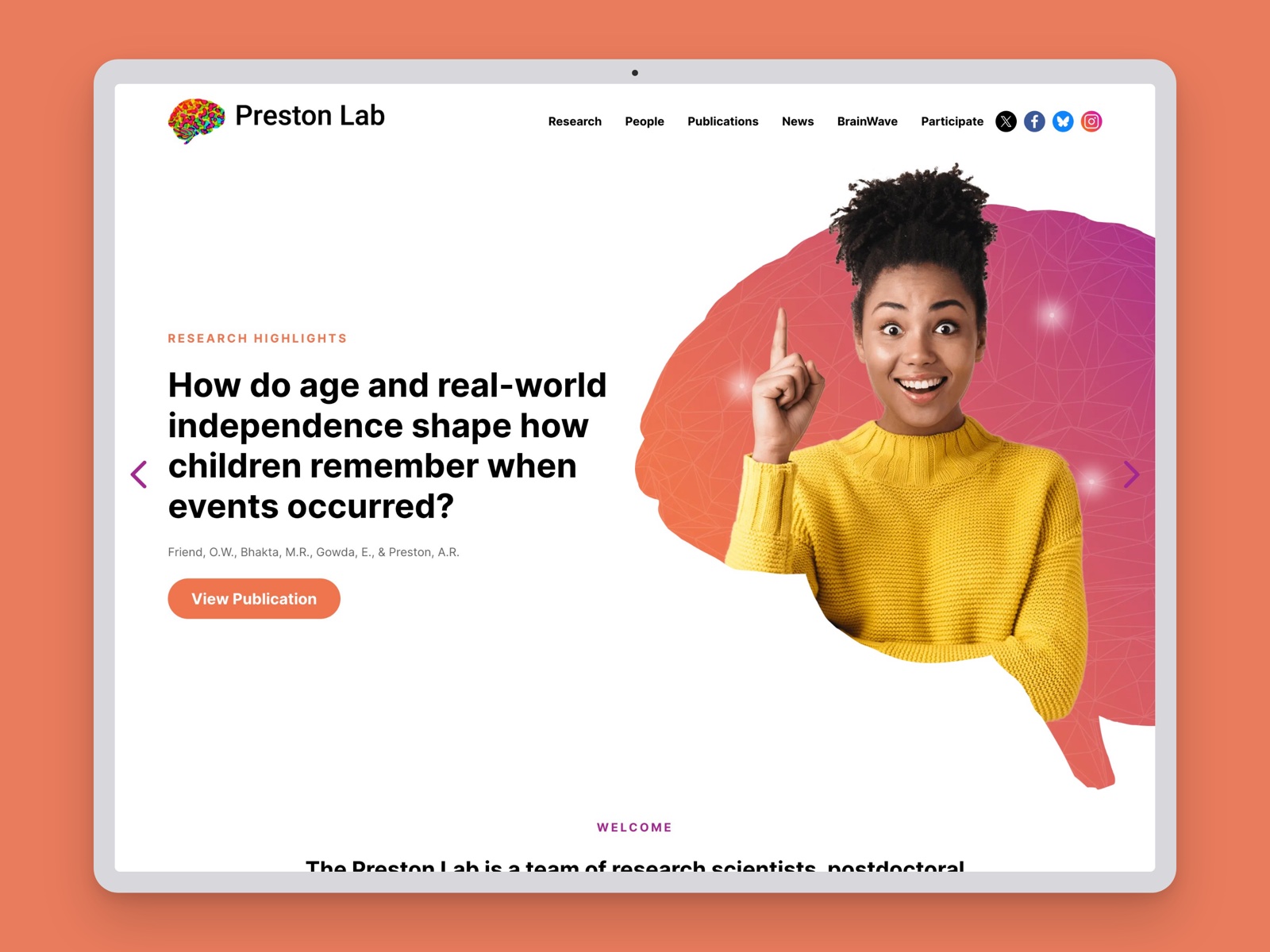
Preston Lab at The University of Texas at Austin (UT Austin) is one of the field's leading groups studying how memory develops, and their previous website wasn't carrying the recruitment weight the science deserved. We rebuilt it around the funnel — without sacrificing the credibility a top-tier neuroscience lab needs to project to peers and collaborators.
At a glance
- Client since: 2014
- Partnership: 12+ years, three website generations
- Affiliation: Center for Learning and Memory, The University of Texas at Austin (UT Austin)
- Recruitment integration: REDCap eligibility screening
- Sub-brand: BRAIN WAVE study landing area with parent-friendly design
- Services delivered: Web design, web development, content strategy, BRAIN WAVE study branding, recruitment funnel optimization, CMS implementation
The challenge: four audiences, one site
Most lab websites pick one audience and quietly fail the others. Preston Lab has four:
- Prospective participants and families — particularly parents weighing whether to enroll a child in a developmental study.
- Collaborators and grant reviewers — peers in the field who need to see publications, methods, and credibility signals fast.
- Prospective students — undergraduates and grad students evaluating whether to apply.
- Alumni and the broader academic network — for ongoing affiliations, hiring, and citations.
The old site, like most lab sites, defaulted to the academic audience and made the recruitment audience hunt. The new site had to flip that — without making the lab look like a marketing operation.
The solution: a funnel-shaped homepage with the academic depth behind it
A homepage that recruits without losing the science
The hero positions the work in plain language, links directly to current publications, and surfaces the recruitment CTA above the fold. Researchers find the science in the same number of clicks as before. Parents find the participation pathway in fewer.
A Participants page wired to REDCap
Eligibility screening runs through REDCap — the standard for clinical and behavioral research at UT — so participant data never lands in a marketing form. The page lays out compensation, the take-home brain images families receive, and what an actual session looks like, before asking anyone to commit to anything.
The BRAIN WAVE landing area
The lab's flagship developmental memory study, BRAIN WAVE, gets its own visual sub-brand and a dedicated landing area written for parents — not for grant reviewers. Eligibility, time commitment, what happens during a visit, and why it matters are all answered before the screening form opens.
Five-topic research architecture
The lab's research surface area is organized into five core topics rather than a chronological publication list, with each topic page connecting to the relevant publications, the team members driving that line, and the methods involved. A searchable publications repository handles the long-tail academic queries.
Team, alumni, and kids pages
Profiles include CVs, contact information, and the mix of formal credentials and personal touches that lab pages live or die on. An alumni/network section maintains the lab's broader academic graph, and a dedicated kids page reinforces — visually and editorially — that this is a place that takes its young participants seriously.
CMS and UT credentialing
UT identity, CMS implementation, and social channel integration are all wired in so the lab's grad students and post-docs can publish news, update studies, and add publications without going through central IT or a vendor.
The outcome
The site does the four jobs at once. Parents get a clear, friendly, trustworthy path to the BRAIN WAVE study. Collaborators land on publication-ready research depth in two clicks. Prospective students see the lab they'd actually be joining. The alumni network has a place to live.
The headline framing the team gave us early on stuck:
The recruitment funnel is the real job of the website.
The rebuild treated it that way.
More research work
Other research projects
Let's work together
Ready to take your
business further?
Tell us about your project and let's create something extraordinary together.