Website Design & Development
Earning Trust Before the First Gift: The Vannie E. Cook Jr. Cancer Foundation's New Website
May 20, 2026 · 9 min read · MPC Studios
Most people want to feel sure about a charity before they give to it. In the BBB Wise Giving Alliance's 2026 Donor Trust Report, released earlier this month, 67.7% of Americans surveyed said it is essential to trust a charity before donating, while only 18.3% said they have high trust in charities. That gap shapes how people give, because a donor who wants to be sure will go looking for proof, and according to the same report, the charity's own website influences that search more than any other source.
A nonprofit website carries even more weight when the cause is children with cancer. The same site has to reassure a donor about where a gift will go and point a parent toward the clinic where a child receives care, and a foundation that supports a clinic has to explain in a few seconds how those pieces fit together.
The Vannie E. Cook Jr. Cancer Foundation in McAllen supports the Vannie E. Cook Jr. Children's Cancer and Hematology Clinic, which opened in 2001 through a partnership with Texas Children's Hospital and Baylor College of Medicine and treats children with cancer and blood disorders from across the Rio Grande Valley. The promise that runs through the foundation's website is that no child is ever turned away because a family cannot pay. The foundation's new website went live this week. MPC Studios designed the previous version as well, so we started this project with a site we knew well and a story we had been helping to tell for years.
The American Cancer Society estimates that about 9,680 children in the United States will be diagnosed with cancer in 2026, and that 85% of children with cancer now survive five years or more. For families in the Rio Grande Valley, a child's diagnosis once came with a long drive. Texas Children's Hospital notes that before the clinic opened, families traveled to San Antonio, five hours away, or to Houston, six hours away, for treatments that can be needed once a week or more. Today those treatments happen in McAllen, delivered by Texas Children's and Baylor College of Medicine physicians.
The foundation's profile on Candid, the organization behind the GuideStar nonprofit profiles, says the foundation's sole purpose since 2000 has been to provide financial and in-kind support to the clinic, including free use of a 28,000-square-foot medical facility and payment of the building's maintenance, utilities, and housekeeping. That relationship gives the website an unusual job. The foundation raises money, looks after the building, and carries a history that reaches back to 1972, while the clinic's medical care comes from Texas Children's and Baylor. Donors need to understand that arrangement before they give, and a family looking for the clinic needs a direct route to it.
Kate Hurry, MPC's creative director, designed the new site around the purple and gold the foundation has used for years, pairing a graceful serif for headlines with a clean, easy-to-read typeface for everything else. The design brief asked for a site that feels trustworthy and warm, and every structural decision had to work for both audiences.
Drawing a clear line between the foundation and the clinic
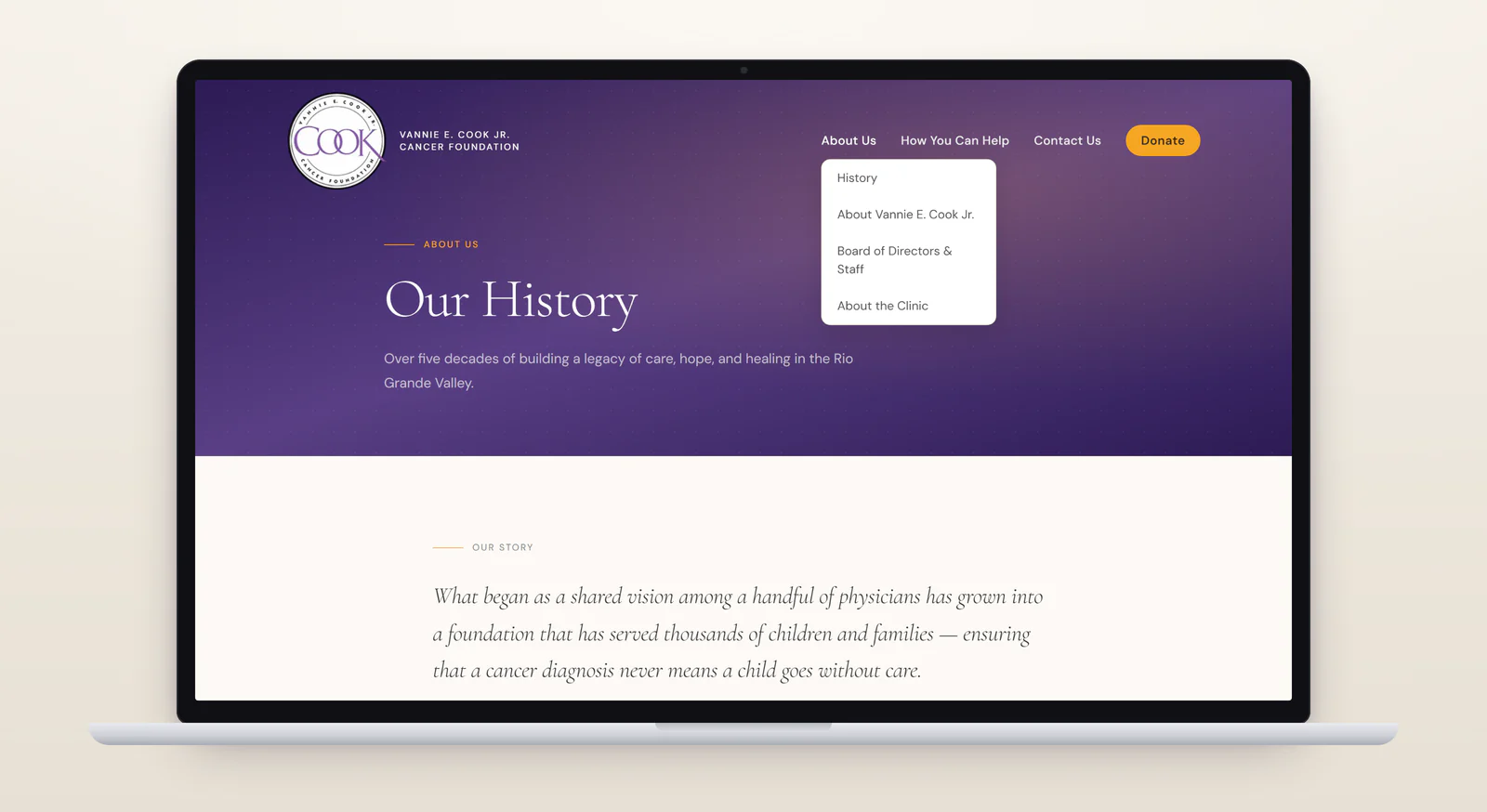
The homepage states the relationship plainly in its About the Foundation section: the foundation supports the Children's Cancer and Hematology Clinic, established in 2001 through a landmark collaboration with Texas Children's Hospital and Baylor College of Medicine. The history page repeats the point just below its opening quote. The navigation follows the same logic. The About Us menu gathers the foundation's own story, from its history to the life of the man it is named for and the board that guides it today, and ends with a link labeled About the Clinic that opens the clinic's page on the Texas Children's Hospital website in a new tab.
That link does real work. A parent searching for appointment details or a physician's name needs the organization that provides the care, and the Texas Children's page is where families can find a provider or schedule a visit, so the foundation sends them straight to it. The rest of vanniecook.org can then speak to the people who make the foundation's work possible, from a first-time donor to a family planning a gift in a will.
Giving donors proof they can check
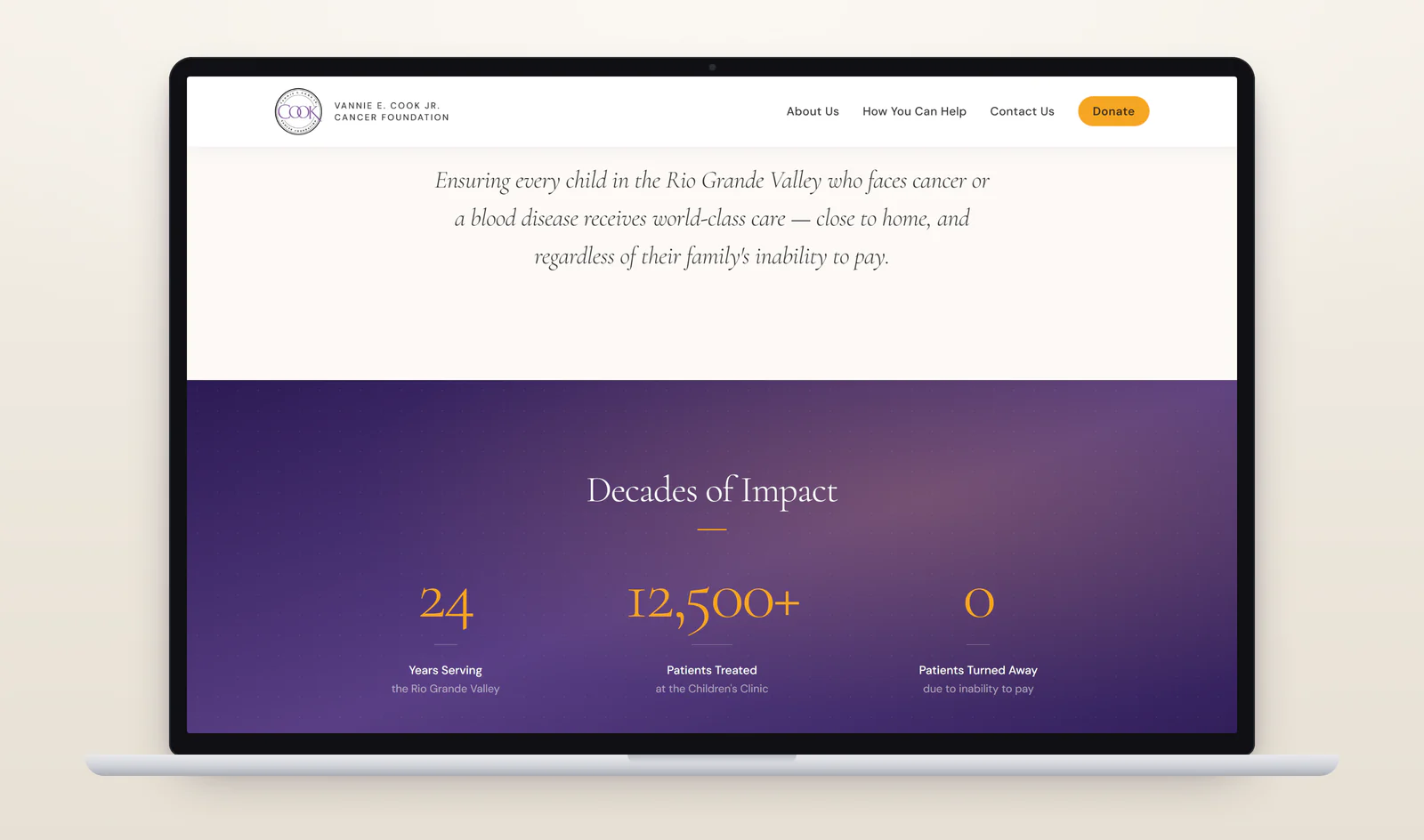
The homepage opens with the headline "Saving Our Children. Healing Our Families." beside portraits of young patients from the clinic, and from there the page moves quickly from feeling to evidence. The mission statement follows, set large in italic serif type, and directly below it a band titled Decades of Impact counts more than 12,500 patients treated at the clinic and zero turned away because a family could not pay. The zero is the number a donor will remember, because it states the foundation's promise as a fact.
Further down, under the heading A Top Rated Children's Cancer Charity Organization, two seals link to independent reviews. The BBB Accredited Charity seal opens the foundation's report on Give.org, which confirms that the foundation meets all 20 of the BBB Wise Giving Alliance's Standards for Charity Accountability. The Candid seal opens the foundation's nonprofit profile, where anyone can read its mission and programs. Smaller versions of both seals sit in the footer of every page.
Those links follow the way careful donors check a charity. Among the Donor Trust Report respondents who research before giving, 54% said charities' websites influence them most, and 39% named third-party monitors, the independent reviewers that evaluate how charities operate. The foundation's site puts both sources one click apart.

Five decades of history, told one milestone at a time
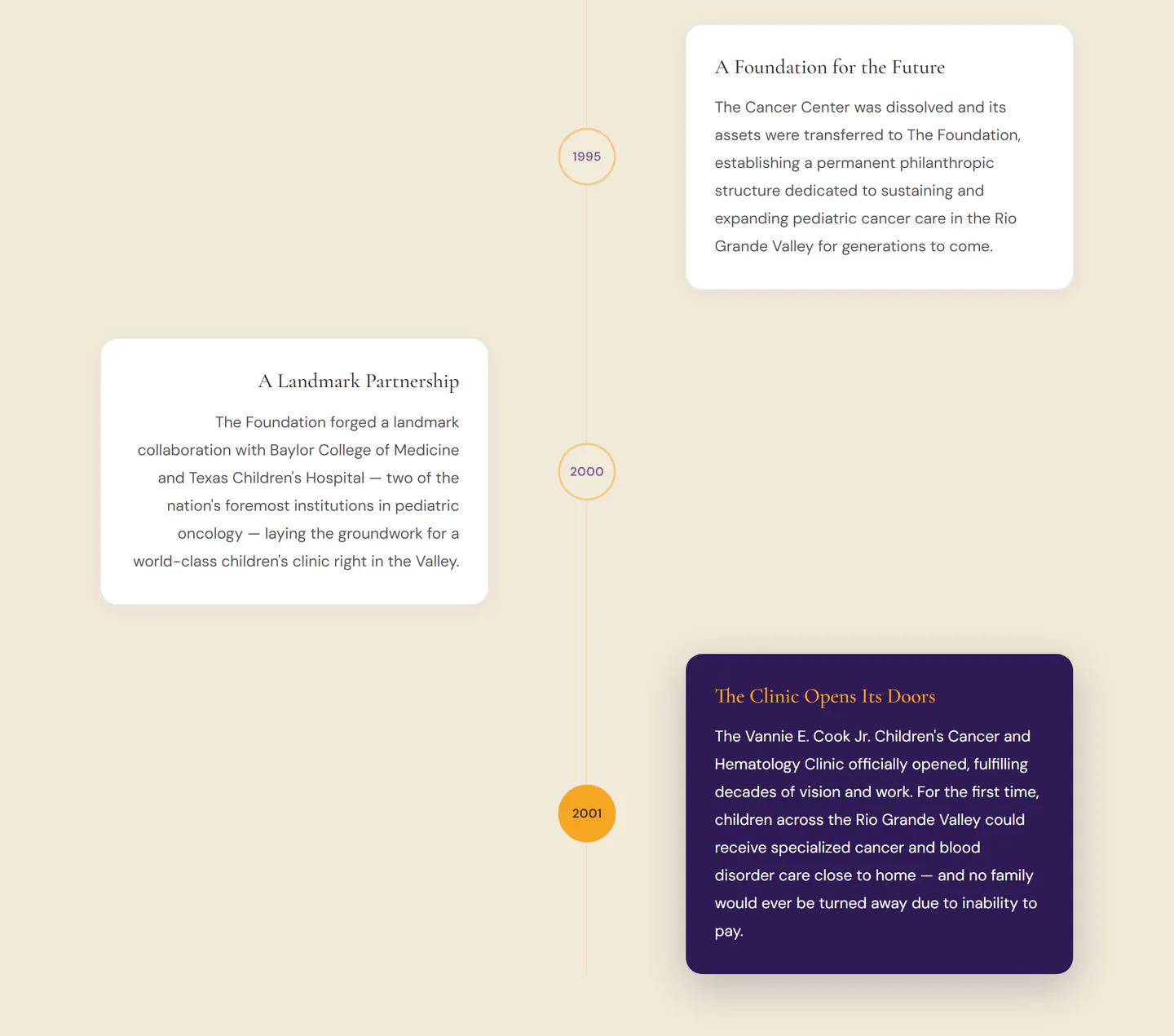
The foundation is older than the clinic it supports, and the new history page makes that lineage easy to follow. A timeline walks through eight milestones, beginning in 1972, when the organization was incorporated with a founding board of physicians and a mission to bring cancer care to the Rio Grande Valley. From there, the timeline moves through the opening of the Rio Grande Cancer Treatment Center in 1977, the center's renaming in honor of Vannie E. Cook Jr. in 1989, and the transfer of the center's assets to the foundation in 1995. The final card, set in deep purple with a gold title, marks 2001, the year the clinic opened its doors.
A long history reassures donors in a practical way. An organization that has adapted its work to the Valley's needs for more than half a century, and that helped create the children's clinic it still supports, gives donors good reason to expect it to be there for the long term. That confidence matters most to someone considering a gift that may not arrive for decades.
A companion page tells the story of the man behind the name, a McAllen businessman and rancher who was active in the cancer treatment center that eventually became the foundation. His daughter, Kathy Collins, chairs the board today, and the board page introduces every director by name. For a donor deciding whether to trust an organization, knowing who oversees it is part of the answer.
Every way to give, laid out on one page
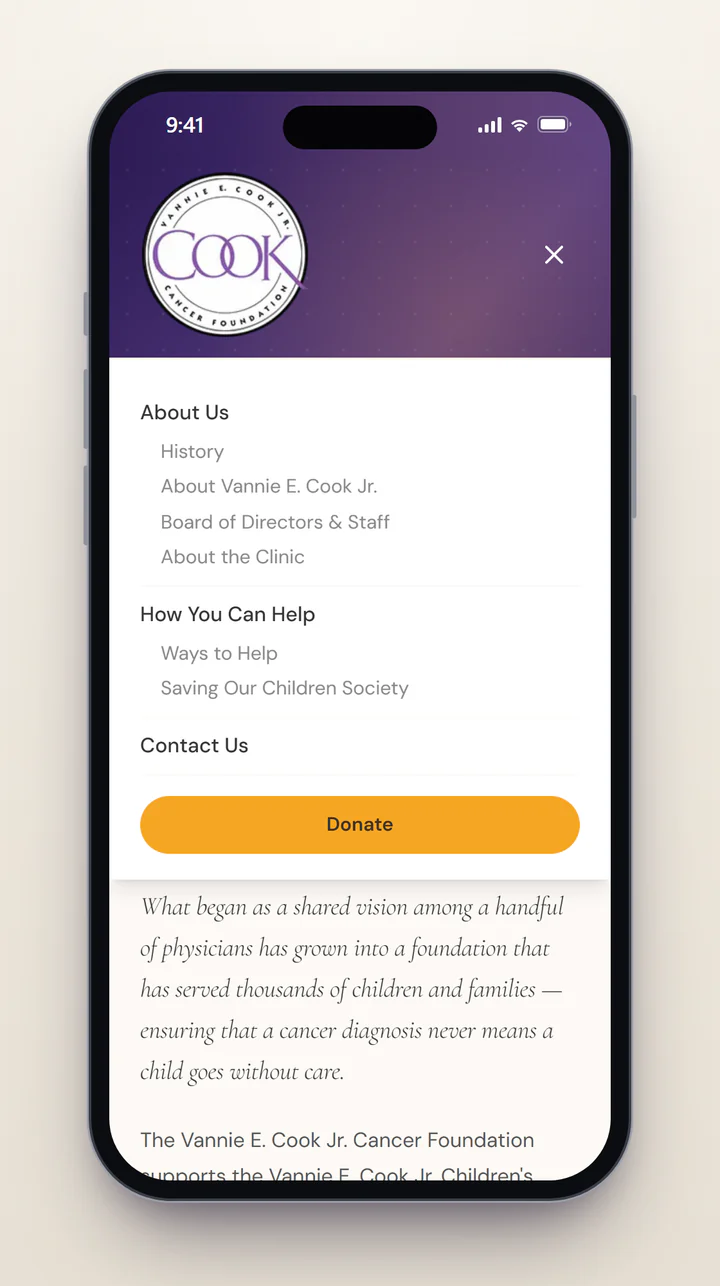
A gold Donate button sits at the end of the navigation on every page and opens the foundation's secure online giving form in a new tab. On a phone, the same button stretches across the bottom of the menu, which puts the donation form two taps from any page: one to open the menu and one on Donate.
For donors who prefer another route, the How You Can Help page gathers six ways to give into a single grid. Giving online is set apart in deep purple with its own Donate Now button, and the card for giving by mail invites a check or credit card gift, sent with the foundation's printed donation form to its McAllen office. Honorary and memorial gifts come with a promise that gift amounts stay confidential and that the honoree and the donor each receive an acknowledgment, which can mean a great deal to someone giving in memory of a loved one.
Other cards explain employer matching gifts and permanent endowed funds, which the foundation shapes with each donor around the programs that matter most to them. The card for third-party fundraising, meaning events that organizations or individuals hold on the foundation's behalf, explains that an event needs 10 weeks' notice before any public announcement, so a school club or a local business planning a benefit knows the rule before printing a flyer.
Keeping the Donate button within reach matters most on a phone. The M+R Benchmarks 2026 study, built on data from 180 participating nonprofits, found that mobile devices now bring in more than half of nonprofit website visits, while desktop visitors still account for most of the gifts and most of the money raised.
Questions get a path of their own. The contact form's subject menu separates questions about donations from those about planned giving and estate plans or about hosting a fundraising event, which tells the foundation what each message is about before anyone replies. Supporters who want to stay in touch can join the email list from a Stay Connected signup at the bottom of every page, and spam protection runs in the background on both forms.
 Menu
Menu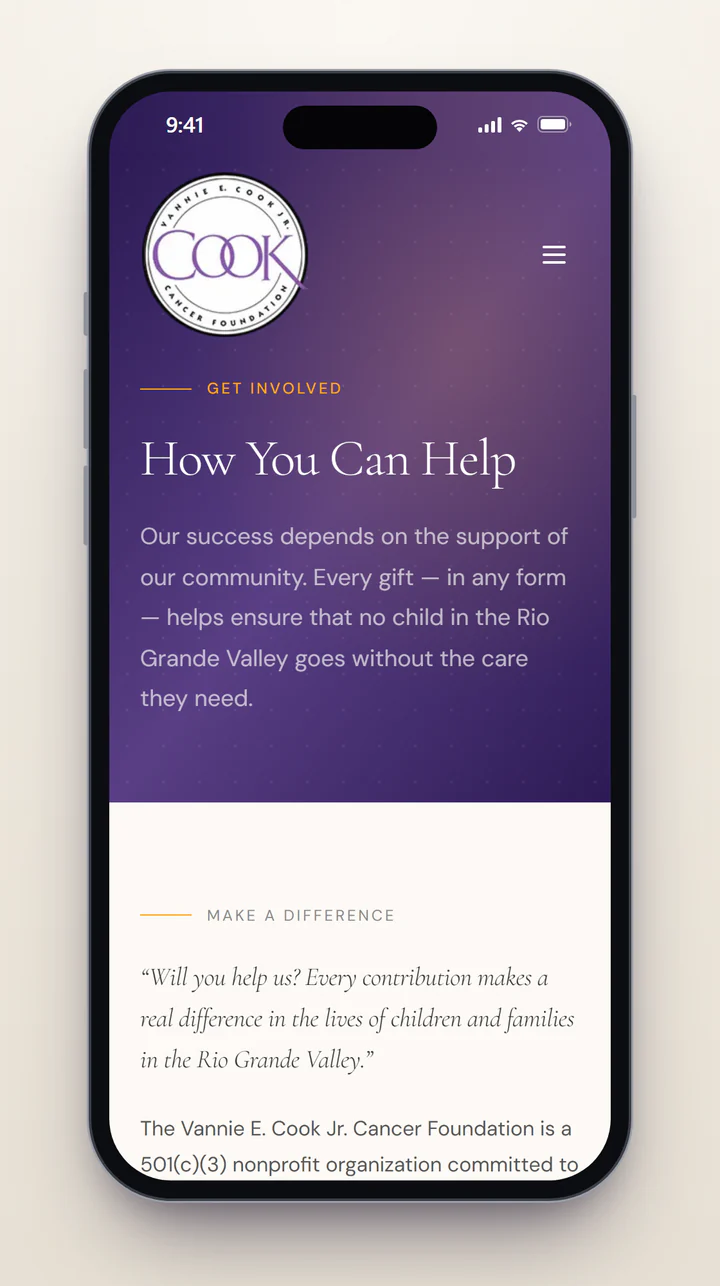 How to help
Room for gifts that outlast a lifetime
Planned gifts are the ones donors arrange for the future, through a will, a trust, or a beneficiary designation on an account or insurance policy. The most common is a bequest, a gift left in a will. Giving USA 2025, the annual report on American philanthropy researched and written by the Indiana University Lilly Family School of Philanthropy, found that bequests accounted for nearly 8% of all charitable giving in the United States in 2024, slightly more than corporations gave that year.
The new site gives that kind of generosity real room. The How You Can Help page explains five planned giving options in plain language, from naming the foundation as the beneficiary of a life insurance policy to an IRA qualified charitable distribution, a direct transfer from an IRA to the foundation that donors 70½ or older can make. A flyer for IRA owners in that age group is linked from the footer of every page.
The Saving Our Children Society has a page of its own. The society recognizes donors who include the foundation in their estate plans. Members join by signing a letter of intent, and the page lists what membership brings, including a gold childhood cancer awareness lapel pin and a name on the Society Recognition Wall at the clinic. Beside that description, the page quotes Dr. Ken Landrum, the foundation's board chair from 1995 to 2014, on the joy of leaving "a legacy of hope" through a planned bequest.
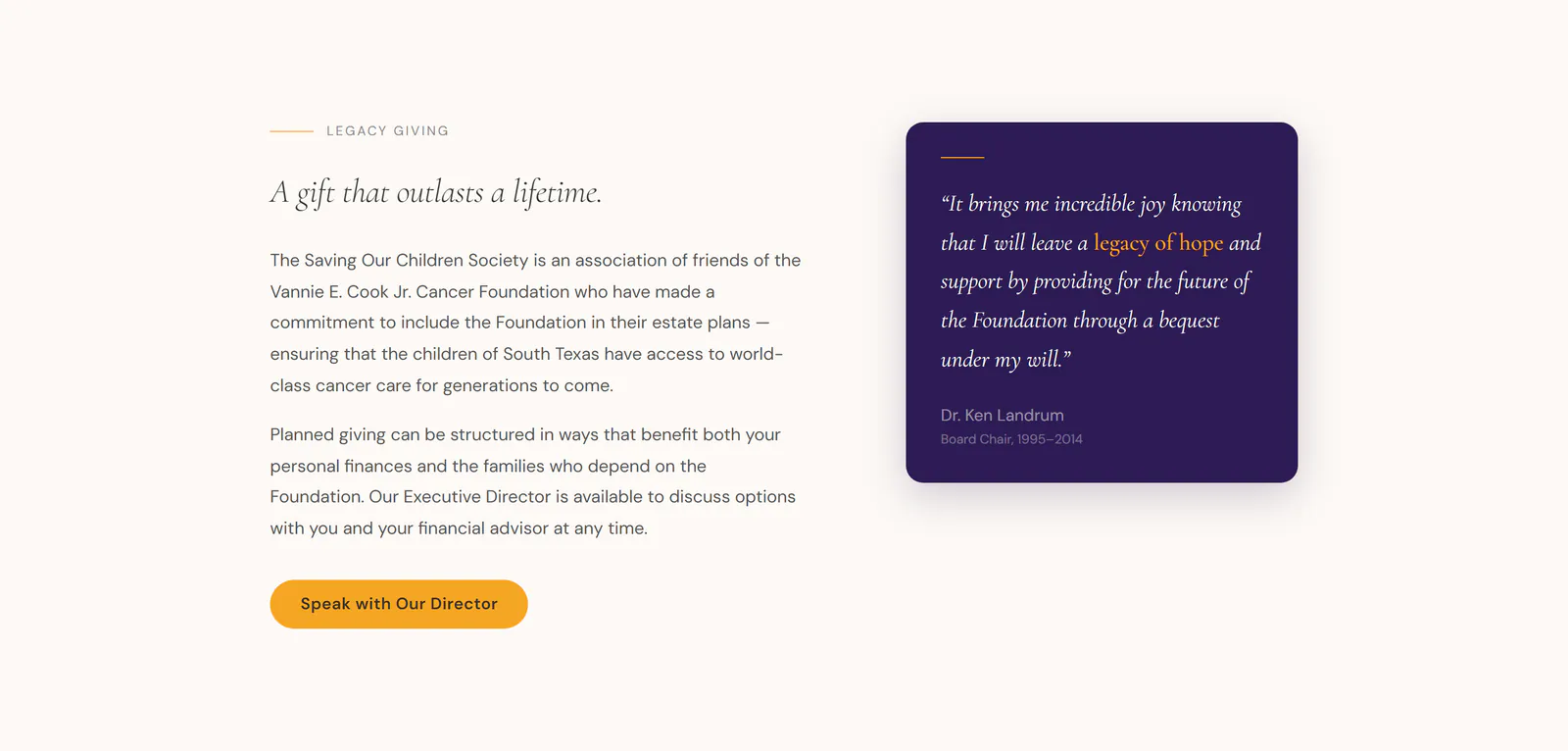
Planned gifts are personal decisions, usually made with family and a financial advisor. A donor weighing one needs clear explanations, a sense of how the gift will be honored, and a person to talk to, and the society's page offers all three, with a button that leads straight to the contact form.
What other foundations can learn from this site
Start by saying plainly what the foundation does and which institution it supports. A supporting foundation often lives alongside an institution the public knows better, and every donor and family who visits deserves to understand the relationship in a sentence. The Vannie E. Cook Jr. Cancer Foundation states it on its homepage and its history page, then sends families to the clinic's own page with one clearly labeled link. That clarity answers the question a careful donor asks first, which is where the gift will go.
Then put the evidence where people look for it. The impact numbers on the homepage, the dates on the timeline, and the names on the board page each answer a question a donor is already asking, and links to independent reviewers let that donor confirm the answers somewhere else. Trust grows from proof a visitor can check, and a website is the easiest place to offer it.
Finally, make room for every kind of gift. A first-time donor needs a Donate button that stays within reach, a community group needs the rules for hosting a fundraiser, and a longtime supporter planning an estate needs clear explanations and someone to call. A site that serves all three helps a foundation carry a community's generosity into its next fifty years.
The Vannie E. Cook Jr. Cancer Foundation's website is live at vanniecook.org. Built by MPC Studios.
Working on a website for a nonprofit or a healthcare foundation? Let's talk.
Let's work together
Ready to take your
business further?
Tell us about your project and let's create something extraordinary together.