Website Design & Development
Paying the Bill and Joining the Crew: A New EMS Website for South Texas Emergency Care
November 10, 2026 · 8 min read · David Winters
Few people choose their ambulance service, and fewer visit its website before they need it. For an emergency medical services (EMS) agency, the website does most of its work afterward. A patient opens it weeks after a transport, statement in hand, to pay a bill or check what Medicare covers. A hospital looks up how to arrange a transfer. An EMT or paramedic weighing a job offer looks at what the agency does and how to apply.
The recruiting side has never been more important. In the fourth annual turnover study from the American Ambulance Association and Newton 360, which surveyed 119 EMS organizations, annual turnover for EMTs and paramedics ran between 20 and 36 percent, and more than a third of new hires left within their first year. When agencies are hiring all the time, the job application on the website gets steady use, and so does the bill-pay page.
South Texas Emergency Care (STEC) is a community-based nonprofit EMS agency in Harlingen, governed by a board of local community leaders. It was incorporated in January 1979 and began service that July as the first paramedic-level service in deep South Texas, and it has grown into what it describes as one of the largest nonprofit EMS and air medical programs in Texas. Today STEC runs ground ambulances, the Valley AirCare fixed-wing air medical service, the MedCom 911 communications center, and South Texas's first Community Health Paramedicine program. STEC's new website went live in late October. MPC Studios also built the agency's previous website.
The old site had served STEC for years, organized into the same sections the agency still uses, with a page for each division and a Billing Area for patients. The redesign kept that structure and every web address, and focused on the job patients most often come to do. STEC's main goal was to make paying a bill online easy enough that fewer patients need to call the billing office.
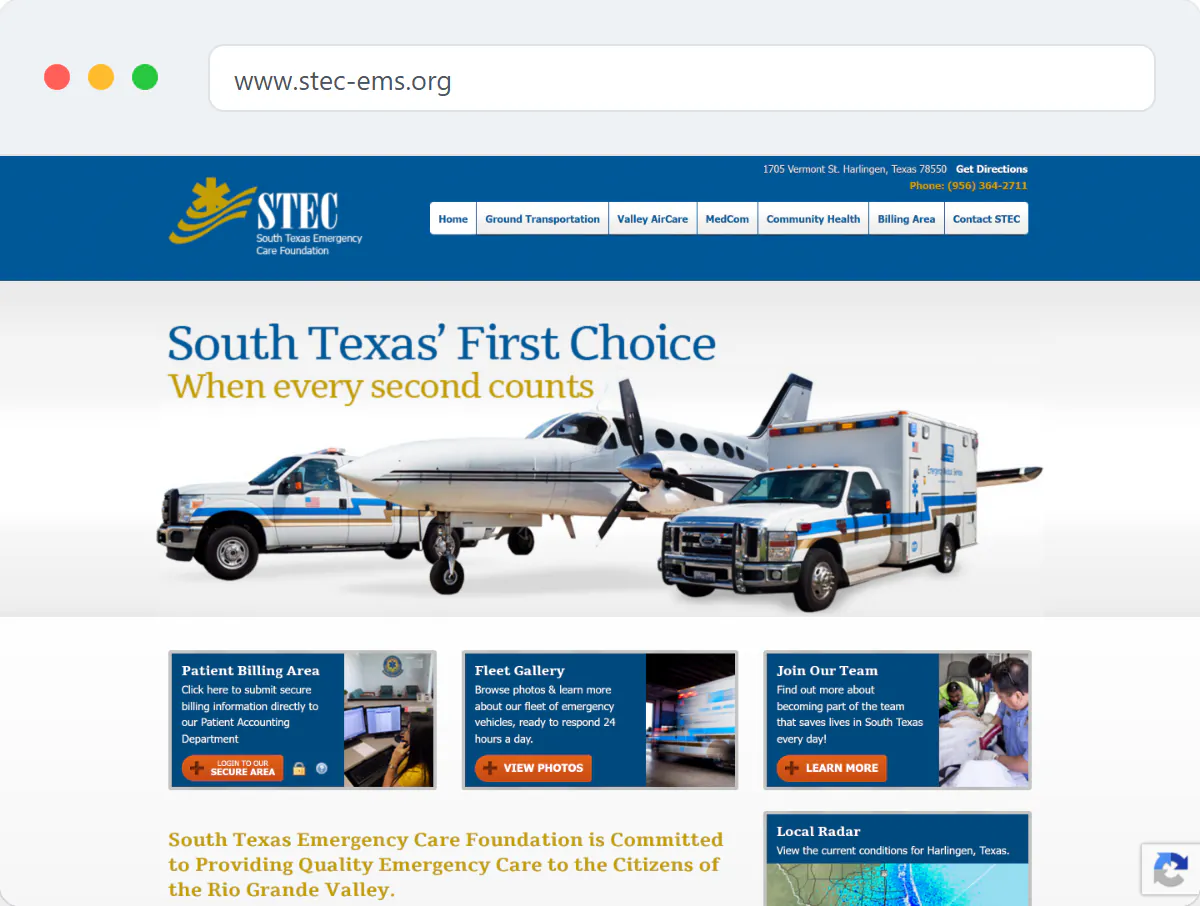 Before
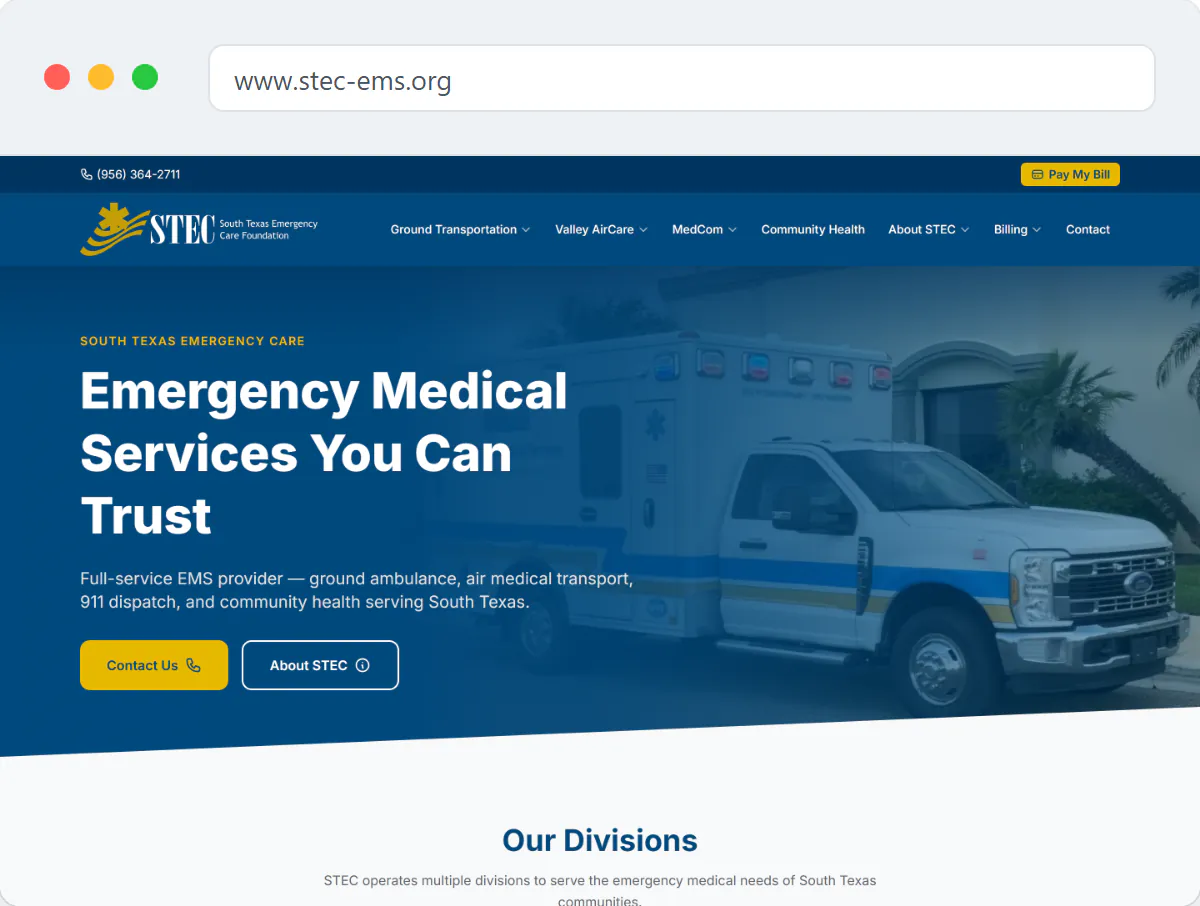 After
A Pay My Bill button on every page
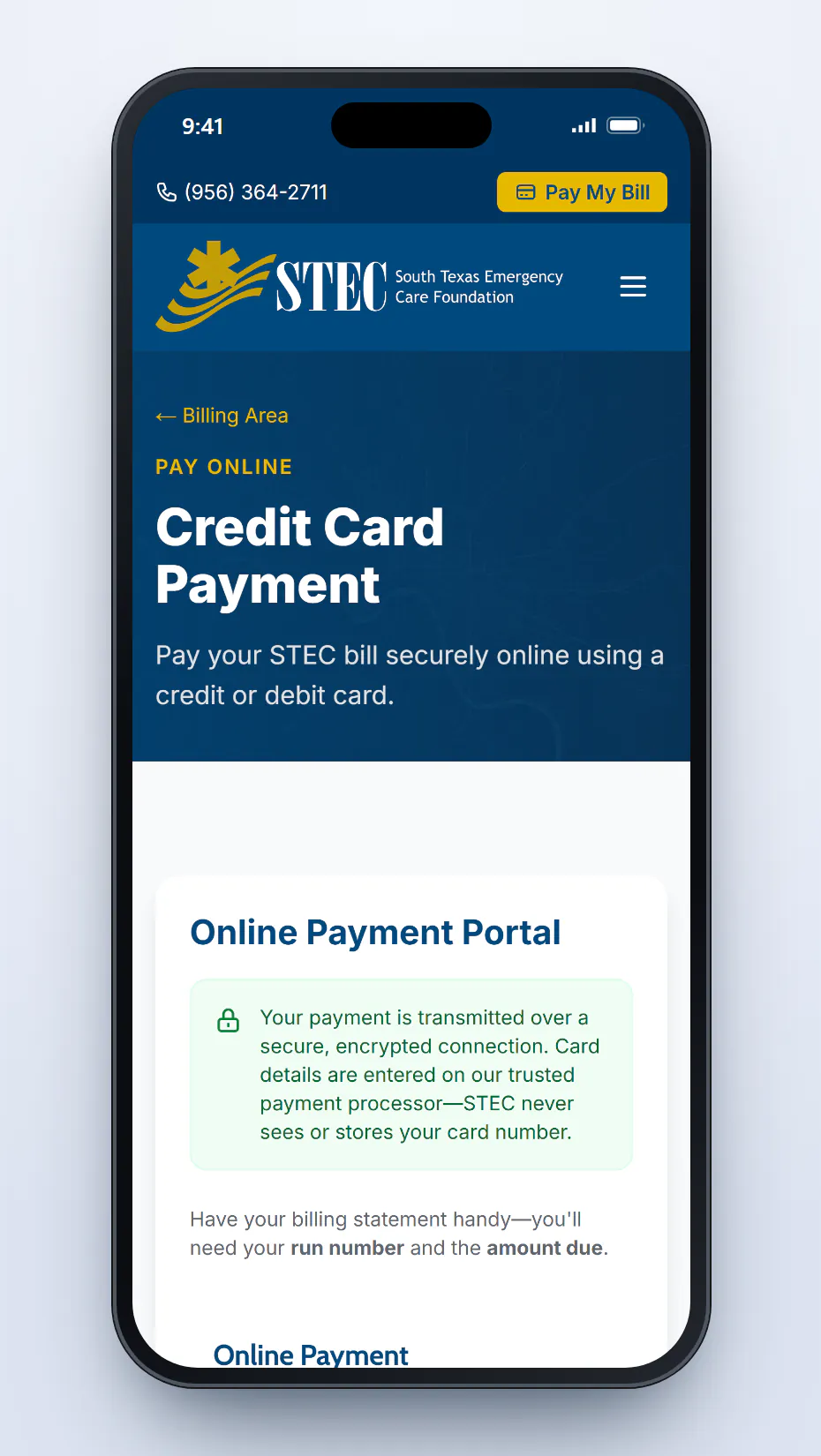
A patient who comes to the site to pay a bill shouldn't have to hunt for the right page. On the new site, a gold Pay My Bill button sits in the bar at the top of every page, on phones and desktops alike, next to a phone number that dials the office with one tap. The homepage repeats it in its closing section, beside Contact Us.
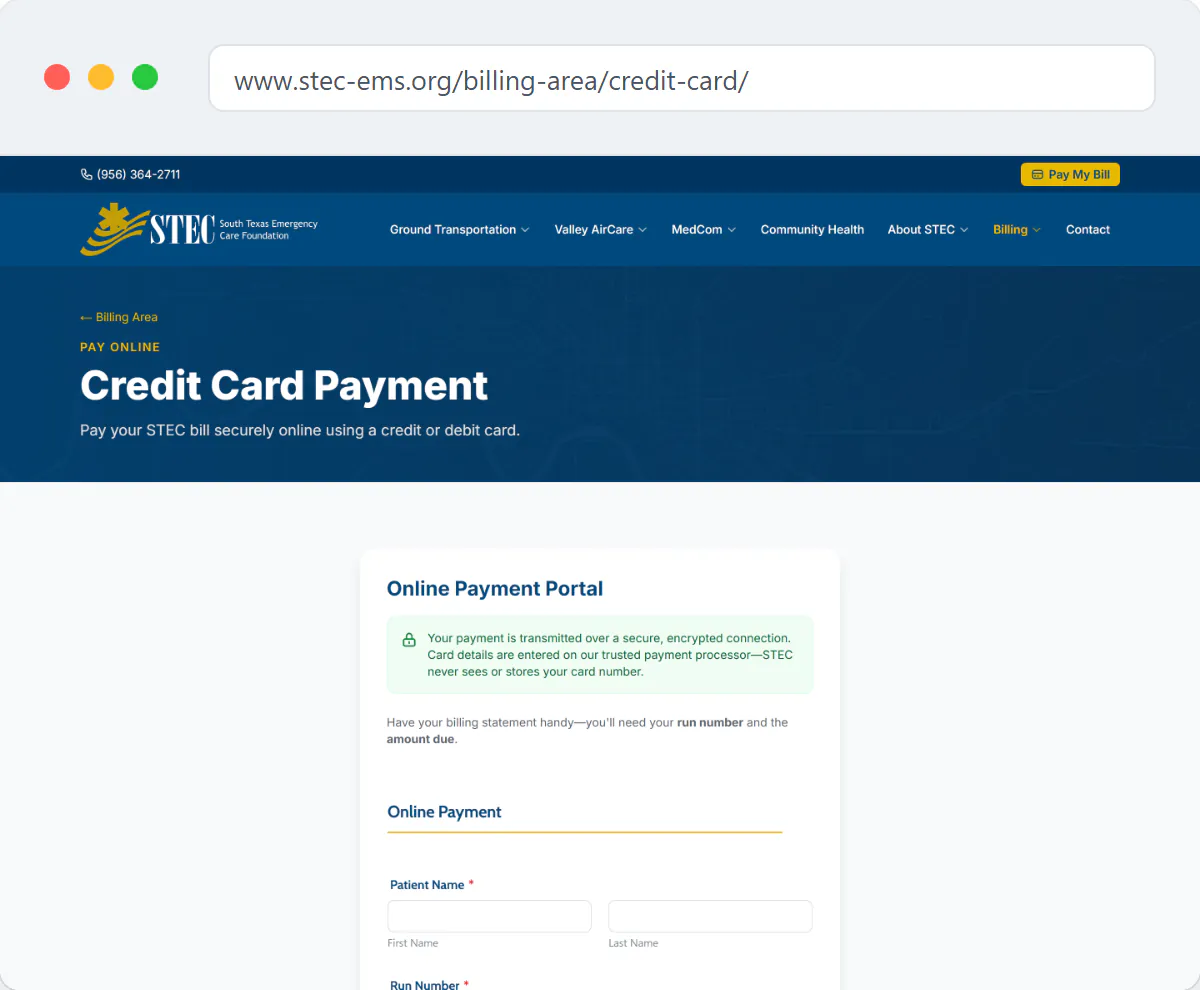
The Credit Card Payment page opens with a short note on security: the payment travels over an encrypted connection, and card details go straight to STEC's payment processor, so STEC never sees or stores the card number. A second line tells patients to have their billing statement handy, because they'll need the run number, the reference number for their transport, and the amount due. The form then asks for the patient's name, the run number, the date of the trip, a daytime phone number, the payment amount and an optional email address for a receipt.
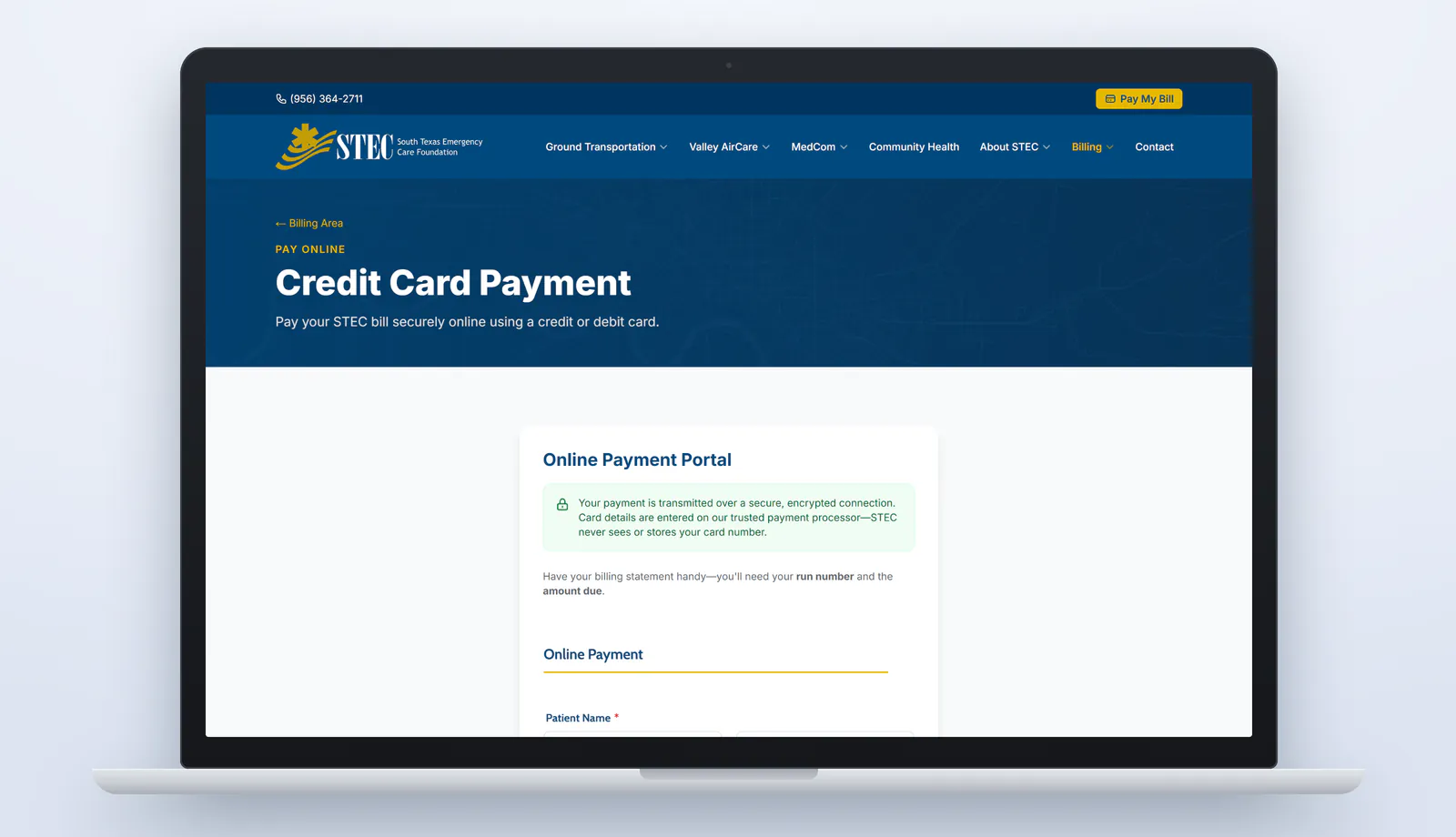
On the previous site, the payment form collected the same details and then forwarded the patient to a separate card terminal to enter the card. The new form takes the card on the same page, through a payment field from Stripe, the payment processor, inside the form itself. The patient finishes the whole payment in one place, and STEC's billing staff receive the payment with the run number and trip date already attached.
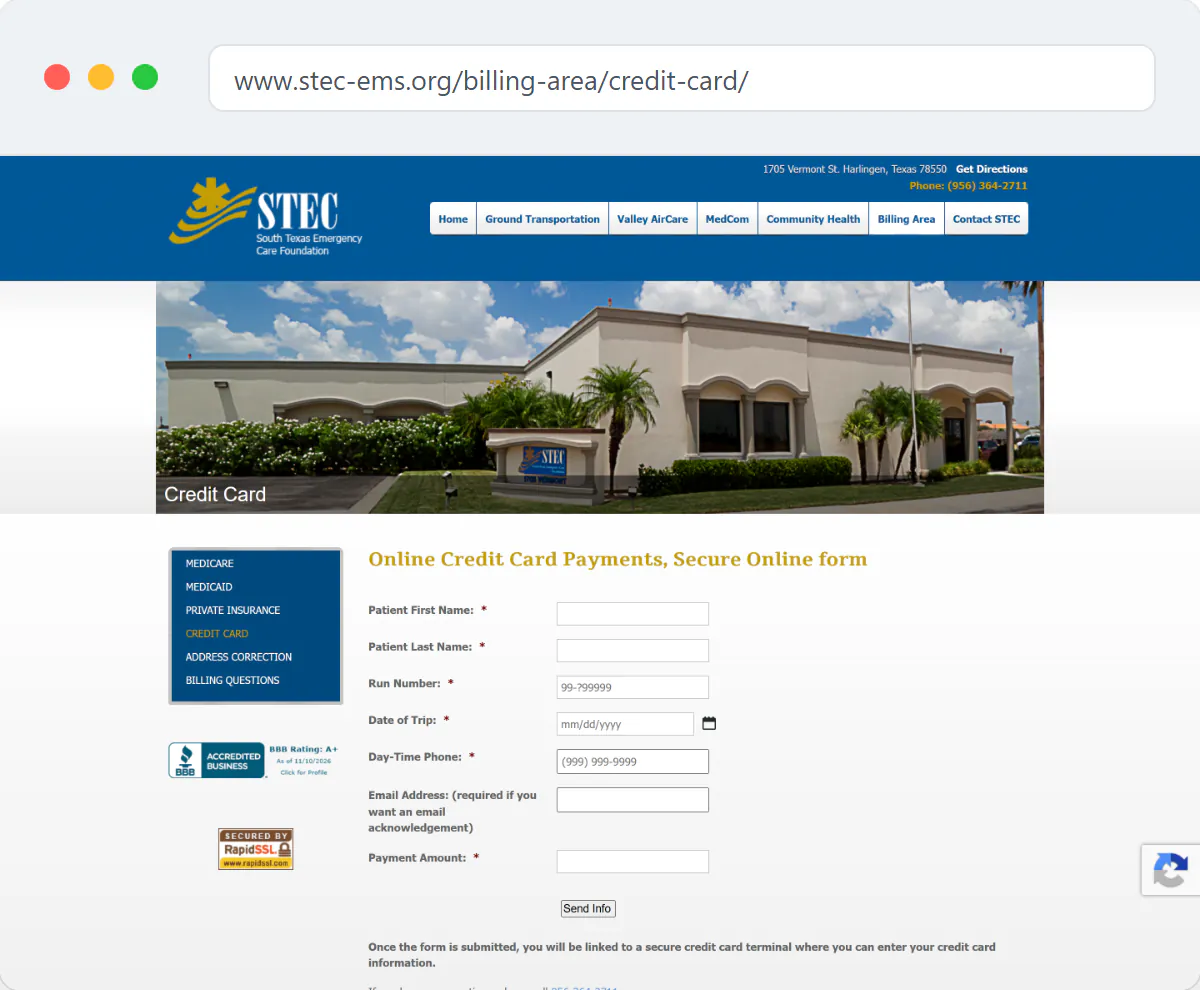 Before
 After
Billing questions answered in one place
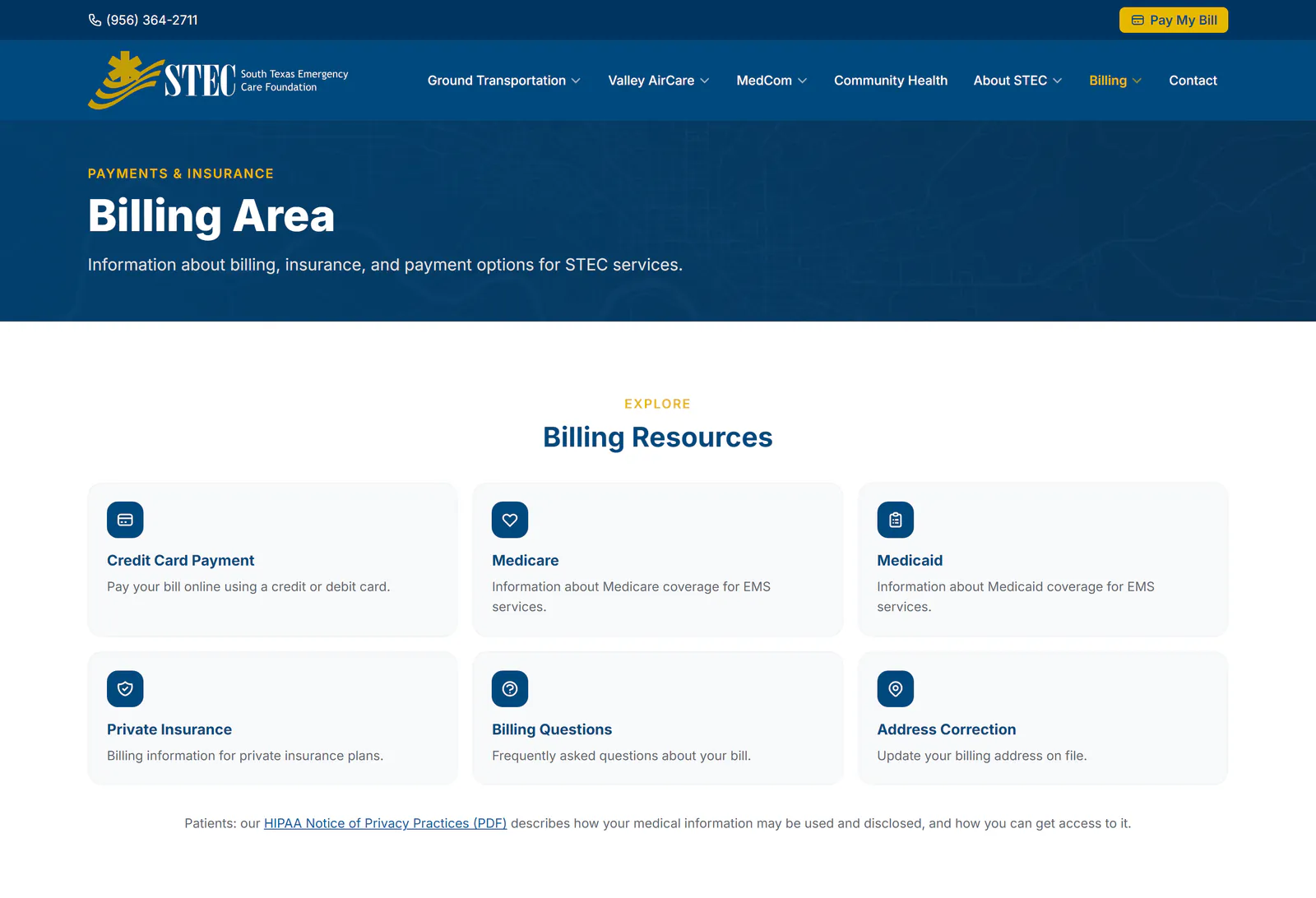
Paying is only one of the reasons a patient visits the billing pages. The Billing Area now opens with six clear options: Credit Card Payment, Medicare, Medicaid, Private Insurance, Billing Questions and Address Correction. The Medicare, Medicaid and Private Insurance pages each include a secure form for sending STEC the coverage details it needs, and the Address Correction page has its own short form. Billing Questions answers the most common questions in a short list that opens one answer at a time.
Those forms handle protected health information, the medical and insurance details covered by HIPAA, the federal health privacy law. All seven forms on the site, from bill pay and billing to job applications and the contact form, run on Jotform with its HIPAA features turned on, and they're embedded in the site's pages so that what a patient types goes directly to Jotform's secure servers and never passes through the website itself. STEC's Notice of Privacy Practices, the document that explains how the agency handles patient information, now lives on the new site, and the old address for it forwards to the new copy.
Recruiting EMTs, paramedics and dispatchers
STEC hires for four kinds of positions: emergency medical technicians, paramedics, MedCom 911 telecommunicators, and patient accounting support staff. The Employee Opportunities page gives each position its own page with an application, and each one opens with the position already selected, so an applicant who clicked Paramedic doesn't have to choose it again.
The application asks for the same information STEC's previous form did, including education, certifications and licenses with the issuing state and date received, and employment history. Keeping the fields the same meant STEC's hiring staff could keep reviewing applications the way they always had, with nothing new to learn on launch day.
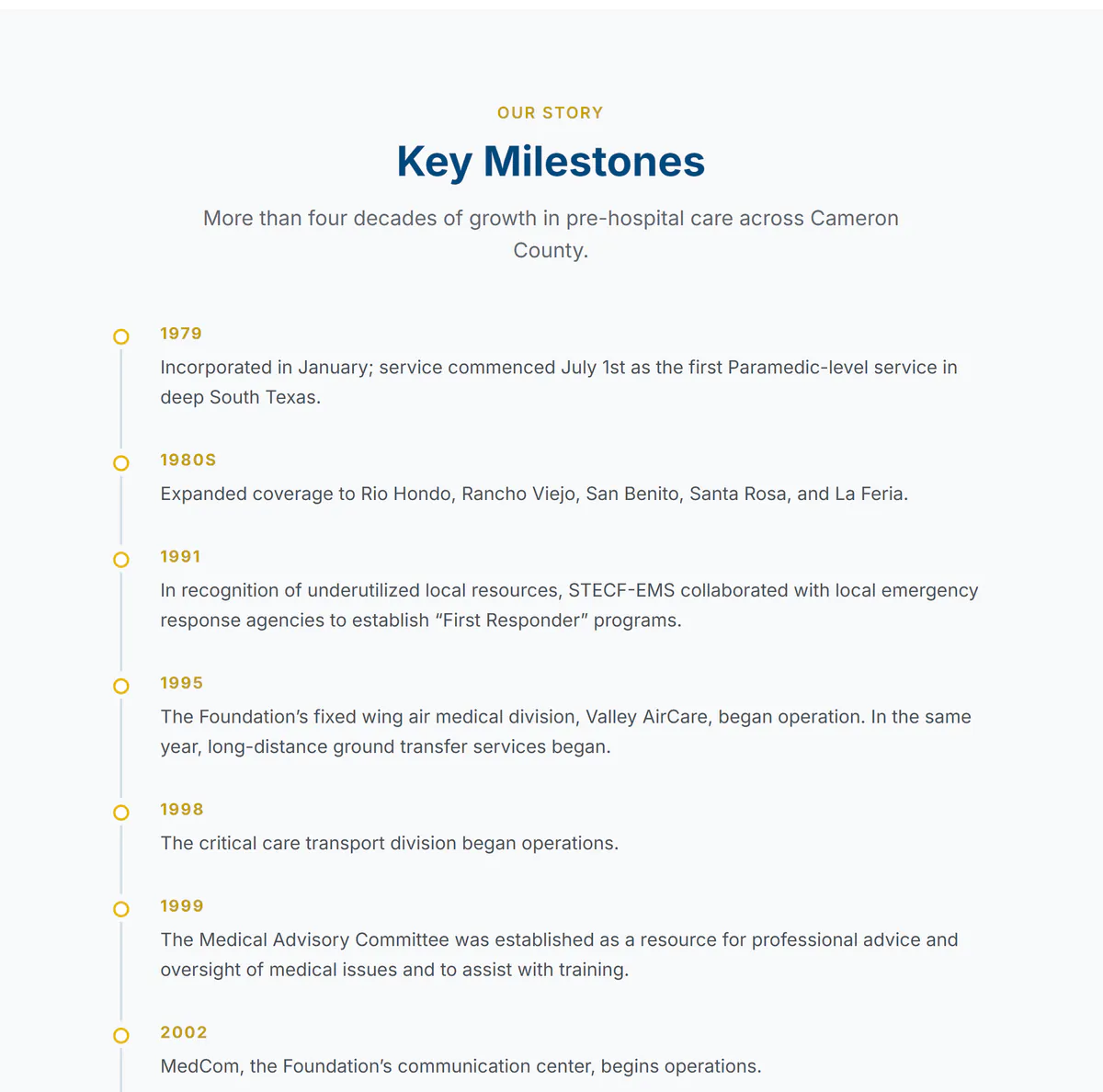
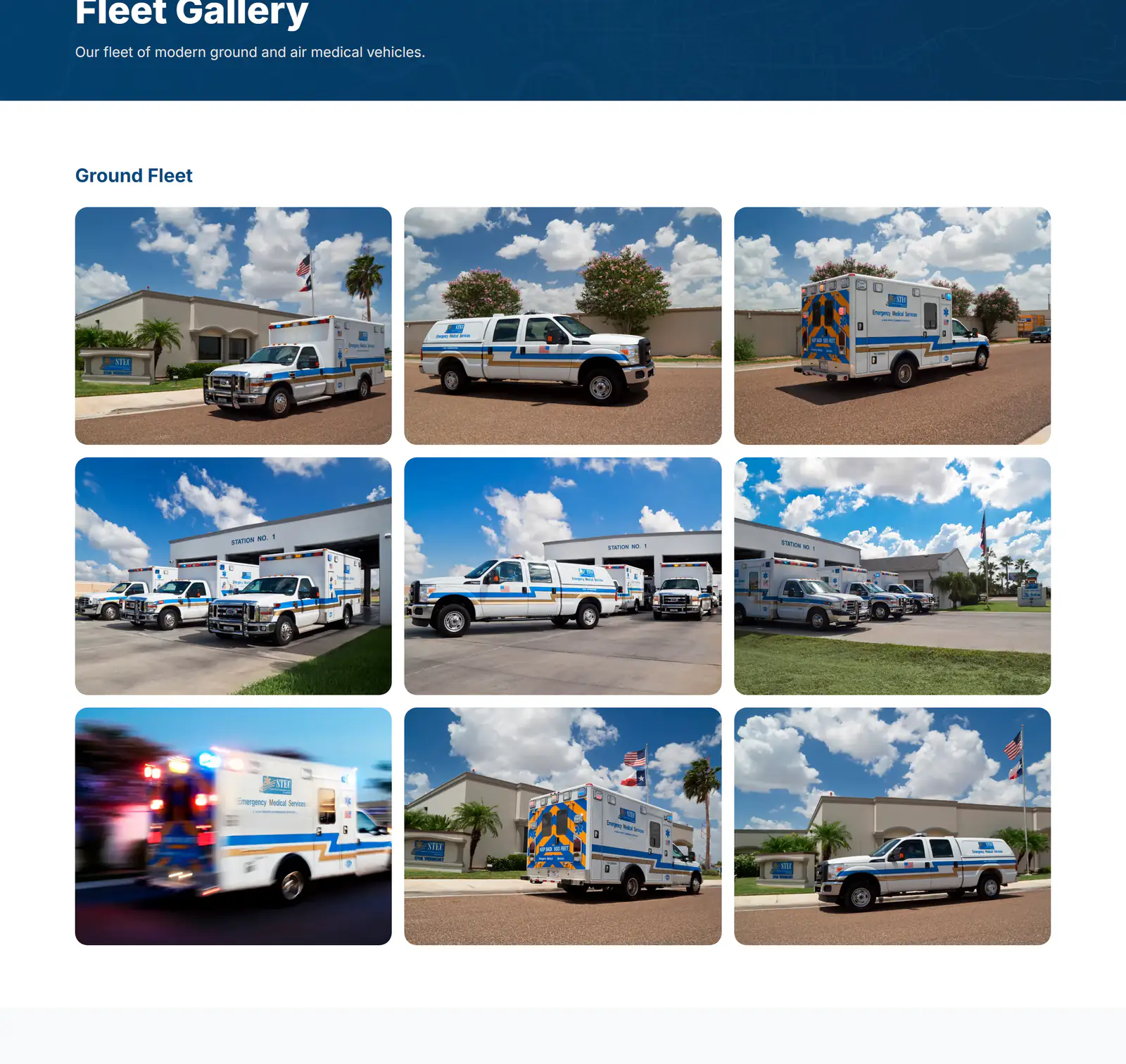
The rest of the site helps make the case to a candidate. An EMS History page traces the agency from its first paramedic-level service in 1979 through Valley AirCare in 1995, MedCom in 2002 and Community Health Paramedicine in 2020, and notes the 2023 COLA accreditation of STEC's mobile laboratory, which STEC says places it among fewer than 2% of EMS providers in Texas. The Fleet Gallery shows STEC's own ambulances and aircraft in photos that open full size and can be browsed with a keyboard.
 History
 Fleet
Explaining four divisions to the public
Each of STEC's divisions has its own section. The Valley AirCare pages describe STEC's fixed-wing air medical service and walk through a transport in five steps, from the first call through in-flight monitoring, including the note that one family member may fly along at no extra cost when the patient is stable. The MedCom section includes Anatomy of a 9-1-1 Call, a long explainer on how an emergency call is routed, located and dispatched, starting with the caller's number and location appearing automatically on the dispatcher's screen. The Community Health Paramedicine page explains how STEC's paramedics visit patients at home and who can make a referral.
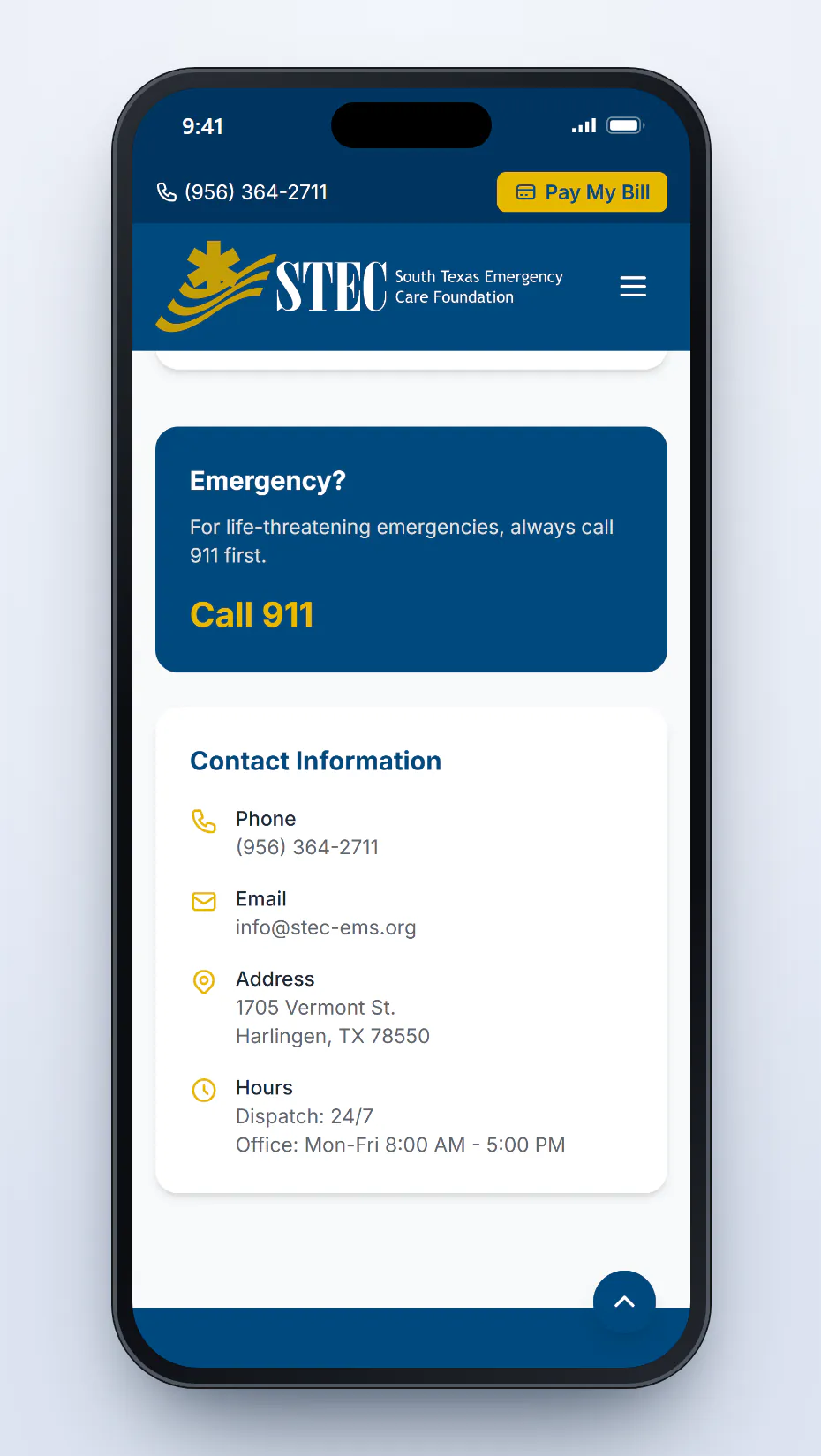
The site is also careful about emergencies. The contact page puts an "always call 911 first" panel beside the contact form, and the site's terms open with a section titled Not for Emergencies. On a phone, the 911 panel sits just below the form, ahead of STEC's phone number, email, address and hours.
 Pay My Bill
 Contact
Keeping every old address working
STEC's old site had been in place for years, and its pages were linked from hospital websites, insurance paperwork and search results. The new site keeps all of its web addresses exactly as they were, down to the trailing slash, so the billing pages, the job applications and the division pages are still where people expect to find them. Before launch, every address listed in the old site's sitemap was checked against the new site. Old category and archive pages that no longer exist, along with the old address for the privacy notice, now forward permanently to the right place.
Behind the scenes, each page carries structured data, code written for search engines, that describes STEC as an emergency service with its address, its 24-hour dispatch and its four divisions. Analytics load only after a visitor agrees to them in the cookie banner, and they count the actions that matter to STEC, like taps on the phone number and the Pay My Bill button. The design builds on STEC's navy and gold logo and its own photos of units, aircraft and stations, and gray text was darkened where needed so that all of it meets accessibility contrast standards. STEC's staff can update the phone number, email, hours and other site-wide details in a content management system without touching code.
What EMS agencies can take from this project
For most EMS agencies, the bill-pay page is the most-used page on the website, and it deserves the most care. Putting Pay My Bill in the same spot on every page, telling patients up front what they'll need from their statement, and keeping the whole payment on one page all reduce the calls a billing office has to answer. Patient forms should send their information to a HIPAA-enabled service directly, with the privacy notice one click away.
Recruiting deserves a close second. With turnover as high as it is across the industry, a clear page for each position, an application that opens with the position already selected, and a history that shows candidates what the agency has built over the years all help make the case to the next EMT or paramedic. And when an agency's web addresses already appear on hospital sites and insurance paperwork, keeping them exactly as they are is the simplest way to make sure nobody lands on an error page.
South Texas Emergency Care's website is live at stec-ems.org. Built by MPC Studios.
Working on a website for an EMS agency or a healthcare organization that takes payments online? Let's talk.
Let's work together
Ready to take your
business further?
Tell us about your project and let's create something extraordinary together.