Website Design & Development
A Website Built Like a System Diagram: How Numeric Engineering Explains Edge Intelligence
April 20, 2026 · 10 min read · MPC Studios
Engineers do most of their vendor research on their own. The 2026 State of Marketing to Engineers report from TREW Marketing, GlobalSpec, and Elektor found that technical buyers complete 62% of the buying journey before they contact a vendor. For a company that sells an entire system, where sensors, onsite computers, satellite links, and physics models all have to work together, that puts a heavy load on the website. An engineer has to see how the pieces connect, and come away convinced that the people behind them understand the physics, before anyone picks up the phone. The same report found that technical buyers trust engineering experts at vendor companies more than any other kind of author, so the website also has to sound like the engineers who do the work.
62%
Share of the buying journey technical buyers complete before contacting a vendor
66%
Technical buyers who rate engineering experts at vendor companies very or extremely trustworthy
Numeric Engineering is a U.S. engineering company based in Cypress, Texas, northwest of Houston. It designs and deploys what it calls instrumented, edge-intelligent systems, measuring how real equipment behaves and turning that data into decisions operators can act on, with the computing done on site. Its principal platform, Deep Edge, is deployed on ten deepwater assets in continuous operation, and the company holds a U.S. patent for monitoring offshore structures with cameras. Numeric's new website went live last week. MPC Studios built the Deep Edge Systems website in 2025, so this project started with a working knowledge of Numeric's flagship platform.
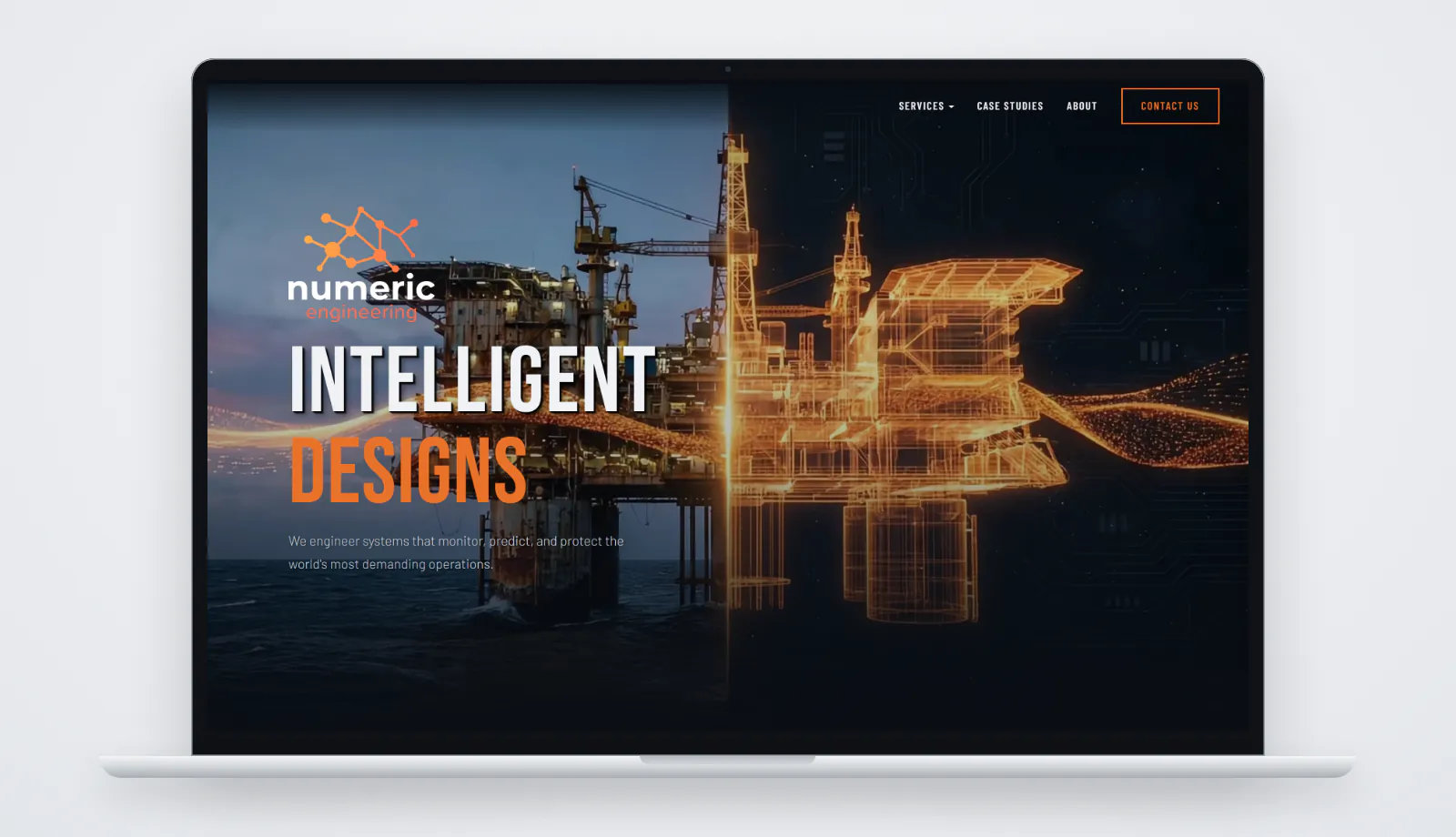
Numeric's work is hard to sum up in a sentence, and the site had to serve very different readers. An offshore engineer wants to know whether Numeric's instruments will hold up on a platform and whether its models will match the field data. Someone evaluating the company for a defense-related program is looking for evidence that its systems keep working when communications drop out. A contracting officer needs the company's government identifiers before a purchase can move forward. The previous site introduced Numeric as a technology consultancy, with its Load Management System as the flagship product. Since then, Deep Edge has become the company's principal operating platform, and Numeric now describes its capabilities for defense-relevant applications as well as offshore energy. The website needed to grow with the company.
Numeric's team supplied the technical content for the new site, including the service write-ups, the problem statements, and the case studies, and approved the short summaries that appear in the diagram. MPC's job was to give that material a structure a first-time visitor could follow.
A homepage that explains the company before it shows the machinery
The homepage opens on the tagline Intelligent Designs and a single sentence: "We engineer systems that monitor, predict, and protect the world's most demanding operations." Behind the headline, a still image splits an offshore platform down the middle, with the platform's steel structure on the left and a glowing orange wireframe model of the same platform on the right. The image works as a one-frame explanation of a digital twin, the live computer model of a physical asset that several of Numeric's systems are built around. A cinematic video takes over once a visitor moves the mouse, touches the screen, or spends eight seconds on the page, so the headline and the still image load first, and phones get their own portrait cut of the footage. That restraint suits a company that designs systems for low-bandwidth environments.
Directly below the hero, a section called Numeric at a Glance defines the company in two sentences. The first introduces DDIL environments and spells out the acronym on the spot (disrupted, degraded, intermittent, and low-bandwidth), a label for places like a platform far offshore, where connections come and go. The second sentence opens with the words "in practical terms" and restates the whole business in plain language, from measuring how physical assets behave to delivering decision support.
The order was deliberate. When the homepage was being planned, Numeric and MPC agreed that visitors should understand who Numeric is and what it does before they meet the technical detail. An engineer arriving from a search result gets a description they could repeat to a colleague, and the architecture diagram waits one scroll below.
A system diagram that doubles as the navigation
The centerpiece of the homepage began as Numeric's own concept drawing. During the design phase, Numeric's team brought a sketch that laid out its capabilities as a flow, starting with sensors and data acquisition, passing through edge computing and a satellite link to the cloud, and ending with the analysis tools that make sense of the data. The idea was that visitors would see the whole system first and then click into whichever piece mattered to them.
MPC built that sketch into the homepage's How We Engineer Intelligence section. Eight clickable nodes, from Instrumentation to Computer Vision, sit on a dark field with a satellite illustration and a glowing wireframe cloud in the middle of the chain, all joined by bundles of orange cable, and small pulses of light travel along the cables the way data moves through a live installation. The look echoes the logo, which sets the company name beneath a small network of orange nodes and connecting lines. Clicking a node opens a short description that ends with a Learn More link to the matching service page, and the Computer Vision popup also cites the company's patent number.
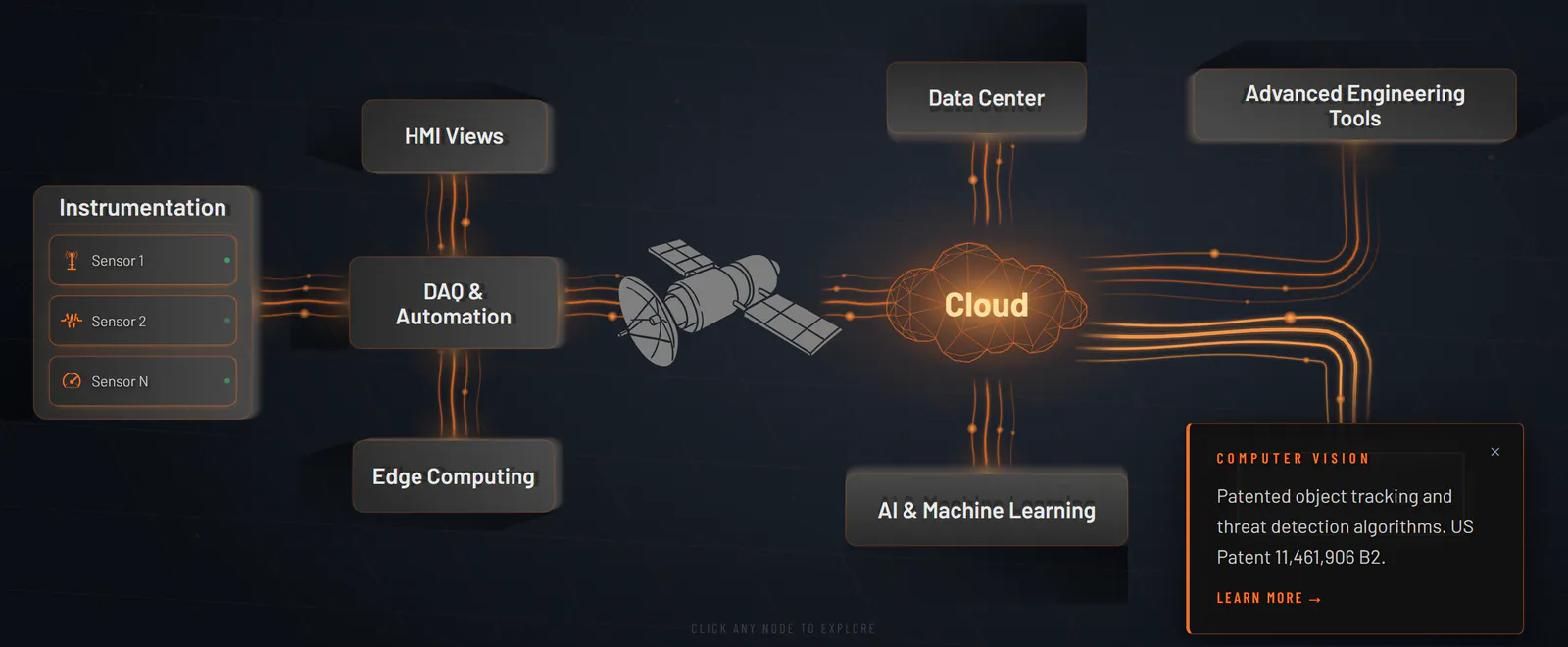
For a company that sells an integrated system, how the components connect is the heart of the pitch, and a diagram shows those connections at a glance. The diagram also lets every reader start where their question is. A controls engineer can go straight to DAQ & Automation (DAQ is short for data acquisition), an IT manager to Data Center, and a structural engineer to Advanced Engineering Tools, while the Services menu lists the same eight modules for anyone who prefers a list.
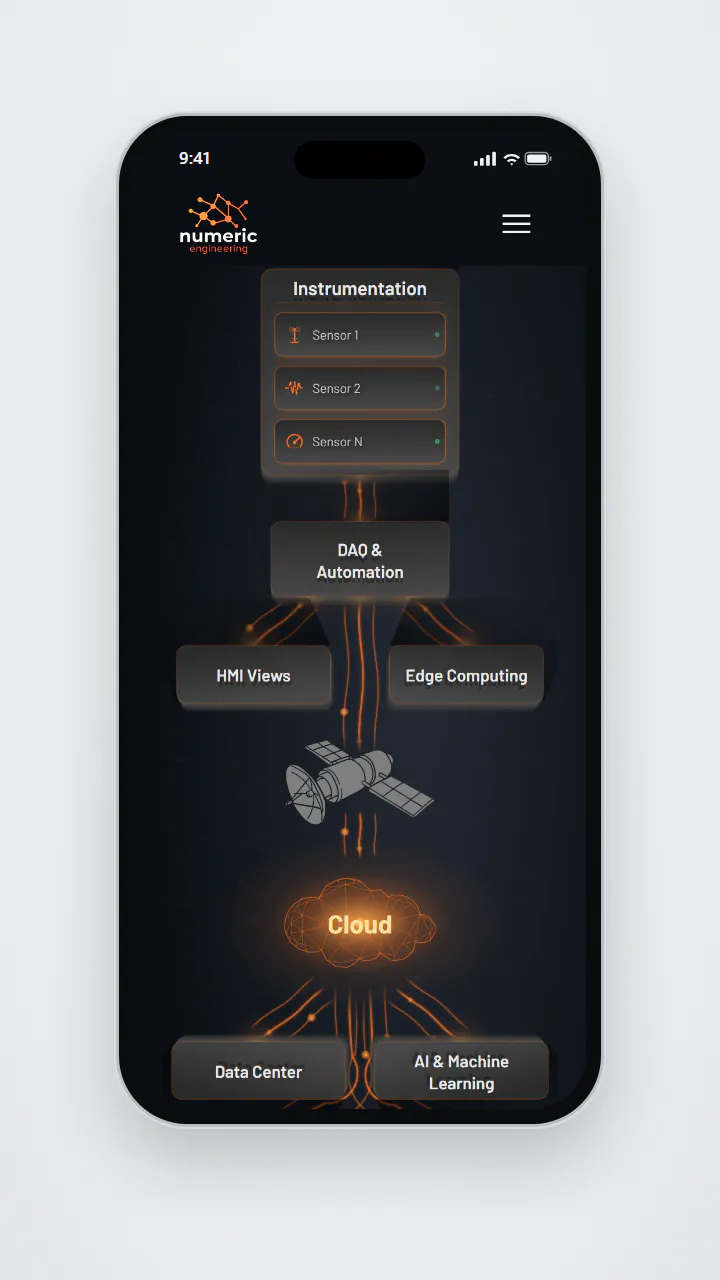
On a phone, the diagram rearranges itself into a vertical stack that runs from the sensors at the top through the cloud to the analysis tools at the bottom. Its code loads only when a visitor scrolls near it, and the animation pauses whenever the diagram leaves the screen.
 Homepage
 Diagram
Problems stated the way engineers state them
Below the diagram, a section titled Solving What Conventional Engineering Cannot lays out four problems Numeric works on, each split into The Problem and The Solution. The first describes a situation offshore operators know well: wave height and wave direction are often incomplete, unreliable, or unavailable during live operations. Numeric's solution infers those environmental forces from the vessel's own measured motion, using physics-based models and machine learning. The other three cover predicting structural fatigue, measuring what installed sensors can't reach, and turning heavy engineering simulations into models fast enough to run on live data.
Each pair ends with a Read Full Analysis link to the Engineering Solutions page, which adds the outcome of each approach and a list of specific capabilities. That page also opens with Numeric's working principles, which start with first-principles physics and treat machine learning as an extension of engineering analysis.
Engineers judge a vendor by whether it understands the problem, and a problem described in the reader's own terms is quick proof that it does. Leading with problems also ties every claim on the page to a specific difficulty an operator will recognize.
Service pages built on one blueprint
Numeric describes each of its eight services as a module of the larger system, and every service page follows the same blueprint. A short introduction explains what the module does. A Technology Stack strip names the equipment and methods involved. On the Instrumentation page, the strip runs from the load cells and strain gauges that measure loads and strain in a structure to the wave radar and ADCPs (acoustic Doppler current profilers, which measure ocean currents) that read the sea around it. Four or five numbered sections follow, each with a list of specific capabilities, and seven of the eight pages close with a related case study.
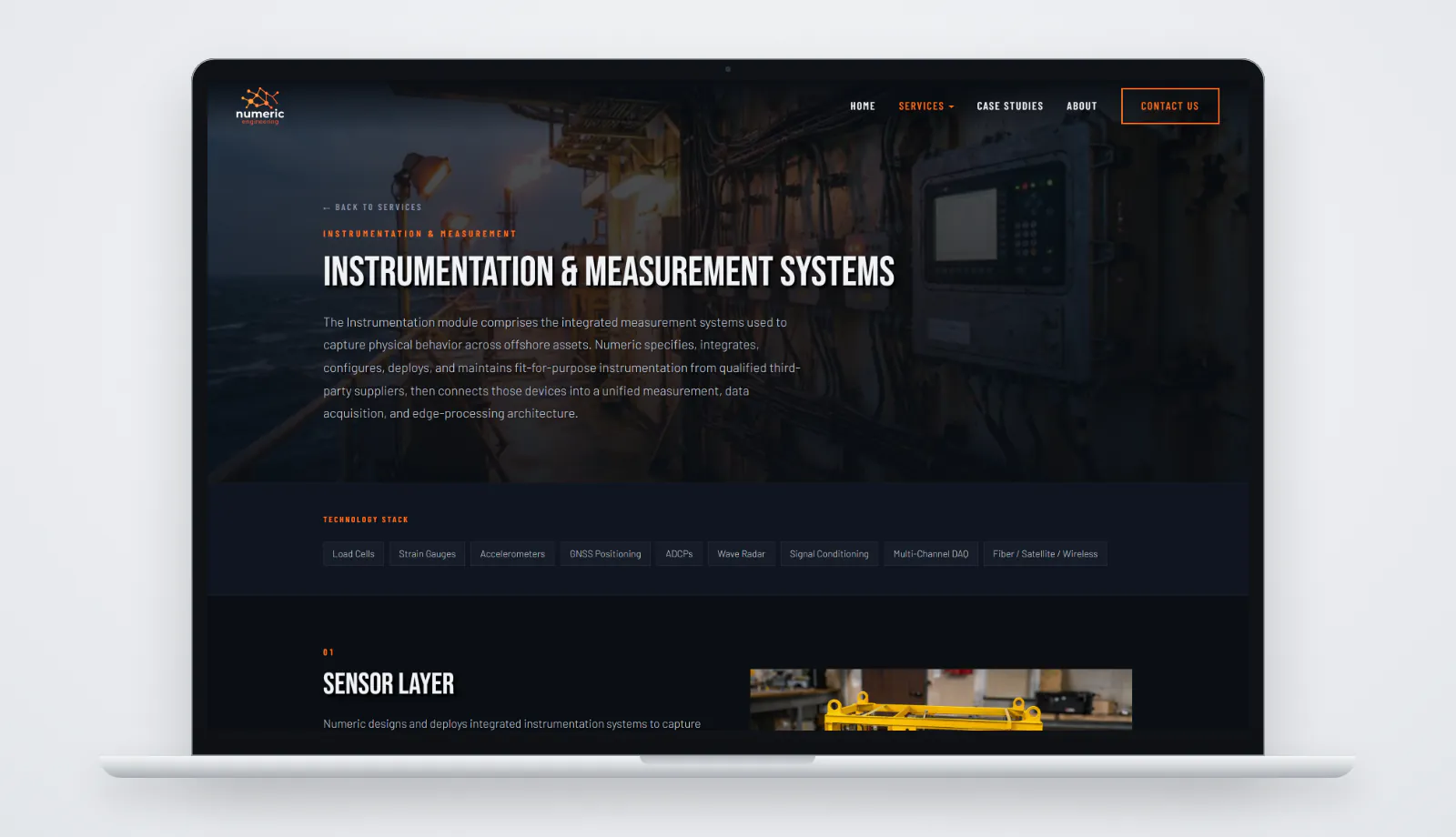
The consistency does real work. Because every page answers the same questions in the same order, an engineer comparing modules always knows where to look, and the strips give a controls engineer the kind of detail that settles compatibility questions early. The DAQ & Automation page, for example, lists the protocols Numeric works with, including Modbus and OPC-UA, two communication standards that industrial equipment uses to exchange data. Images alternate from side to side as the sections progress, and on phones every image stacks above its text.
Case studies with details a buyer can check
The Case Studies page holds four projects, and each reads like a short engineering report, moving from The Challenge to The Solution to The Results with a Technology Stack panel alongside. The Deep Edge study starts with offshore operators juggling separate vendors for sensors, software, AI, and integration, and ends with a single platform supporting offshore and onshore staff across ten deepwater assets. The Load Management System study describes a physics-based digital twin that replaces spreadsheet stability calculations on a floating production facility, working out the right ballast tank levels from live sensor data. The remaining two cover the patented camera-based motion tracking and a fatigue-monitoring approach trained on synthetic data from finite element analysis, the simulation method engineers use to predict how structures respond to stress.
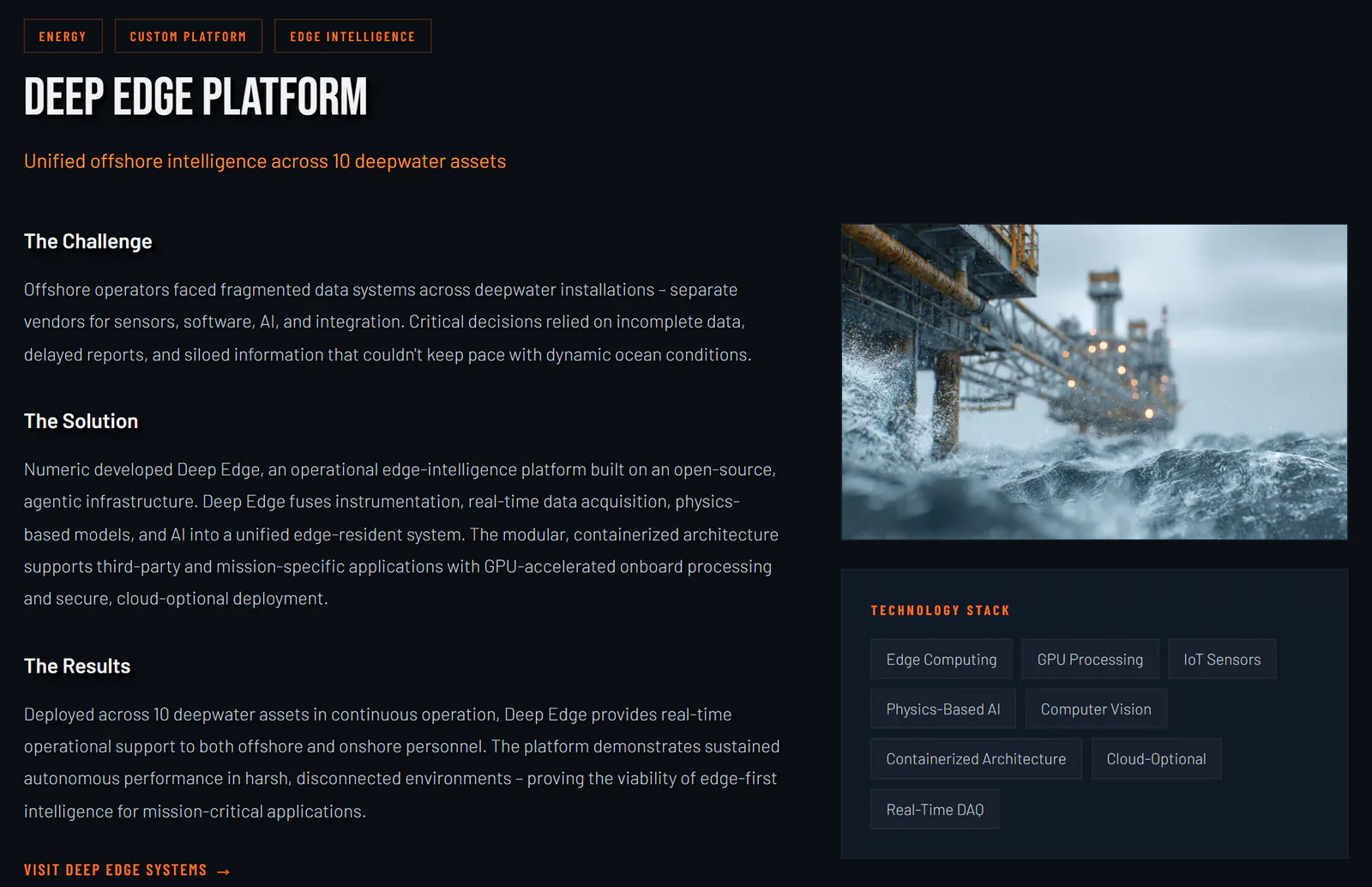
Several details on these pages can be verified by anyone. The computer vision study cites U.S. Patent 11,461,906, which is public record: a camera-based system for monitoring offshore structures, issued to Numeric in 2022. The Deep Edge study links out to the platform's own website. For an audience that checks claims for a living, a patent number or an asset count builds credibility because it gives the reader something to test.
Credentials and contact details where buyers look for them
Every page on the site ends with a strip of credentials aimed at government buyers. The UEID is Numeric's Unique Entity ID, the identifier the federal government assigns through SAM.gov, its System for Award Management. The CAGE code is a Commercial and Government Entity code, which the Federal Acquisition Regulation defines as an identifier the Defense Logistics Agency assigns to an entity at a specific location. The two NAICS codes, 541330 and 541715, classify Numeric's work as engineering services and as research and development in the physical, engineering, and life sciences, and PSC code R425 is the federal product and service code for engineering and technical support.
The strip closes with Numeric's firm registration number from the Texas Board of Professional Engineers and Land Surveyors, which requires any entity offering engineering services to the public in Texas to register, and its ISO 9001:2015 registration mark from QAS International. ISO 9001 is the international standard for quality management systems.

Contracting officers rely on these codes. Under the same regulation, they assign a single NAICS code to every solicitation and contract, and a buyer who can confirm a vendor's identifiers on its website saves a lookup. The About page speaks to the same reader, with a paragraph that describes Numeric "for technical and contracting purposes," including defense-relevant applications that require resilient sensing and operation under degraded communications.
The contact page follows the same practical thinking. TREW's research found that 59% of technical buyers prefer email for a first vendor contact, and the page lists Numeric's email address first, beside a form that requires only a name and an email address. The same research lists validating information found online among the reasons technical buyers contact a vendor, and the form's timeline field even suggests "exploring options" as an acceptable answer.
What engineering firms can learn from Numeric's website
The best material for a technical website usually exists inside the company already. Numeric's team had the precise language, the problem statements, and the first sketch of the diagram, and the design work gave that material an order a newcomer could follow. Technical buyers trust engineering experts at vendor companies more than any other kind of author, so an engineering firm's website should let its engineers do the explaining, then organize their words around the questions a buyer arrives with.
A company that sells an integrated system can let a picture of that system carry much of the introduction. Numeric's diagram introduces the full scope of the work on one screen and lets each reader enter at the part that matters to them, and the consistent service pages behind it make comparing modules easy. The same discipline shows in the case studies, where the key claims come with something a skeptical reader can verify, from the patent number to the link to a working platform.
Finally, write for everyone involved in the purchase. The engineer judging technical fit, the manager weighing operational risk, and the contracting officer checking registrations may all visit the same website, each looking for different evidence. Numeric's site answers the first with a technology stack on every service page, the second with case studies, and the third with a footer full of identifiers. When every reader finds the detail they came for, the first phone call starts from a shared understanding of what the company does.
Numeric Engineering's website is live at numericengineering.com. Built by MPC Studios.
Does your engineering firm's website explain your work as clearly as your engineers do? Let's talk.
Let's work together
Ready to take your
business further?
Tell us about your project and let's create something extraordinary together.