Website Design & Development
Retiring the PDF Physician Directory: How Mid Valley Physicians Association Made Its Network Searchable
August 14, 2026 · 8 min read · MPC Studios
Look up a doctor in an insurance directory, and the phone number might reach a practice that moved two years ago or a doctor who has since retired. Directory accuracy is one of healthcare's most stubborn problems. When the Centers for Medicare & Medicaid Services reviewed the online provider directories of 52 Medicare Advantage organizations, it found that 48.74% of the provider locations listed had at least one inaccuracy, such as a doctor who wasn't at the listed address or a phone number that was wrong.
Patients depend on those listings anyway. In a 2024 survey by Harmony Healthcare IT, 46% of patients said they use Google to find a new doctor, and the same share said they use their health plan's online directory. For a physician network, the directory is one of the most important features on its website, and it needs to be one of the easiest to keep current.
Mid Valley Physicians Association (MVPA) is a non-profit Physician-Hospital Organization based in Weslaco, Texas. A Physician-Hospital Organization, or PHO, brings a hospital and independent physicians together to handle managed care contracting, the agreements that set how health plans cover and pay for care. Community physicians and Knapp Medical Center formed MVPA in August 1996, and its directory now lists 66 member physicians and 24 clinics in nine Rio Grande Valley communities centered on Weslaco and Mercedes. MVPA's new website went live on August 12. MPC Studios also built the association's previous website, which served MVPA for well over a decade.
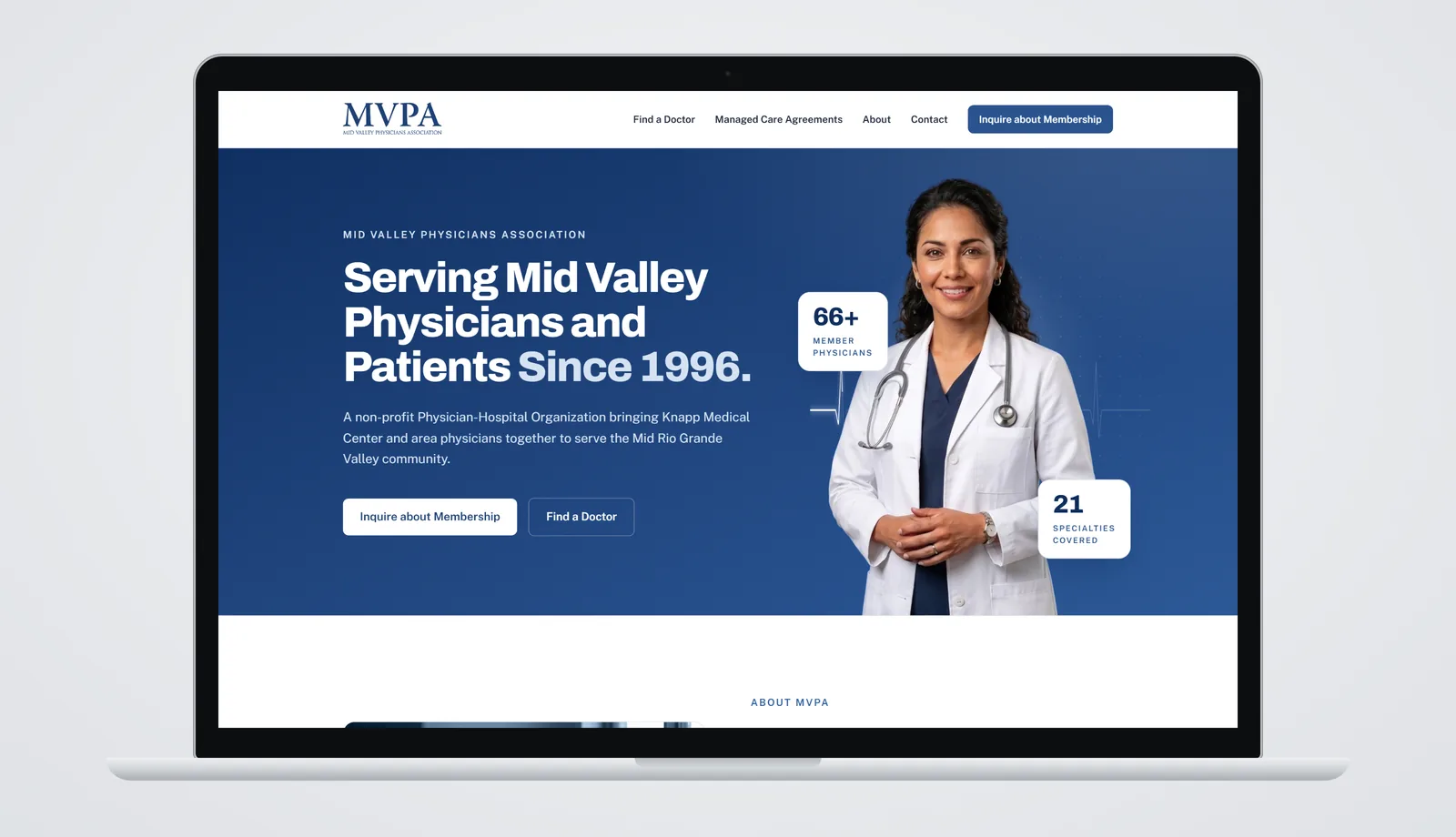
The previous site kept its structure simple, with a page for membership, one for managed care agreements, and a member directory that visitors downloaded as a PDF. A downloadable directory made sense when that site launched and most people browsed on desktop computers. Today many patients look up a doctor on their phone, where a multi-page PDF means pinching and zooming to find a single name. Every change to a PDF also means editing the document, exporting it again, and uploading a new file, and that extra work makes it easy for any directory to fall behind the membership it describes.
The new site had to work for three audiences at once. Patients needed a directory they could search without calling the office. Independent physicians considering membership, the audience MVPA most wants to reach, needed a clear case for joining and an easy way to ask about it. Health plans and hospital staff needed to see a network that is current and well organized. The directory also had to stay accurate long after launch, because all three audiences rely on it.
A physician directory that works like a search
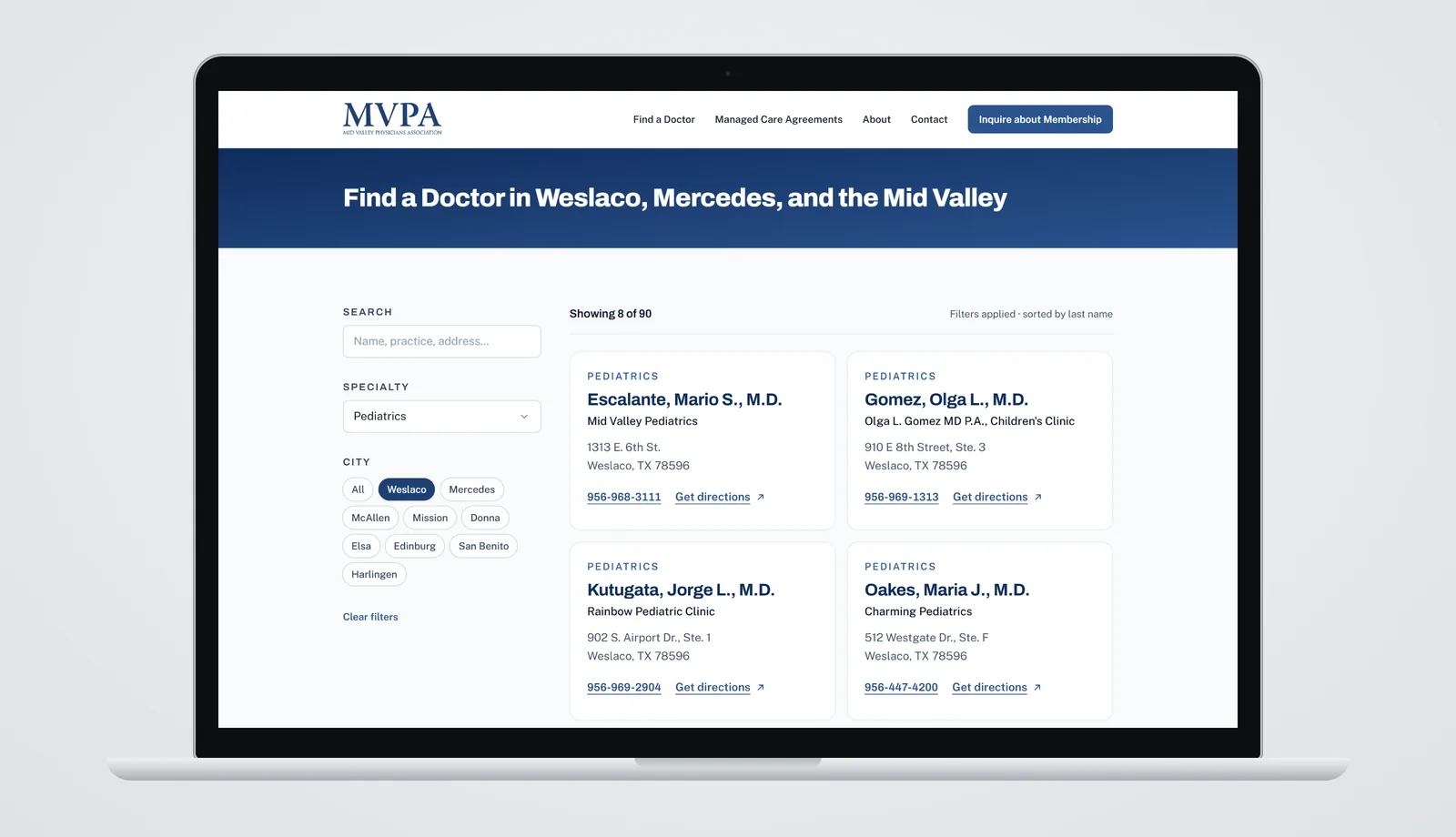
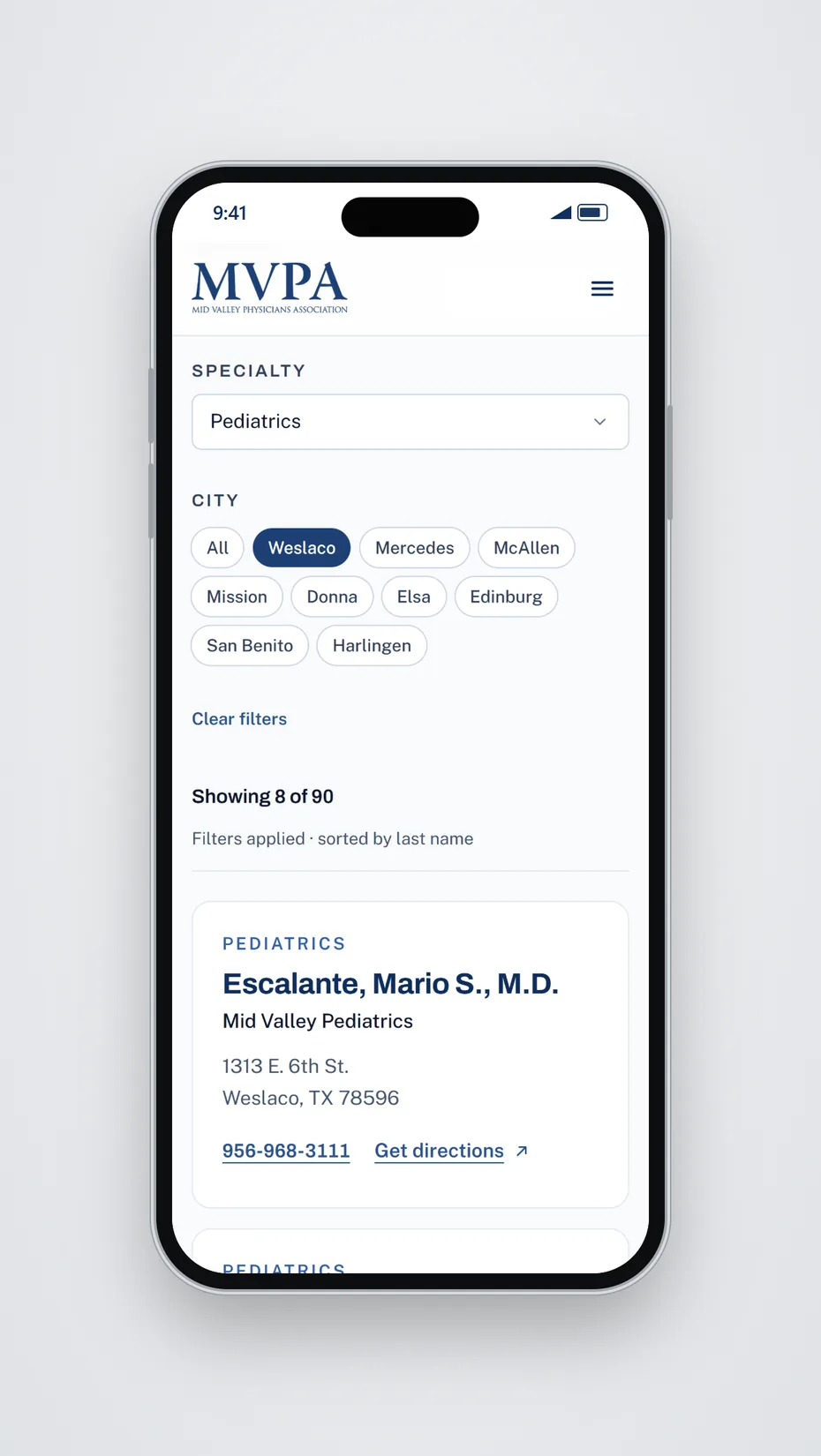
The new Find a Doctor page puts every member physician and clinic on a single page that anyone can narrow down. Visitors can filter by 21 specialties and nine cities, or type a doctor's name, a practice, or a street into the search box. Results are sorted by last name, and each listing shows the practice name, address, and phone number.
The listings are designed for the moment after someone finds the right doctor. On a phone, each phone number places a call with one tap, and a Get directions link opens the address in Google Maps, so a patient driving to an unfamiliar clinic never has to retype it. Physicians who practice more than one specialty appear under each of them. A pulmonologist who also covers critical care and sleep medicine turns up in all three searches, so patients find that doctor under whichever specialty they look for.
The homepage works as a shortcut into the directory, listing all 21 specialties with the number of members in each. Every specialty links to a pre-filtered view, so a parent looking for a pediatrician is one click from a list of them. The directory's page title, the name that appears in the browser tab and as the headline in Google's results, reads "Find a Doctor in Weslaco & Mercedes, TX," which mirrors the way people search for care close to home.
Keeping the directory accurate after launch
A directory is only useful while it's accurate, which makes maintenance as important as design. On the new site, every physician and clinic is its own entry in the content management system, the editing tool behind the site's pages. Adding a new member, changing a phone number, or removing a listing is a quick edit to a single entry. The homepage's member and specialty totals, along with the number beside each specialty, are calculated from the directory itself, so they update along with the listings and never need to be changed by hand.
Before launch, MVPA's contract coordinator sent over the association's latest member directory, and every entry on the site was checked against it. The site launched as an exact match, with 90 physician and clinic listings across 21 specialties.
Old links got the same attention. Search engines had indexed the PDF directory, and the old page addresses may still live in bookmarks and on other websites. Permanent redirects, forwarding notices that tell search engines a page has moved for good, now send the old PDF's address to the live directory and each old page address to its closest new equivalent.
Explaining membership to the physicians MVPA wants to recruit
Mid Valley physicians are weighing membership at a hard time for independent practice. The American Medical Association's Physician Practice Benchmark Survey found that 42.2% of physicians worked in private practice in 2024, down from 60.1% in 2012. When the AMA asked physicians whose practices had been acquired in the past decade why their practices sold, the most common answer was the need to negotiate higher payment rates with payers, the health plans and insurers that pay for care.
42.2%
Physicians in private practice in 2024, down from 60.1% in 2012
70.8%
Physicians in acquired practices who cited negotiating higher payment rates with payers
63.6%
Cited managing payers' regulatory and administrative requirements
Those are the pressures a Physician-Hospital Organization exists to share. MVPA members get one administrative relationship covering more than 40 health plans. Under what's called the messenger model, MVPA works with health plans on behalf of the whole network, and each physician still decides individually which contracts to sign. The new site explains that arrangement in plain language, then lists what members receive, including help with claims and network issues, educational programs for physicians and office staff, and delegated credentialing. Credentialing is the review health plans use to verify a physician's license, training, and history before adding them to a network. With delegated credentialing, MVPA completes that review once at the network level, and participating plans recognize it.
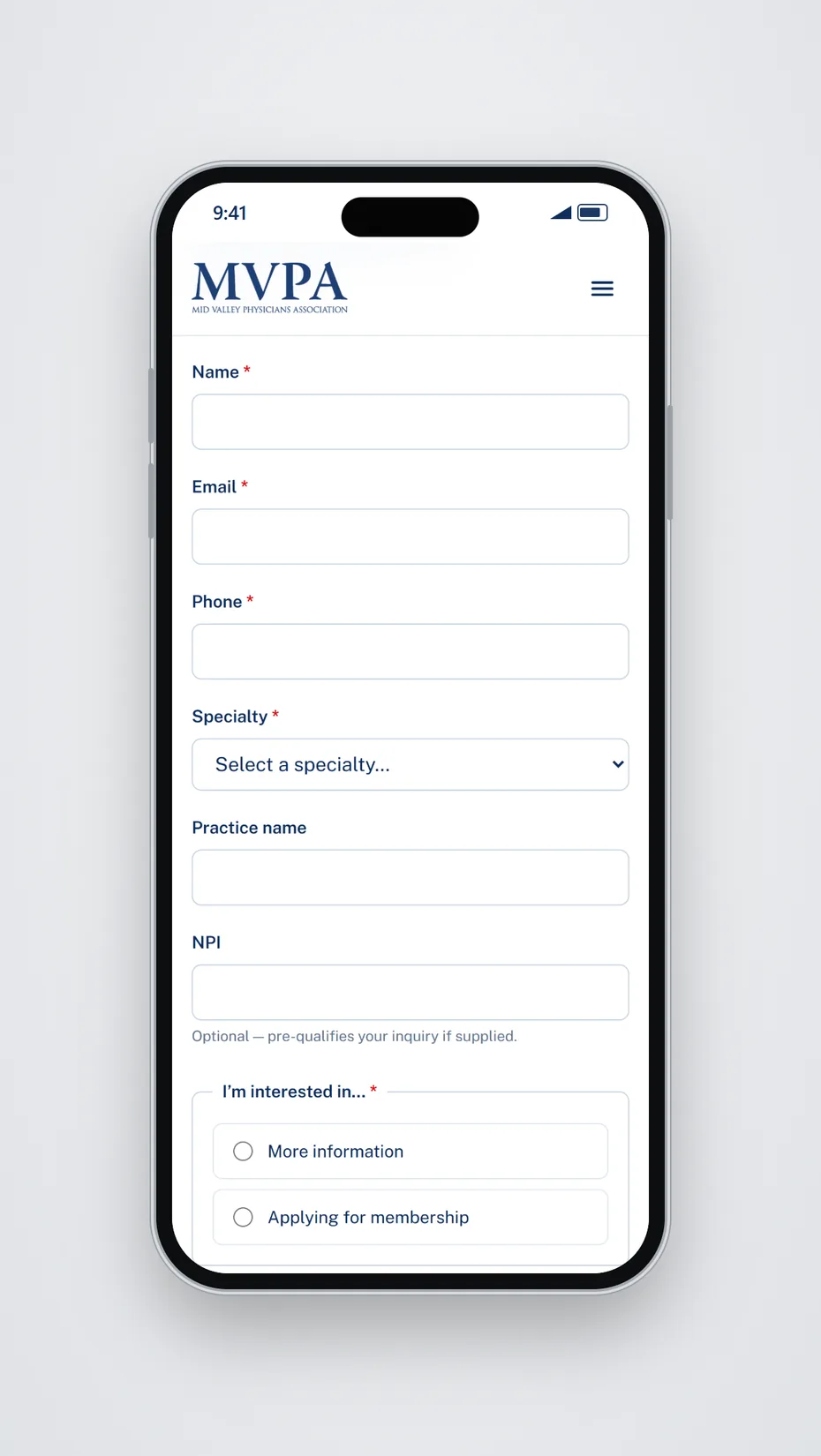
The membership inquiry form asks only for what MVPA needs to start a conversation. A physician enters a name, email, phone number, and specialty. The practice name is optional, and so is the NPI, the 10-digit National Provider Identifier physicians use on insurance claims, though including one pre-qualifies the inquiry. A required choice between More information and Applying for membership tells MVPA what kind of conversation to prepare for.
Every inquiry goes to Nelda Diaz Cortez, MVPA's contract coordinator, who follows up personally, and the office phone number sits beside the form for physicians who would rather call. The Inquire about Membership button also appears in the main navigation on every page, so a physician browsing the directory or the list of health plans is always one click from the form.
 Find a Doctor
 Membership inquiry
More than 40 health plans, searchable by type
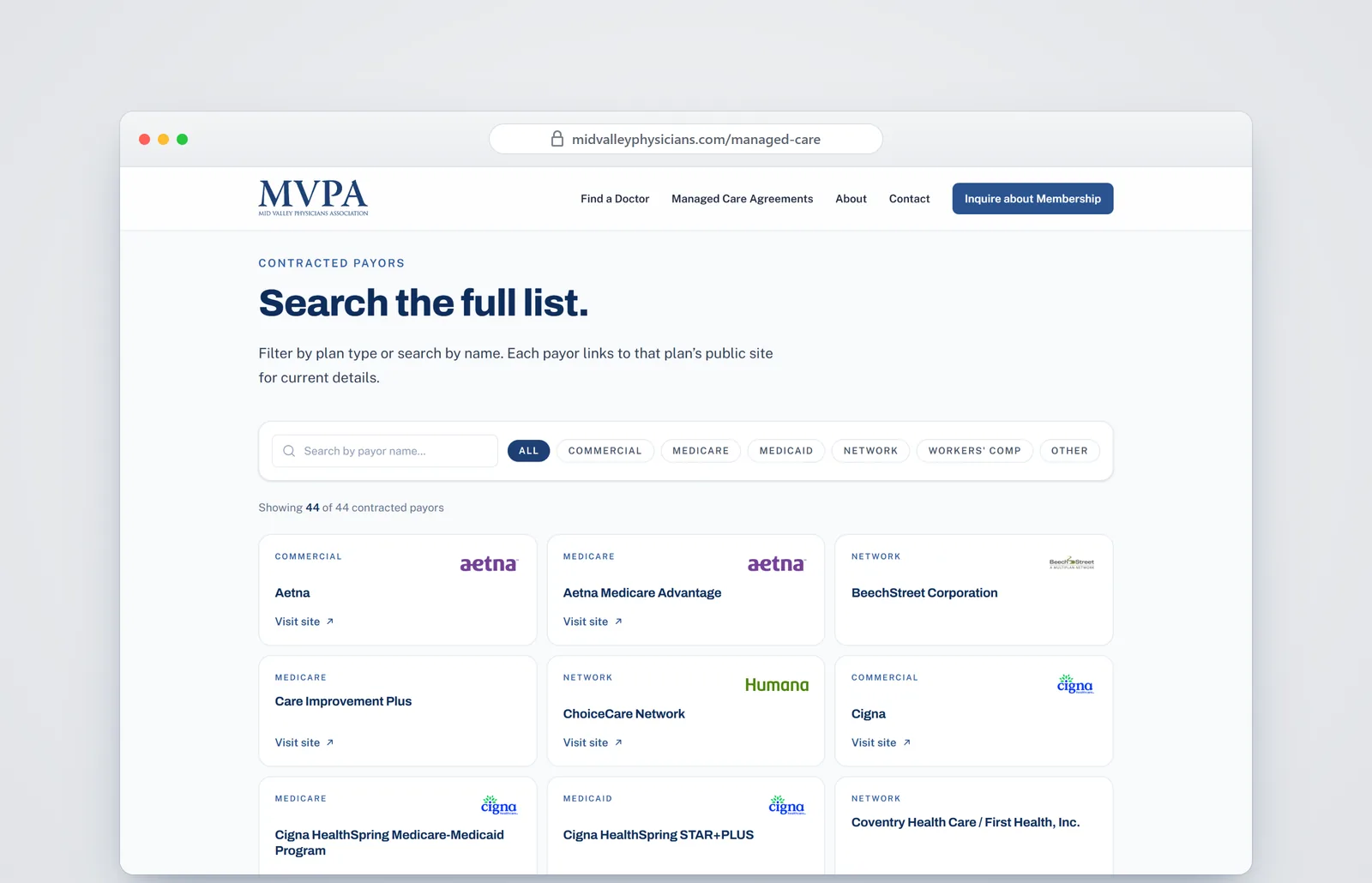
For a physician weighing membership, the list of contracted health plans is the core of the offer. For health plans and hospital staff, the same list shows the breadth of the network. The previous site listed the plans as links on a single page. The new Managed Care Agreements page opens by explaining what contracting through MVPA means, then presents every plan as a card labeled by plan type. Visitors can filter to commercial insurance, Medicare, Medicaid, or workers' compensation plans, or type a name like Humana into the search box, and the cards link to each plan's own website for current details.
The homepage previews the same list with a scrolling strip of plan logos, so a physician skimming the page sees familiar names like Aetna and Molina before reading a word about contracting.
A calm, modern look for a 30-year-old institution
Healthcare websites have to earn trust quickly, and MVPA's audience ranges from busy physicians to older patients looking for a specialist. The design stays restrained, built on a single navy and generous white space. The navy comes straight from the MVPA logo, and the familiar MVPA wordmark still sits at the top of every page. Headlines are set in Archivo, a sturdy modern typeface, and body text in Public Sans, which the U.S. Web Design System developed for clear, readable government websites. The main decorative touch is a thin heart-monitor line that runs through the homepage's opening section.
 Before
 After
AfterReadability shaped the smaller decisions, too. Text and buttons use strong color contrast, and the footer links are underlined, so visitors with color blindness never have to rely on color to spot them. Every form field has a visible label, and the site's animations switch off for anyone whose phone or computer is set to reduce motion. According to the CDC, more than one in four U.S. adults reported having a disability in 2022, and details like these help decide whether those visitors can use a site comfortably.
What physician networks can learn from this project
For any physician network, the directory is the part of the website the public uses most, and it holds up best when it's built as data, with one entry for each physician or clinic that patients can search by what they already know, like a specialty, a town, or a doctor's name. A directory built that way is far easier to keep accurate, and accuracy is the detail patients and health plans notice. When the phone number works and the doctor is at the address the listing shows, the whole network looks as well run as it is.
Recruiting physicians takes a different kind of clarity. The reasons physicians give for selling their practices, from negotiating with health plans to keeping up with their administrative demands, read like a description of what a Physician-Hospital Organization offers, so the case for membership is strong when it's stated plainly. Terms like the messenger model and delegated credentialing need a two-sentence explanation, and once they get one, the value of membership is easy to see. A named person who calls back and an inquiry form that asks only for the essentials make the first step easy to take.
It also pays to build a directory that can grow. For networks that contract with many health plans, the most useful addition is usually a link between each physician and the plans that physician accepts. Under a messenger model, participation can vary from one doctor to the next, and letting patients filter by insurance answers the question they most need answered before they call.
Mid Valley Physicians Association's website is live at midvalleyphysicians.com. Built by MPC Studios.
Working on a website for a physician group, medical association, or healthcare network? Let's talk.
Let's work together
Ready to take your
business further?
Tell us about your project and let's create something extraordinary together.