Website Design & Development
Where Can I Buy Your Soil? How Mayer Materials Built One Website for Pros and Home Gardeners
August 5, 2026 · 10 min read · MPC Studios
Companies that make lawn and garden products and sell them through nurseries and landscape suppliers know a certain phone call well. Someone saw a bag at a garden center or at a friend's house, loved what it did for their plants, and wants to know where to buy one. The call is a compliment, and it is also a small puzzle. The manufacturer's day-to-day business is with the nurseries, turf managers, and landscapers who order by the pallet, and the sale itself belongs to the stores that stock the bags.
Home gardeners are putting more into their gardens. The 2026 Axiom Gardening Outlook Study, as reported by Garden Center magazine, found that 63.6% of home gardeners planned to plant more and expand their gardens this year, and that 49.5% spent more money on gardening in 2025. A manufacturer's website has to serve its business buyers well, and it also needs a good answer for every gardener who shows up looking for a bag.
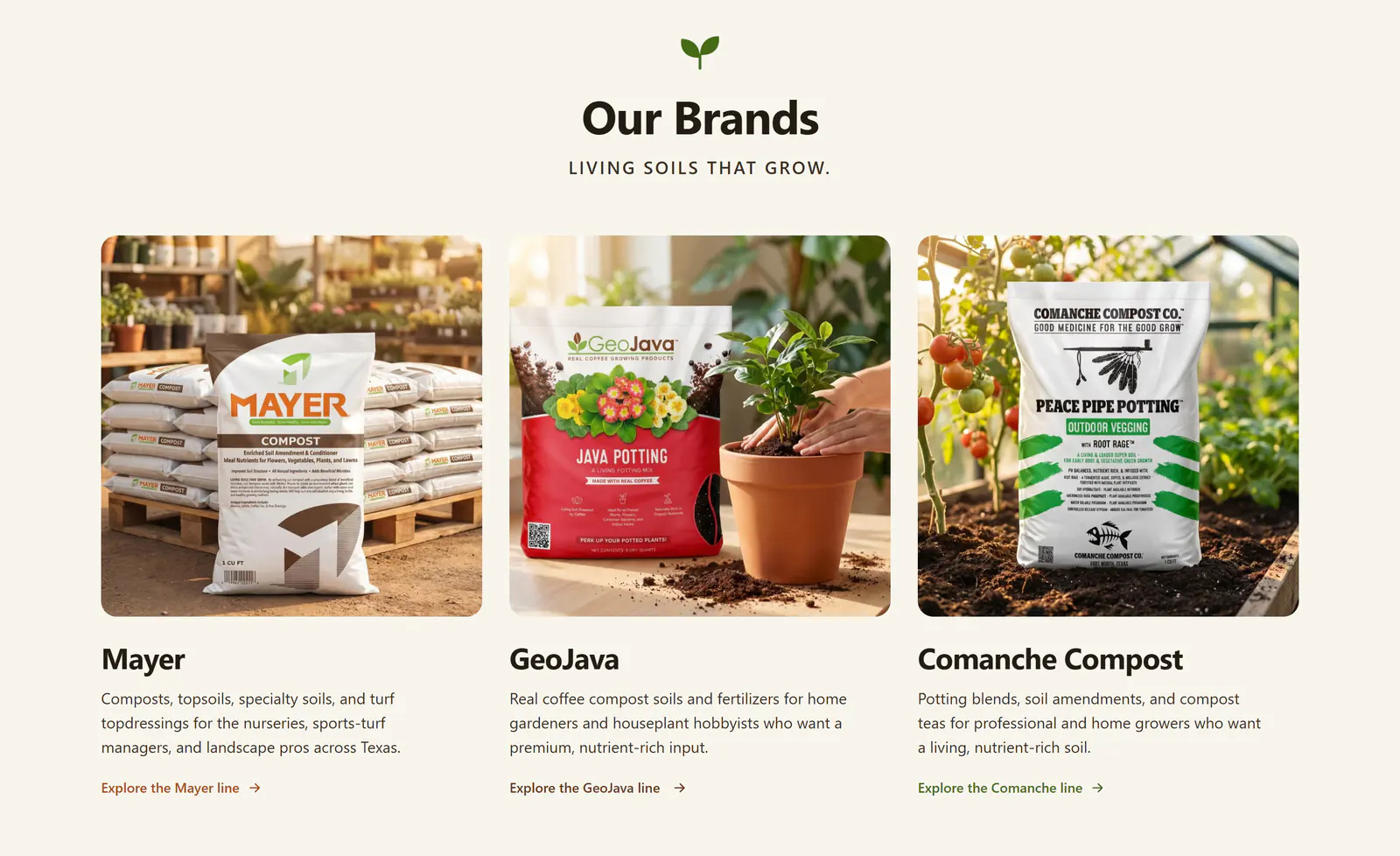
Mayer Materials makes soils, composts, and turf topdressings at its own facility in Azle, Texas, northwest of Fort Worth. The company started in 2006 as a sand pit, turned to composting in 2016, and is run by David and Heather Mayer, who hand-craft every product in Azle. It sells under three brands: Mayer, the traditional line of composts, topsoils, and specialty soils for Texas nurseries, turf managers, and landscape pros; GeoJava, a boutique line of coffee compost soils and fertilizers for home gardeners and houseplant lovers; and Comanche Compost, which makes living super soils and liquid compost teas for professional and home growers. All three are built on a cold brew coffee compost made from spent grounds that Mayer collects from roasters and cafés.
The new site at mayermaterials.com replaces the company's longtime address, mmrcs.com. MPC Studios has worked with the Mayers on the GeoJava and Comanche Compost websites for years, and this project gave the parent company a home that ties all three brands together.
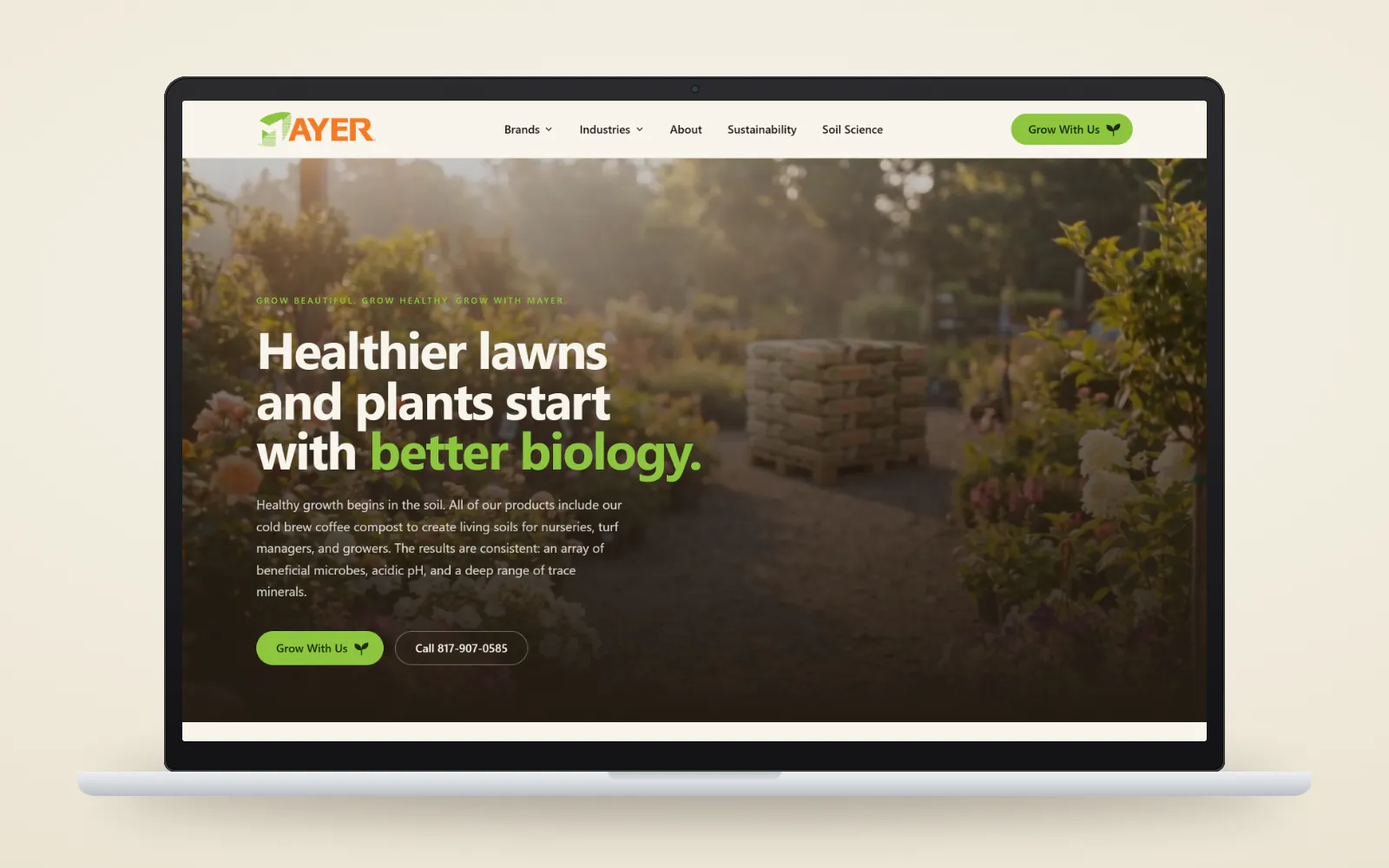
The site needed to do three jobs at once: show nurseries, turf managers, and landscape contractors that Mayer can supply them in bags and in bulk, give each brand room to speak to its own audience, and send the home gardener looking for a single bag somewhere useful. The right answer for that gardener depends on the product. Mayer sells select soils and composts by the cubic yard at its Azle facility, garden centers and suppliers carry the bags, and GeoJava ships nationwide on Amazon.
The design took its cue from the phone. When someone calls the yard, the first thing the Mayer team wants to know is what the caller is working on, because the company has a soil for nearly every job. That question became the line that closes nearly every page of the new site: "Tell us what you're growing."
A contact page that sorts buyers with one question
The contact page states Mayer's terms in plain words: its compost and specialty soils are sold in bags and bulk, by the pallet, super sack, and bulk yard, to nurseries, retailers, and landscape pros across Texas. A super sack is an oversized woven bag of loose material that gets moved with a forklift. The next line speaks to everyone else: "Buying for yourself? We will point you to the nearest place to pick some up."
The form starts with one choice, Business or Personal. Business buyers are asked for a business name, a business type, and the volume they need, from bulk by the cubic yard to super sacks or pallets of bags. Personal visitors get a shorter form that skips those fields and asks, "How can we help?" That single page with a Business or Personal choice at the top came from the Mayers' own review notes. A Where to Buy panel beside the form covers the three ways to get product: select soils and composts by the cubic yard at the Azle yard on weekdays, bags at local stores, and GeoJava online through Amazon.
The payoff for the Mayer team is an inbox where business inquiries arrive with the details needed to quote them, so a nursery's request can get a real answer on the first reply. The home gardener gets an answer too, often before hitting send.
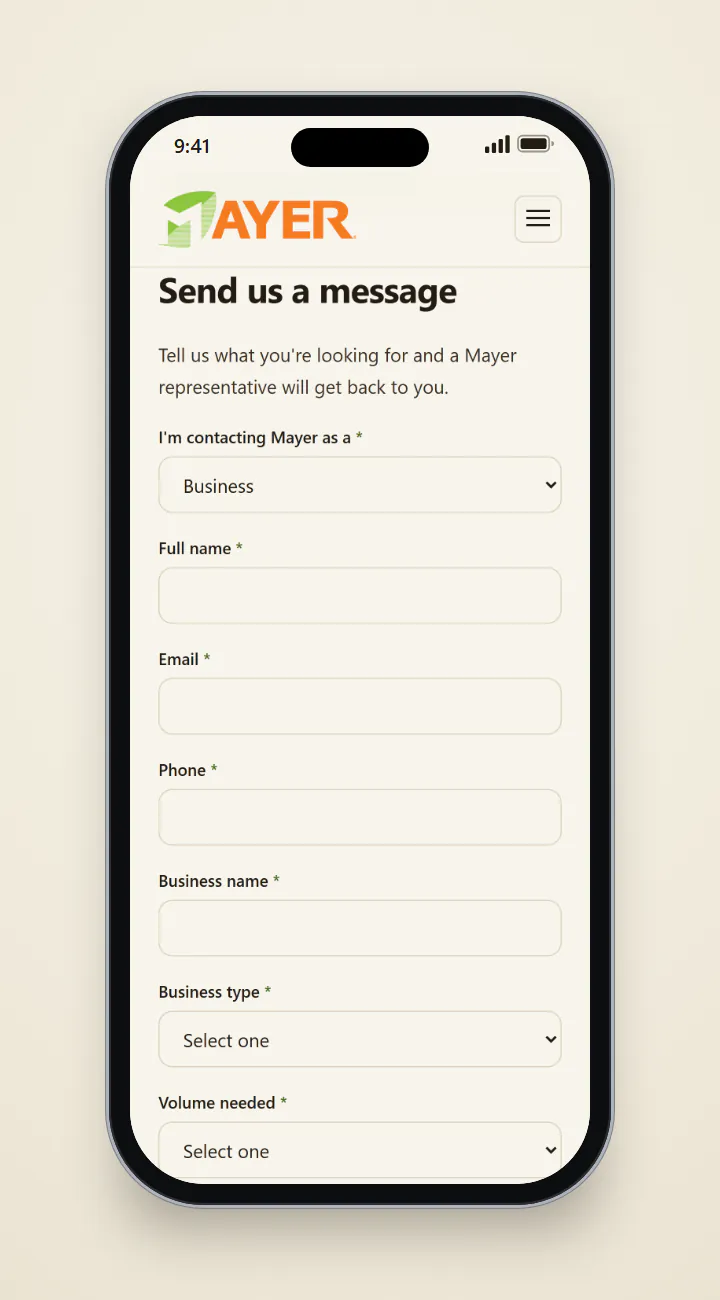 Business
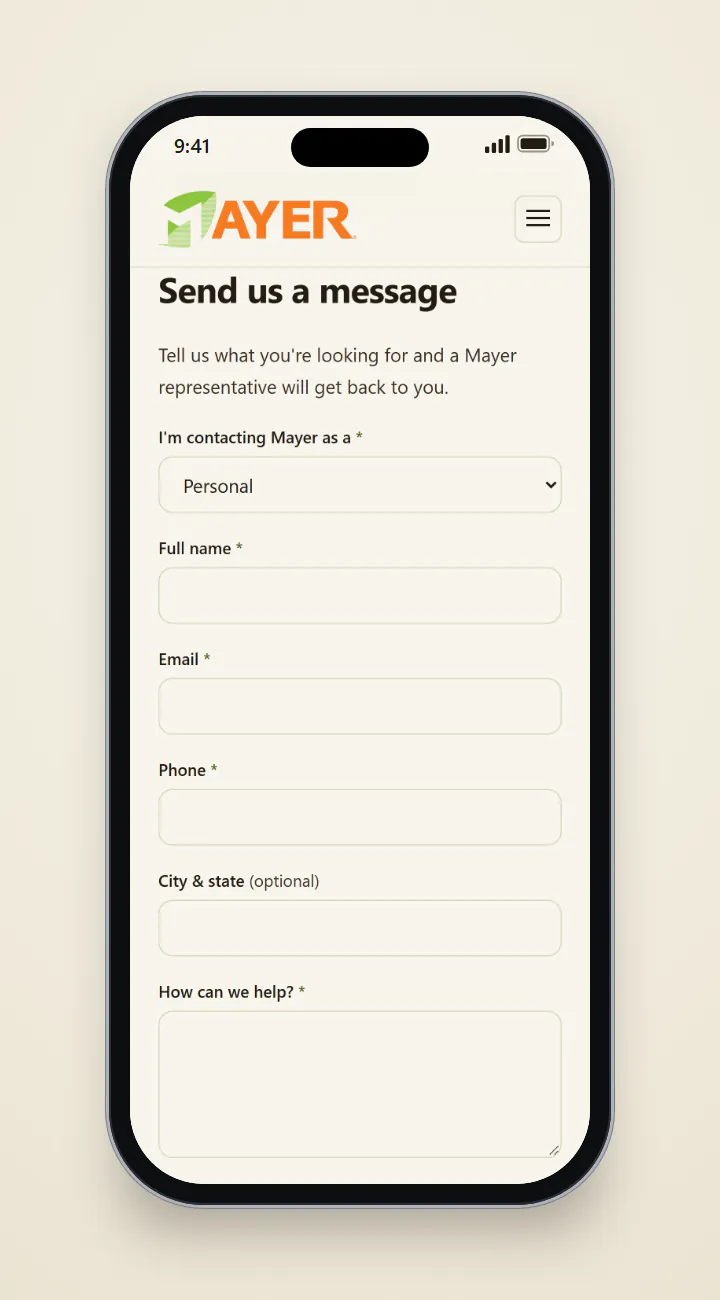 Personal
A directory that sends shoppers to the stores that carry the bags
The Where to Buy page opens with the headline "Find our products near you." and lists more than 40 places that carry or use Mayer, GeoJava, and Comanche products. Most are clustered in North Texas, and a few reach farther, from a Houston garden center to Comanche Compost customers in Oklahoma and New Mexico. Visitors can search by name or city and filter by brand or by type of business, from garden centers and suppliers to landscape designers, growers, and sports turf companies. Each listing gives an address and phone number, along with a website link where there is one and a tag for each brand the location carries. The brand pages link to the same directory, which lives in the site's content editor, so adding a location takes a quick content update.
For a company that sells through independent garden centers, sending shoppers to those stores is part of the sales strategy. Mayer's nursery page promises that the line stays with independent nurseries and garden centers that compete on quality, away from the big chains. In the same Axiom study, fewer gardeners named Lowe's, Home Depot, or Walmart as their main source of plants and gardening supplies, which Axiom founder Mike Reiber told Garden Center magazine is a positive sign for independent garden centers. A directory that routes local demand to those stores gives them one more reason to keep Mayer bags on the shelf.
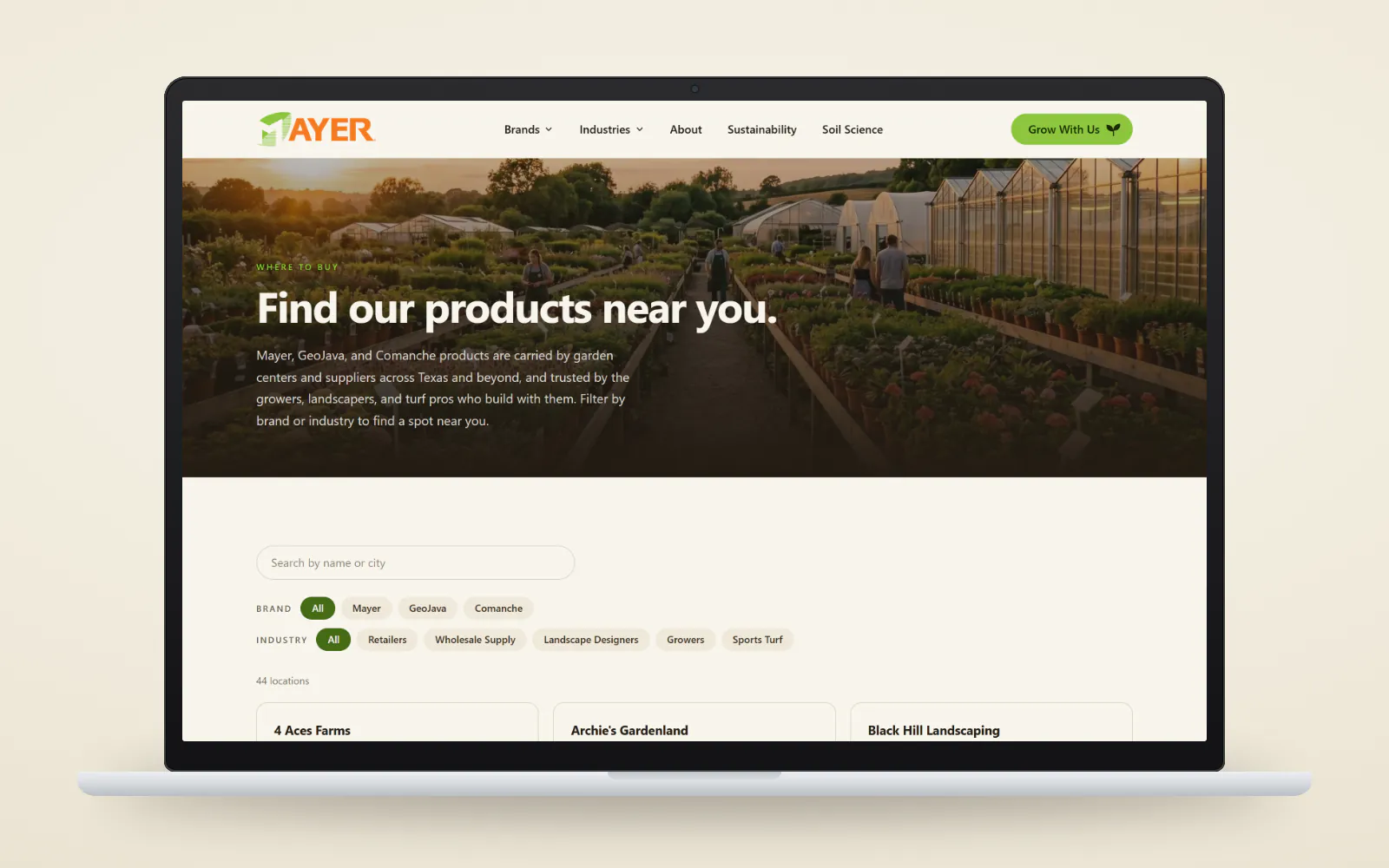
One home for three brands, sorted by who is buying
The Brands menu gives each line its own page and its own voice, from Mayer's "Grow beautiful. Grow healthy. Grow with Mayer." to Comanche Compost's "Good medicine for the good grow." GeoJava and Comanche Compost already have their own websites, so their pages here introduce each line and send buyers on to geo-java.com, GeoJava's Amazon store, and comanchecompost.com. Mayer's own line is cataloged in full here, since this is its only website.
The Industries menu offers a second way in, organized by the job. Five pages cover the main kinds of buyers, from golf course superintendents and landscape contractors to nurseries, vegetable growers, and houseplant lovers, and each one recommends products from whichever of the three brands fit that job. The sports turf page pairs Mayer's finely screened Compost and Premium Topsoil with GeoJava's Java Turf and Comanche Compost in 1/4-inch and 1/8-inch screens, and a short FAQ explains topdressing, the practice of spreading a thin layer of compost over existing turf to rebuild the soil underneath.
A buyer usually arrives with a job to do and may not know which brand belongs on it. Organizing by job gathers the right products in one place, whichever brand they carry, and the brand pages serve the buyers who already know what they want. Pages built around a specific use also match how people search, since a superintendent is far more likely to type "compost topdressing for sports turf" than the name of a product line.
Product pages that read like the back of the bag
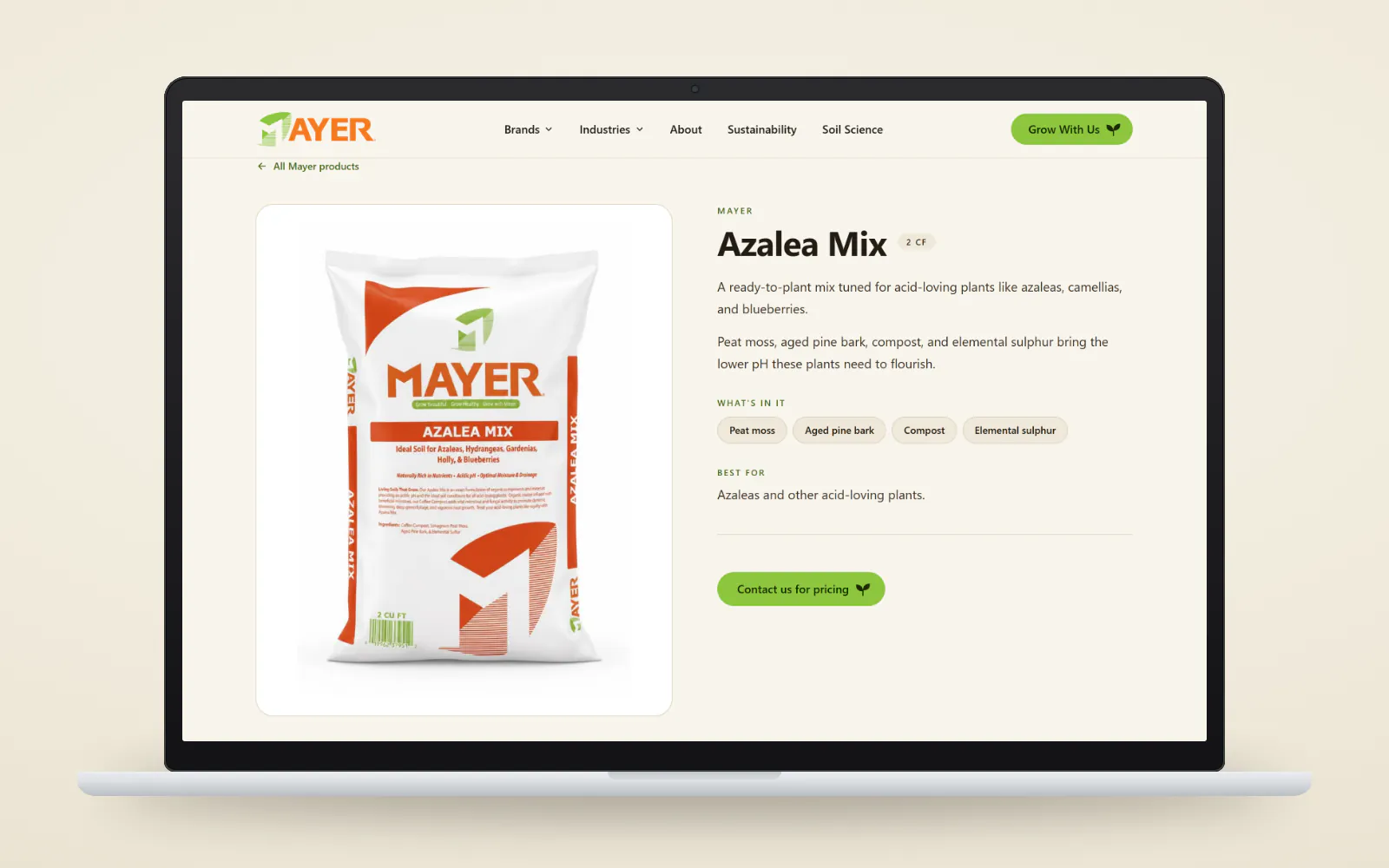
Each of the eight products in the Mayer line has a page laid out like an Amazon listing, which is what the Mayers asked for. Every page leads with a large image of the bag and its size, follows with a short description, lists the ingredients under "What's in it," names the plants the mix suits under "Best for," and ends with a green "Contact us for pricing" button where a shopping cart would usually sit. Sizes match the bags, so Azalea Mix is marked 2 CF, meaning two cubic feet. Pricing stays off the site because Mayer quotes by the pallet, super sack, and bulk yard, so each page's job is to help a buyer choose the right mix and start a conversation.
For a nursery buyer comparing mixes, the ingredient list answers the first question they would ask a sales rep. Azalea Mix, for instance, combines peat moss, aged pine bark, compost, and elemental sulphur to give azaleas, camellias, and blueberries the acidic soil they need.
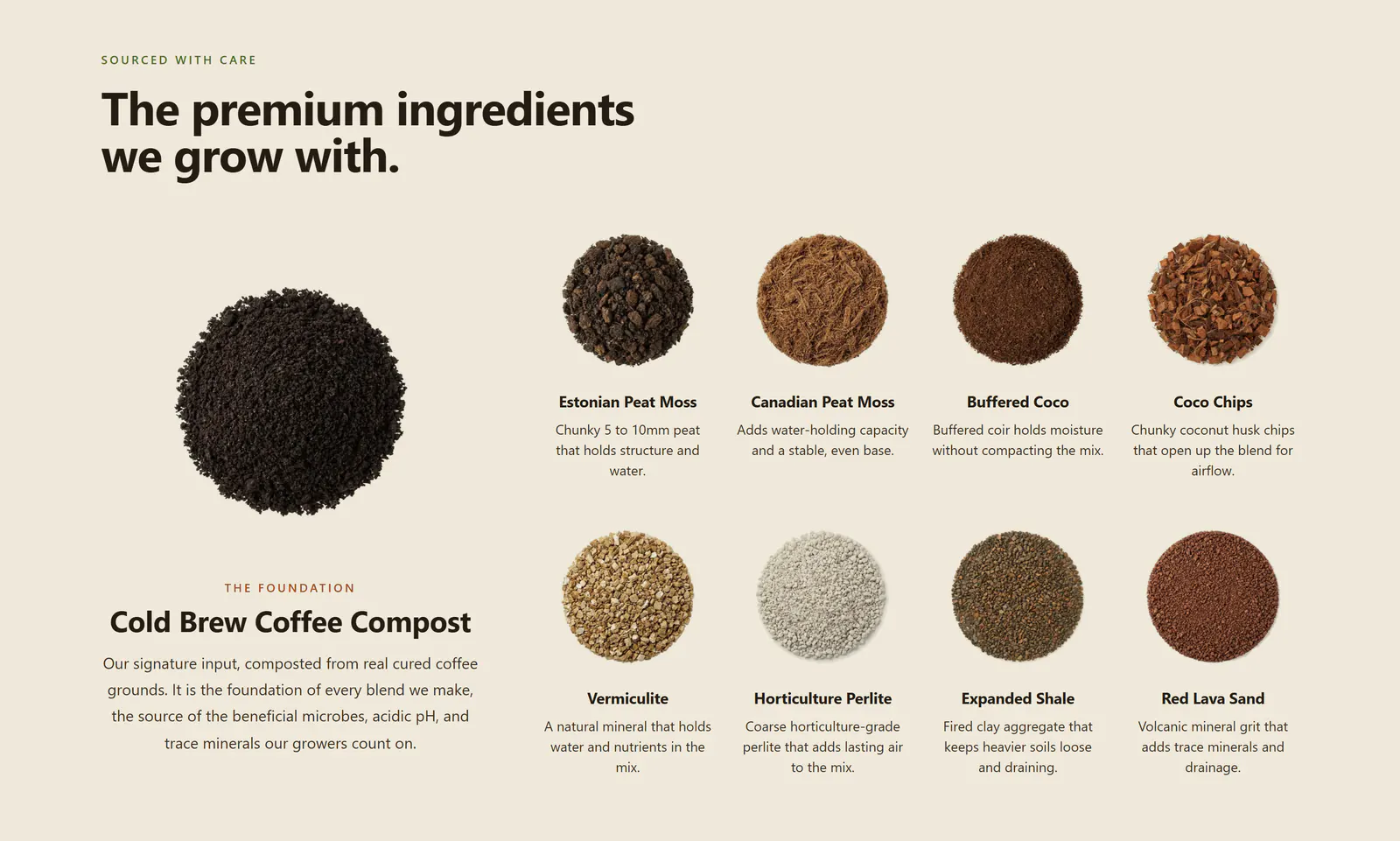
The homepage extends the idea with a section called "The premium ingredients we grow with." The cold brew coffee compost takes the largest spot as the foundation of every blend, surrounded by the materials Mayer mixes with it, from chunky Estonian peat moss that holds structure and water to red lava sand that adds trace minerals and drainage. Soil is hard to judge from the outside of a bag, and showing what goes inside backs up the houseplant page's promise that the mixes are never cut with fillers.
Research that backs up the coffee
Coffee compost is an unusual ingredient, and a turf manager deciding what goes under a putting green will want evidence. The site's Soil Science section provides it. Its featured article summarizes a Texas A&M AgriLife Research study of spent coffee grounds in turfgrass, and the sports turf page links to it under the heading "Backed by Texas A&M Research."
As Texas A&M AgriLife Today reported, turfgrass ecologist Ben Wherley and master's student Garrett Flores mixed spent grounds into sand root zones, the layer where turf roots grow, at 10 and 20 percent by volume. Over the following three months, Bermuda grass in the coffee-amended mixes matched or beat grass grown with sphagnum peat moss, the usual organic amendment, for growth, color, density, and nutrient retention. When the researchers withheld water, the coffee-amended root zones held off wilting longer and bounced back faster once watering resumed. The same story quoted David Mayer, who said the company had used coffee chaff, the papery skin that comes off beans during roasting, from the area's two largest coffee roasters in its compost for years.
University research carries weight with the professionals Mayer sells to. The Soil Science section runs on the same content editor as the store directory, so new research notes can be added as studies come out.
A counter that keeps the coffee story in motion
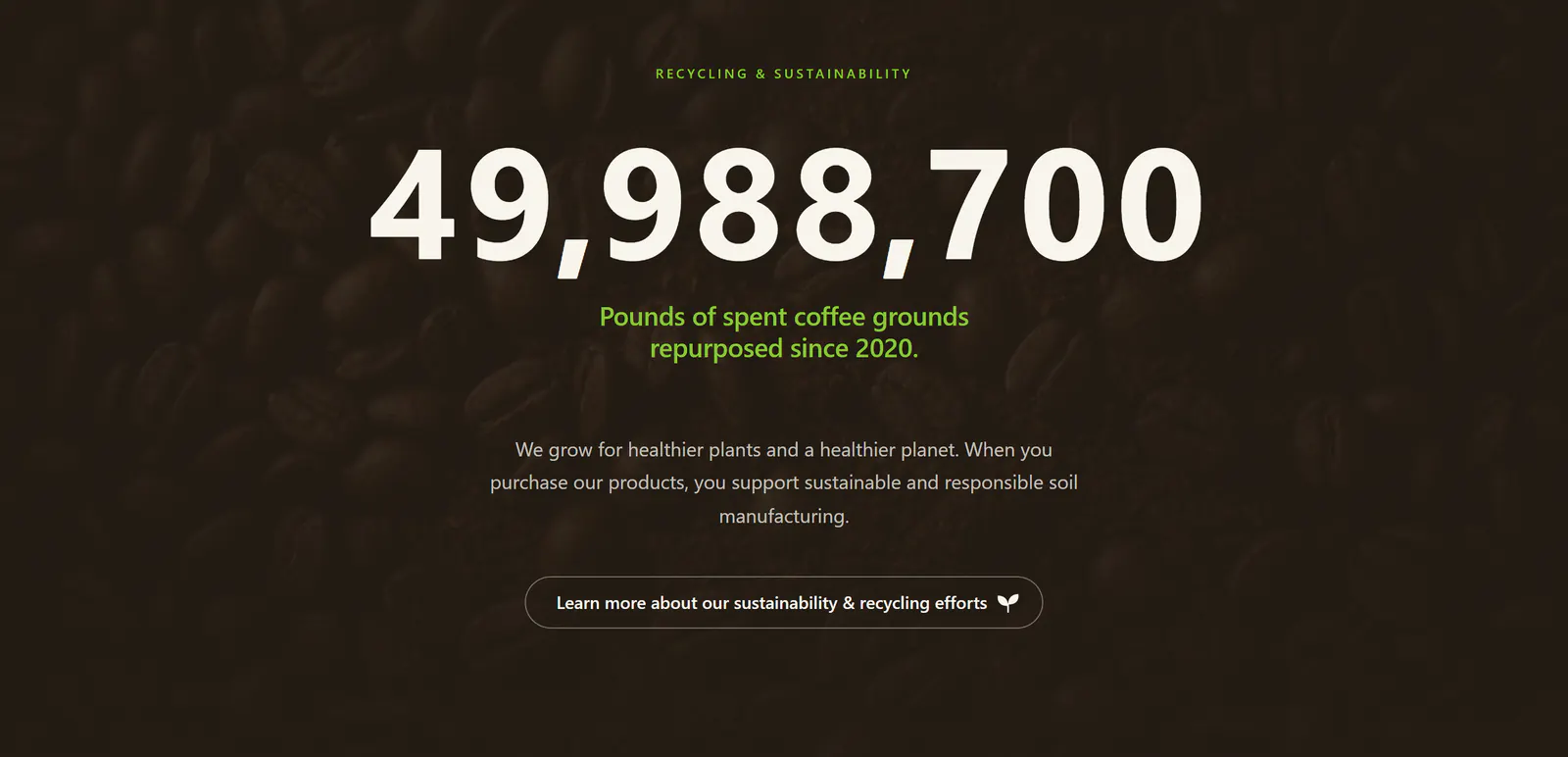
Mayer's recycling comes with a number, and the homepage makes the most of it. A dark band set against coffee beans holds an odometer-style counter of the pounds of spent coffee grounds Mayer has repurposed since 2020. Mayer tracks its recycling in tons, and the site shows pounds, which gives the total the scale it deserves. The counter starts from the more than 48 million pounds Mayer had recorded by June and keeps climbing while the page is open, and visitors whose devices are set to reduce motion see the same total without the animation. The Sustainability page, headlined "Coffee is at the heart of everything we do," walks through the loop: Mayer collects grounds and chaff from roasters and cafés, composts them for months into a living soil, and uses that compost as the base of every blend.
The scale makes sense once you consider how much coffee the country brews. According to the National Coffee Association's Spring 2026 National Coffee Data Trends report, 66% of American adults drank coffee in the past day, and every cup leaves grounds behind. Grounds thrown in the trash join the food waste that, according to the Environmental Protection Agency, makes up about 24 percent of the everyday trash from homes and businesses that goes into U.S. landfills. Food breaks down quickly once it is buried, and the EPA estimates that landfilled food waste produces 58 percent of the methane that escapes from those landfills into the air.
A rolling counter turns that math into something a visitor can watch, and it shows buyers that Mayer's sustainability claim comes with a running total.
Decisions made on a working homepage
MPC's creative director, Kate Hurry, designed and built the site, starting with the homepage alone. Sal Yanez, MPC's project manager, walked the Mayers through a working version in the browser before any inner pages existed, and that first review worked through practical questions like which bag to feature, which logo version to use, and how to order the industries. Every change after that appeared at a live preview link the Mayers could open on any device. Mayer was also the first client site MPC built on its new AI-assisted, code-based workflow, which is designed around that kind of quick, visible iteration.
At launch, mmrcs.com and each of its pages began forwarding to the matching page on mayermaterials.com with permanent redirects, which tell search engines a page has moved for good. Old bookmarks and search listings still land in the right place, and the address now matches the name on the bag.
What other growing-products companies can take from Mayer's site
If your products reach customers through other businesses, the "where can I buy it" question deserves a real answer on your website. Mayer's directory sends home gardeners to the independent stores that carry its bags, which strengthens the relationships the company depends on, and the contact page separates a pallet order from a single bag before anyone fills out a form. The best way in is often a question your own team already asks on the phone, and Mayer's version became "Tell us what you're growing."
It also pays to make quality visible. Soil looks like soil in a photo, so Mayer's site shows what goes into each blend, points to university research on its signature ingredient, and puts a rolling number on its recycling. Each of those gives a careful buyer something concrete to check, and together they present a family company in Azle as the serious manufacturer it is.
Finally, put something real in front of the people who know the business as early as possible. A working homepage turned open questions into quick decisions and kept the rest of the build pointed in the right direction, which matters a great deal to owners who have a yard to run.
Mayer Materials' website is live at mayermaterials.com. Built by MPC Studios.
Selling through garden centers and suppliers and still getting calls from shoppers who want to buy direct? Let's talk.
Let's work together
Ready to take your
business further?
Tell us about your project and let's create something extraordinary together.