Website Design & Development
A Research Lab Website for a Lab on the Move: The Kuhl Lab at the University of Oregon
September 16, 2015 · 5 min read · MPC Studios
When a research lab changes universities, its website becomes the lab's address before the boxes are unpacked. Prospective graduate students read it before they apply. Colleagues read it before they write to propose a collaboration. People thinking about volunteering for a study read it to learn who runs the lab and what the research involves. Each of those visitors arrives with a different question, and the site has to answer all of them with no one from the lab there to explain.
More of those first visits now happen on a phone. Pew Research Center's U.S. Smartphone Use in 2015 report found that 64% of American adults own a smartphone, and in April Google began using mobile-friendliness as a ranking signal for searches made on phones. A lab website has to read well on a small screen to reach the people who are looking for it.
The Kuhl Lab studies the cognitive neuroscience of memory. Led by Brice Kuhl, an assistant professor in the University of Oregon's Department of Psychology, the lab combines fMRI, the brain imaging method that tracks activity across the brain, with analysis methods that "extract memories from the neural activity patterns they evoke." This fall the lab moved from New York University to the University of Oregon in Eugene, and its new website launched with the move.
A homepage that leads with the research
The homepage opens on a slider of research highlights. Each slide states a finding in the lab's own words, such as "Repetition suppression and multi-voxel pattern similarity differentially track implicit/explicit visual memory," and a View Research button opens the paper itself. A visitor who wants to know what the lab actually publishes is one click from the source.
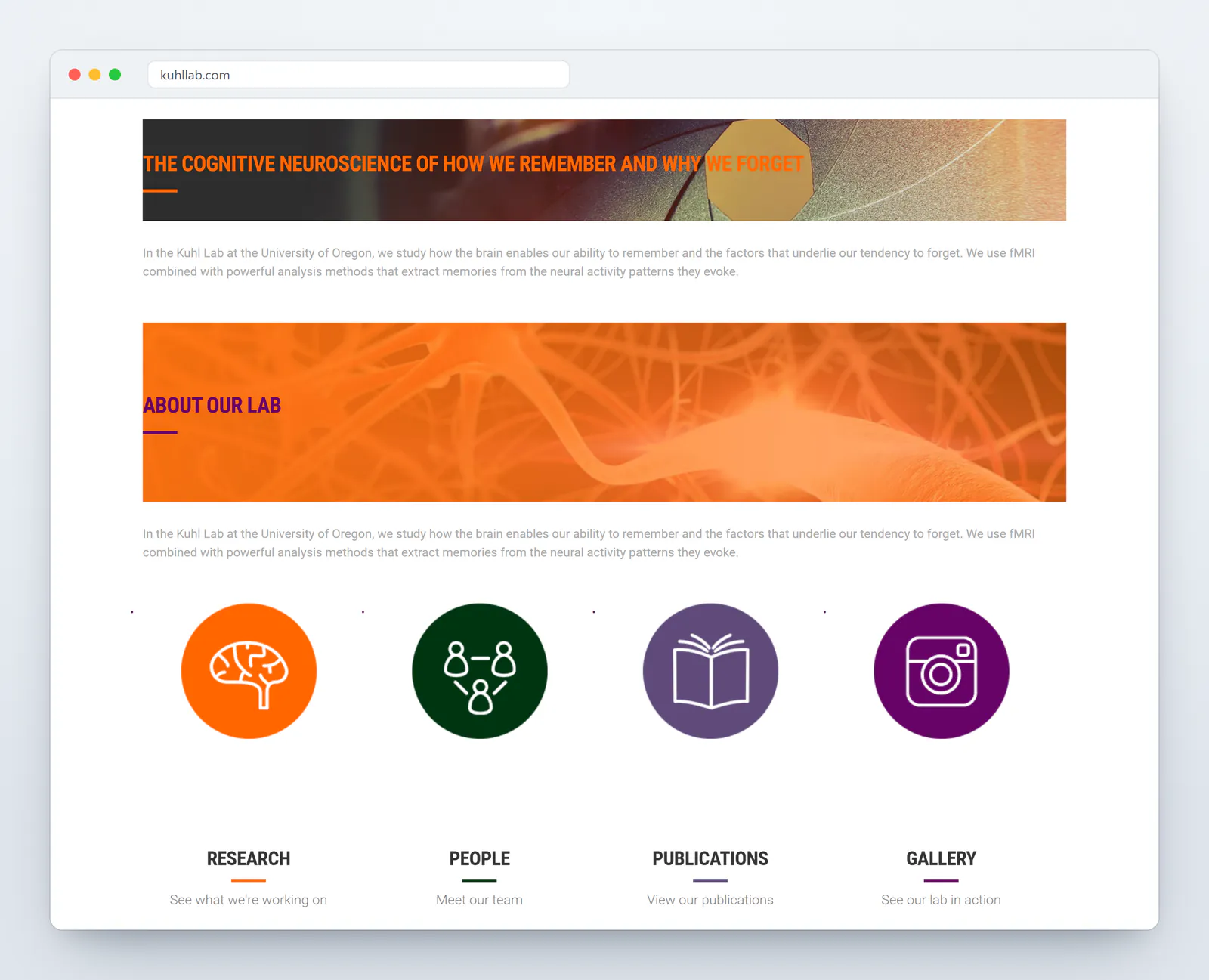
Below the slider, the lab's focus fits in one line: "The cognitive neuroscience of how we remember and why we forget." A short paragraph explains the approach, and a row of icon tiles leads to the research, the people, and the publications. Someone arriving for the first time can tell what the lab studies, and where to go next, without scrolling far.
Research explained one question at a time
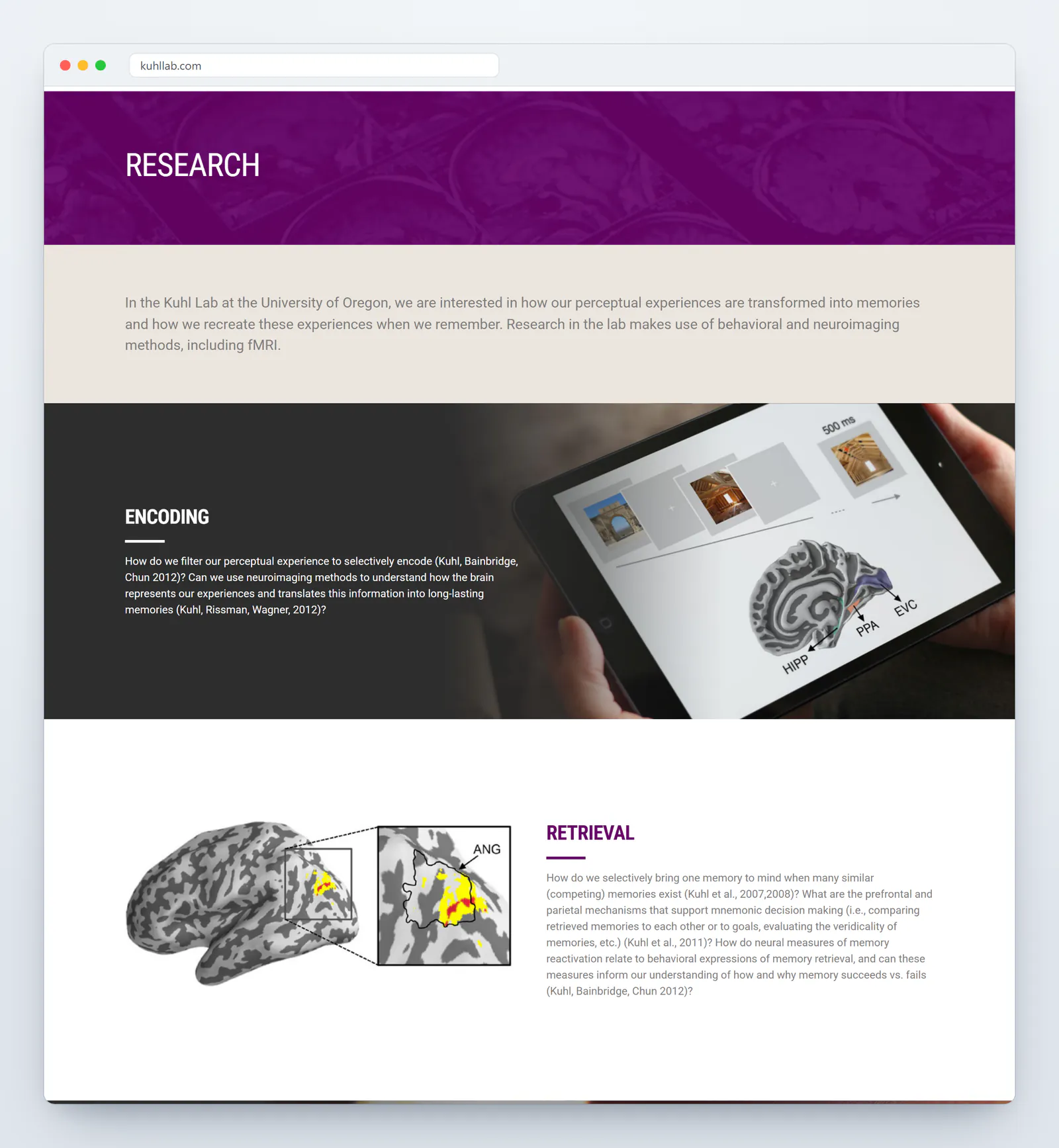
The Research page divides the lab's work into four areas: encoding, retrieval, selective attention, and fMRI pattern analysis. Each area gets its own band with a figure from the lab's work and a description written as a set of questions. The encoding section asks how we filter our perceptual experience to decide what becomes a lasting memory. The retrieval section asks how we bring one memory to mind when many similar memories compete.
Writing the research as questions makes the page readable for a prospective student who hasn't read the papers yet, and the citations inside each section give a faculty colleague a direct path into the literature. Alternating dark and light bands, each paired with a figure, keep a page of dense material easy to scan.
Publications and people, organized for the visitors who need them
The Publications page lists the lab's papers by year, going back to 2004, with the authors, title, and journal for each and a link to the full PDF. A link at the bottom opens the lab's Google Scholar profile. For graduate applicants and for colleagues reviewing the lab's work, a complete publication list with the papers attached is often the first thing they look for.
The People page introduces each lab member with a photo, a role, and a short bio, and each profile has buttons to download a CV or send an email. The lab is admitting graduate students for fall 2016, so a clear picture of who works there, and how to reach them, matters right now.
Lab news, and a standing invitation to take part
The Lab News section gives the lab a place to share milestones as they happen. Its first posts announce the move from NYU, welcome Nicole Long to the lab after her Ph.D. at the University of Pennsylvania, and invite prospective graduate students to apply.
Memory research depends on volunteers, so the footer on every page carries a Participate note inviting anyone interested in a behavioral or fMRI study to get in touch. The footer also lists the lab's address in the Lewis Integrative Science Building and its affiliations with the Department of Psychology and the Lewis Center for Neuroimaging, so contact details are never more than a scroll away.
Built to read well on a phone
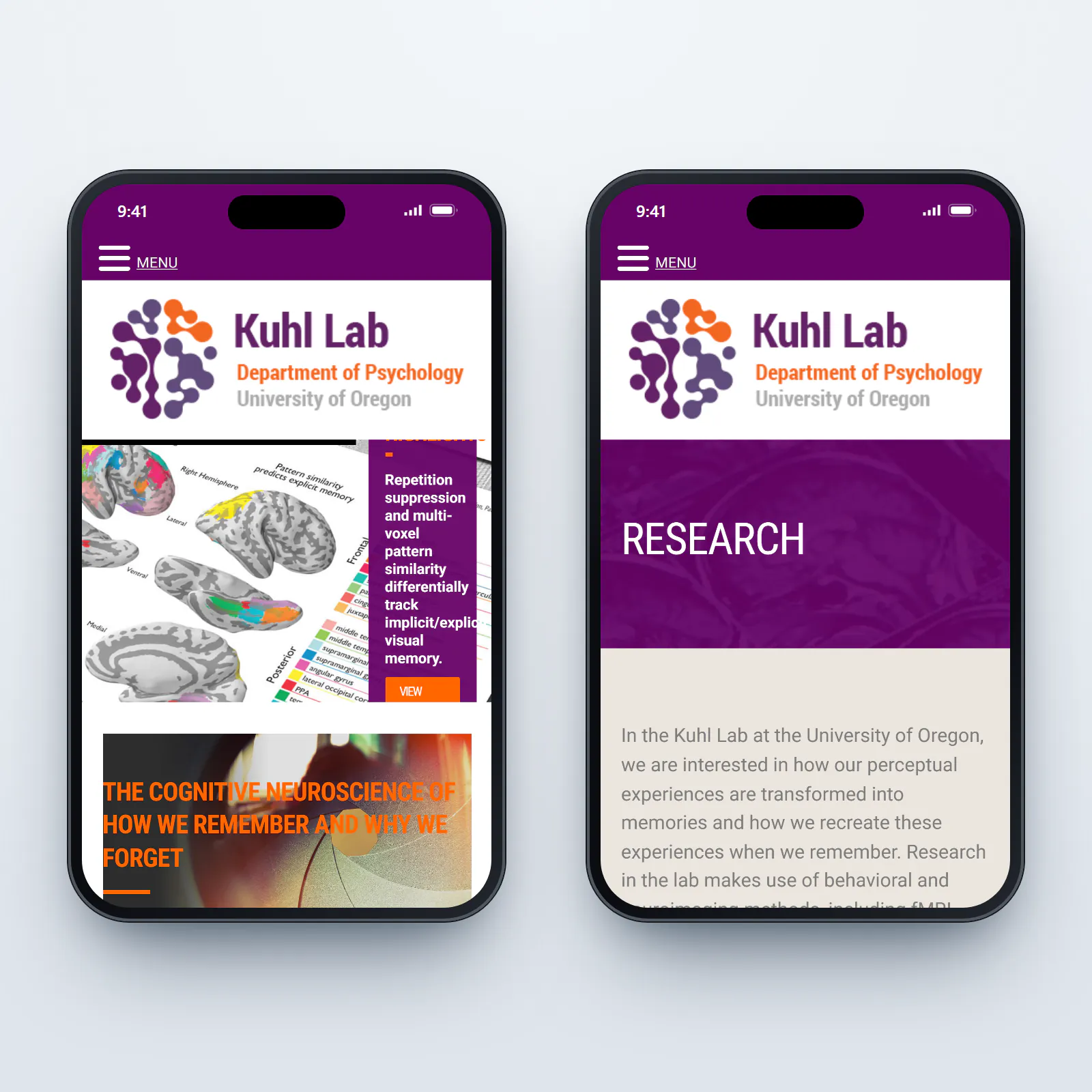
The site carries the lab's purple and orange identity through custom page headers and a matching set of icons, and it adapts to any screen size. On a phone the navigation folds into a single menu button, and the research highlights, headings, and text reflow to fit the screen. A student comparing labs between classes sees the same research, the same papers, and the same contact details as someone at a desk.
What other research labs can take from the Kuhl Lab's site
A lab website does its most important work when nobody from the lab is around to explain it, so the Kuhl Lab's site starts from the questions visitors bring. A prospective student wants to know what the lab studies and whether the work is a good fit, so the research is stated plainly on the homepage and explained one question at a time on the Research page. A colleague wants the papers, so the publication list is complete and every entry opens a PDF. A potential study volunteer wants to know who to contact, and that answer sits at the bottom of every page.
Labs that are moving, growing, or recruiting can take the same approach. Describing the science in language a newcomer can follow, keeping the publication record easy to scan, and making the people behind the work easy to reach will serve almost every visitor a lab gets. Treating the phone as a primary screen matters too, since that is where more and more first visits begin.
The Kuhl Lab's website is live at kuhllab.com. Built by MPC Studios.
Working on a website for a research lab or an academic department? Let's talk.
Let's work together
Ready to take your
business further?
Tell us about your project and let's create something extraordinary together.