Website Design & Development
How MPC Studios Works: A Small Texas Team, End to End
May 12, 2026 · 7 min read · MPC Studios
Most businesses come to us after a string of agency relationships that ended with a half-finished website, a stale marketing budget, or a custom tool nobody can support. The same pattern shows up in banking, in law, and in construction. Companies hire a vendor for one piece of the puzzle, the relationship gets thin, and a few years later they are starting over with another firm.
We have been doing this since 1998 from Harlingen, Texas. Six people on the team, every one of them working directly on client projects. No account-manager handoffs, no offshore hand-off of the actual build, no surprise invoices for "extras" that turn out to be table stakes. This post walks through how we actually run engagements, because most prospective clients want to know what working with us feels like before they decide to talk.
Discovery starts with the business, not the website
The first conversation never opens with "what do you want your website to look like." It opens with what the business is trying to do this year, what is in the way, and what success looks like twelve months from now. A community bank trying to recruit a younger customer base has a different problem than a personal-injury firm trying to win more referral checks, and the websites that solve those two problems look almost nothing alike.
By the end of discovery we have a written brief that names the audience, the conversion goals, the technical constraints, and the editorial cadence the client can realistically maintain. That brief becomes the source of truth for every decision that follows. When a designer later wonders whether to put the rates table above the fold or below it, the answer comes from the brief, not from a stakeholder's gut feeling in a review meeting.
The brief is the part of the project that pays for itself ten times over. Every overrun we have ever seen at another shop traces back to a project that skipped this step.
For most clients we also do an audit of the existing site (analytics, search performance, competitive positioning, accessibility) so the new build starts from a real baseline. Our website design and development page explains the full audit scope.
Strategy is where the project gets cheap
Almost every overrun we have ever seen at another shop traces back to the same root cause: a project that skipped strategy and went straight to design. Pretty mockups created without a content strategy or a clear conversion map produce beautiful sites that do not move the business, and then everyone spends the next six months patching.
Our strategy phase covers four things. We define the information architecture (the page tree, the navigation, the URL structure). We map the conversion flows (who lands where, what they need to see, what action they should take next). We build a content inventory (every page, every section, every CTA, every piece of media). And we agree on the technical stack before a single component gets designed.
Stack choice matters more than most clients realize. The right CMS for a four-person construction firm is different from the right CMS for a regional bank with three compliance officers reviewing every published page. A small healthcare practice does not need the same infrastructure that powers a regional contractor managing dozens of active bids. We document the trade-offs in plain English so the client can make the call with us, not after us.
Build happens in two-week increments
The design and development phase runs in two-week sprints. At the start of each sprint we share the plan, at the end we ship the work to a staging URL the client can click around. Feedback rolls into the next sprint instead of stacking up into a six-week "review phase" that ends with a panicked launch.
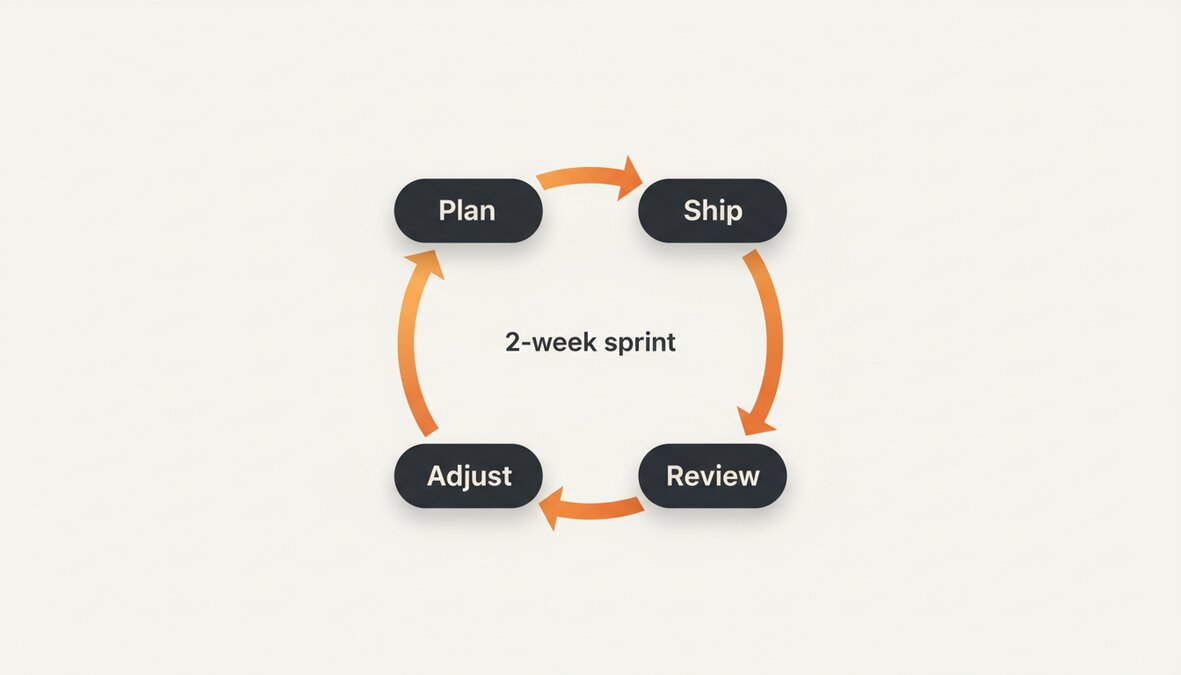
A few things stay consistent across every build, regardless of industry. Mobile is treated as the primary canvas (Google reports that more than 60% of all U.S. web traffic now originates on mobile devices, and for many of our clients that share runs higher). Accessibility is a default standard rather than a final-pass remediation. And every page gets a documented purpose, so when someone six months from now asks "why is this page here," there is an answer.
For clients commissioning a custom application alongside the marketing site, the engineering work runs on the same sprint cadence. The same project manager owns both threads, which is the only way to keep the data model on the application side aligned with the content model on the marketing side. The custom software page describes how we handle the application track specifically.
Launch is not a finish line
Most agency relationships fall apart in month three after launch. The site goes live, the team disbands, the client tries to file a support ticket, and silence. We treat launch as the start of a relationship rather than the end of one.
Institutional knowledge of a client's business compounds. The team that already knows your audience, your seasonality, your compliance constraints, and your editorial voice can ship a new landing page in three days.
In the first ninety days post-launch we monitor the analytics together, surface anything that is underperforming against the discovery brief, and fix it. After that, ongoing support runs on a monthly engagement (content updates, SEO maintenance, paid-media management, AI agent training, whatever the client needs). Some clients are with us a decade later, working with the same team that built the original site.
The point is not loyalty for its own sake. The point is that institutional knowledge of a client's business compounds. The team that knows your audience, your seasonality, your compliance constraints, and your editorial voice can ship a new landing page in three days. A new vendor will need two months to get back to that baseline, and the bill at the end of those two months is usually higher than a year of ongoing support would have been.
What you actually get from working with us
The deliverable is rarely just a website. The deliverable is a system that does business for you while you are sleeping. That includes the public site, the CMS your team can update without engineering help, the analytics you can read at a glance, the SEO posture that compounds month over month, and the institutional partner who will still be there when you want to add a new service line in 2028.
For industries we work in regularly, we bring more than craft. We bring pattern recognition. We have built sites for banks navigating new disclosure requirements, for law firms restructuring around referral economics, and for construction firms bidding on bond-funded school work. The institutional and regulatory knowledge each of those projects produced does not disappear. It goes into the next project.
If any of that sounds like the kind of relationship you want with your next web partner, the contact page is the right place to start. We will set up a discovery call, ask the questions we asked above, and decide together whether we are the right fit before either side commits to anything.
Ready to start a conversation about your next project? Get in touch. We answer every inquiry within one business day.
Let's work together
Ready to take your
business further?
Tell us about your project and let's create something extraordinary together.