Website Design & Development
Building the Bid List: How Holchemont's New General Contractor Website Recruits Subcontractors
August 10, 2026 · 10 min read · MPC Studios
When a school district or a hospital puts a new building out to bid, the general contractors competing for the job are pricing a great deal of work that other companies will perform. Much of a commercial building, from the concrete slab to the electrical panels, is built by specialty subcontractors, so a general contractor's bid is only as strong as the trade partners it can call. A contractor with a deep bid list can gather more prices on each part of the job, and it has more crews to draw on when a schedule tightens.
Skilled trade crews are in short supply. The 2025 Workforce Survey from the Associated General Contractors of America (AGC) and NCCER, the most recent edition, found that nearly every construction firm trying to hire was struggling to find qualified workers, and that worker shortages, whether a firm's own or its subcontractors', were the most common reason projects ran late.
92%
Hiring firms that report a hard time finding qualified workers
45%
Firms with project delays caused by shortages of their own or subcontractors' workers
The survey's Texas results, drawn from 71 firms in the state, point the same way. Eighty-five percent of the Texas firms had openings for hourly craft workers, 45 percent said craft positions had become harder to fill than a year earlier, and 46 percent said shortages of their own or their subcontractors' workers were delaying projects.
A tight labor market turns a general contractor's website into a recruiting tool. A subcontractor who finds a contractor online wants to know what kind of work it builds, how it treats its trade partners, and how to get on its bid list, and clear answers make the next bid invitation easier to say yes to.
Holchemont, Ltd. is a commercial general contractor in McAllen, Texas, that has built hospitals, schools, clinics, and city buildings across the Rio Grande Valley since 2007. When we planned the company's new website in June, Holchemont made recruiting subcontractors the site's primary goal, with project owners as the second audience. The new site went live on August 6.
Holchemont's focus on subcontractors has roots in its previous website, which MPC Studios built in 2018. That site introduced a Bid Opportunities section so subcontractors could find information about upcoming projects, and it gave the section a button in the top bar of every page. The new site carries that idea through every page: a bid button sits in the header, a dedicated page walks trade partners through prequalification, and every project in the portfolio ends with an invitation to bid on the next one.
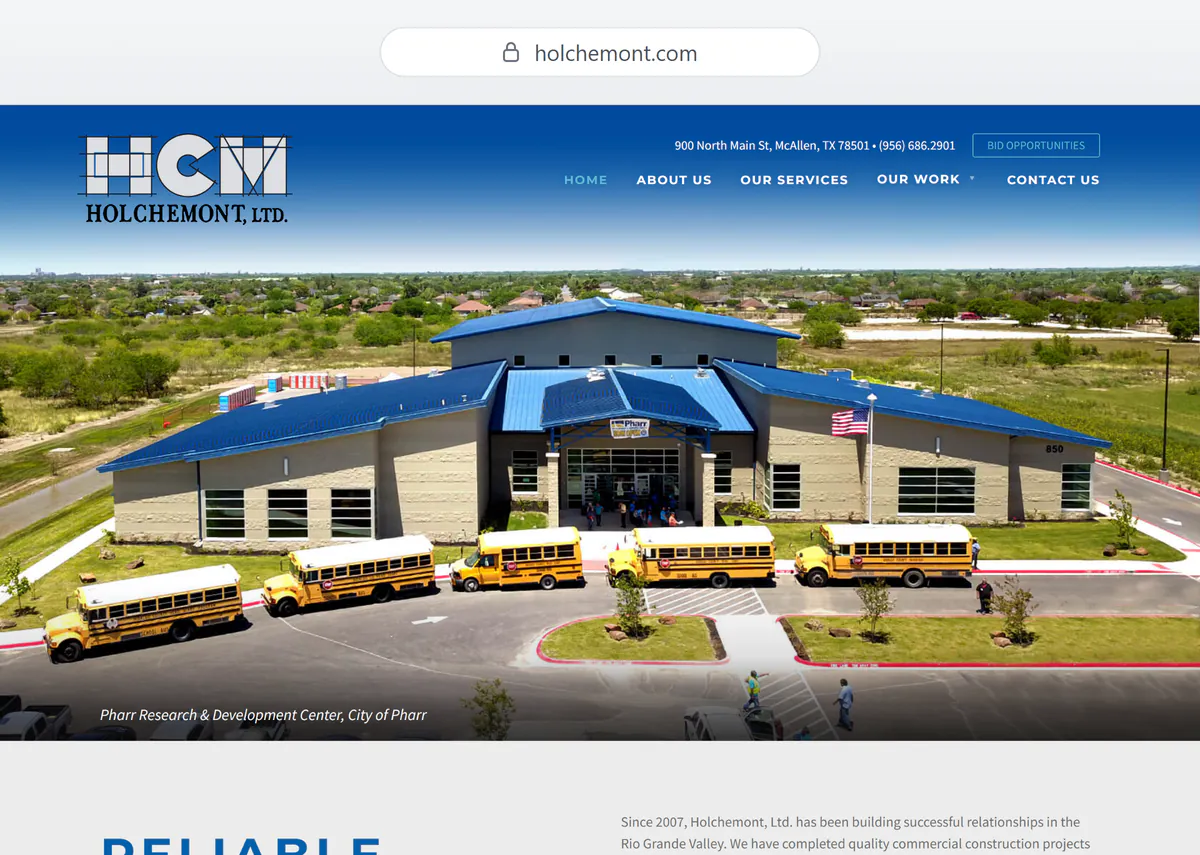 Before
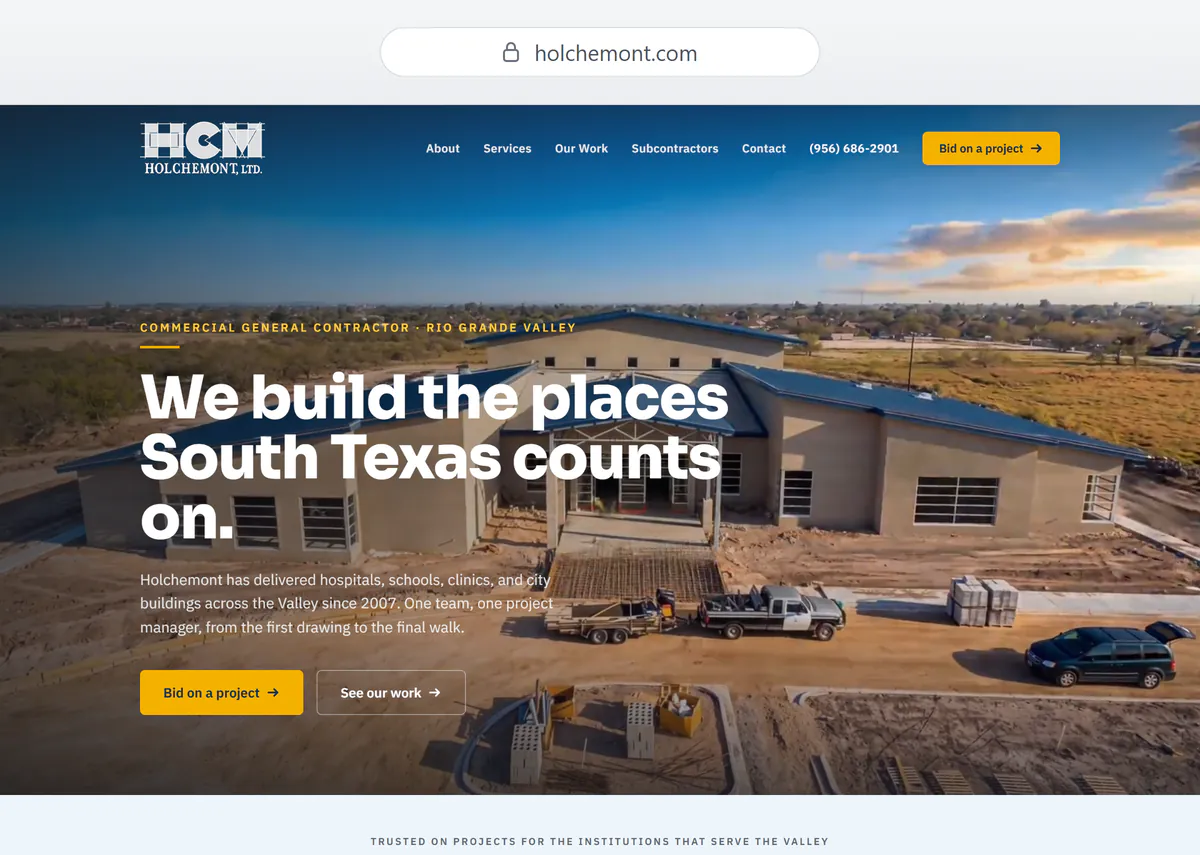 After
AfterA front door for trade partners on every page
The gold Bid on a project button sits at the end of the navigation on every page, beside the office phone number. On the homepage it appears again as the first button under the headline, ahead of See our work, and the page closes with a band written straight to subcontractors: "We are always looking for qualified subcontractors across every trade." Because the bid button lives in the header, any page can be the starting point, whether a subcontractor lands on a project page from a search result or on the About page after a referral.
The contact page keeps the two audiences apart. Its form asks whether someone is reaching out as a project owner or developer, an architect or engineer, a subcontractor, or something else, and a panel beside the form sends trade partners to the bid page to prequalify. Project inquiries and prequalifications arrive through separate forms, so each one reaches Holchemont's office with the details it needs.
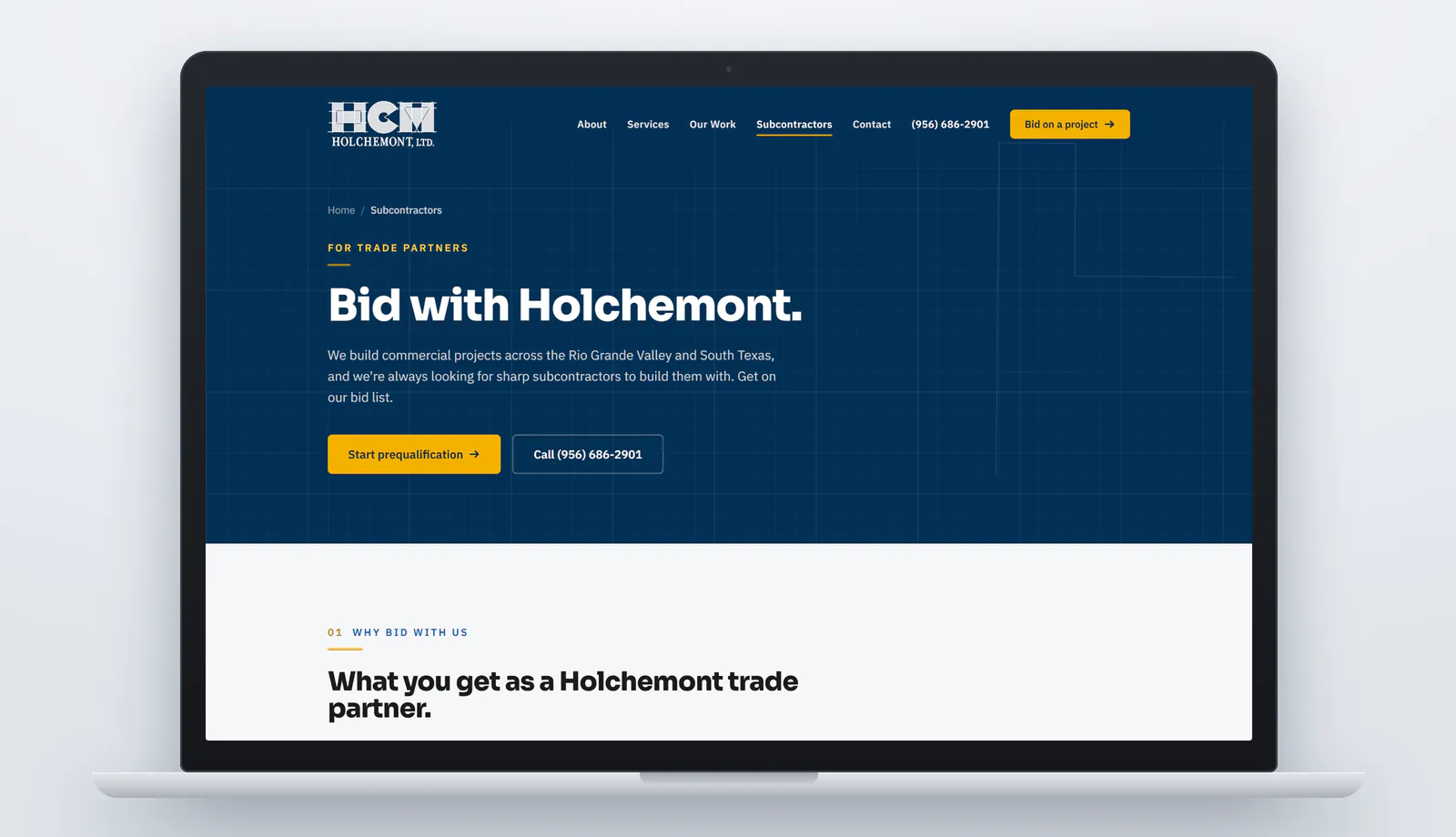
Four steps onto the bid list
Before a general contractor invites a subcontractor to bid, it usually prequalifies the company. That means confirming the company has done similar work, carries the right insurance, and works safely, and that it can be bonded when a project requires it, meaning a surety company will guarantee its work. The formal version of that paperwork is thorough. ConsensusDocs, which publishes standard construction contract documents, maintains a subcontractor statement of qualifications that runs from a company's completed projects and bonding capacity through its finances and safety program.
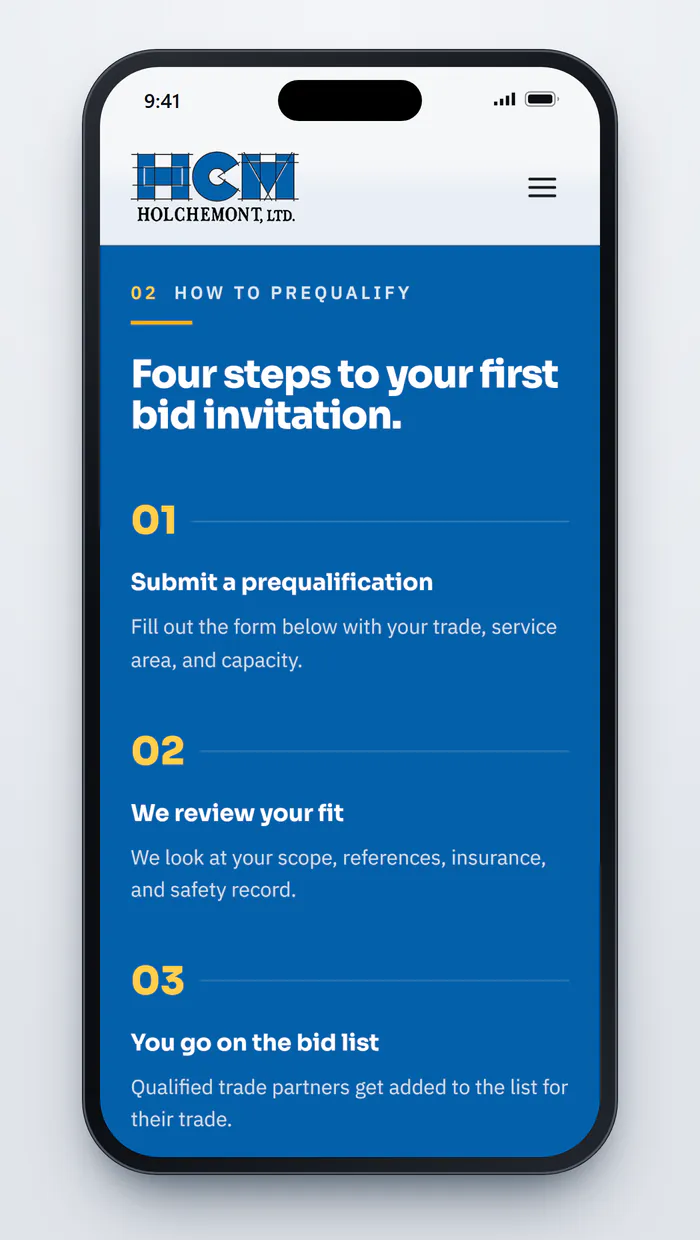
Holchemont's subcontractor page explains its own process before it asks for anything. A section titled Four steps to your first bid invitation lays out the sequence: a subcontractor submits a prequalification with its trade, service area, and capacity; Holchemont reviews its scope, references, insurance, and safety record; qualified companies go on the list for their trade; and when work in that trade comes up in their area, they get an invitation to bid. A second section, What makes a good trade partner, sets expectations plainly. Holchemont looks for a track record in the trade backed by references, general liability and workers' compensation coverage that meets project requirements, and bonding capacity for public and bonded work. It also wants crews that work safely and can document it, with the manpower to hold the dates the company commits to.
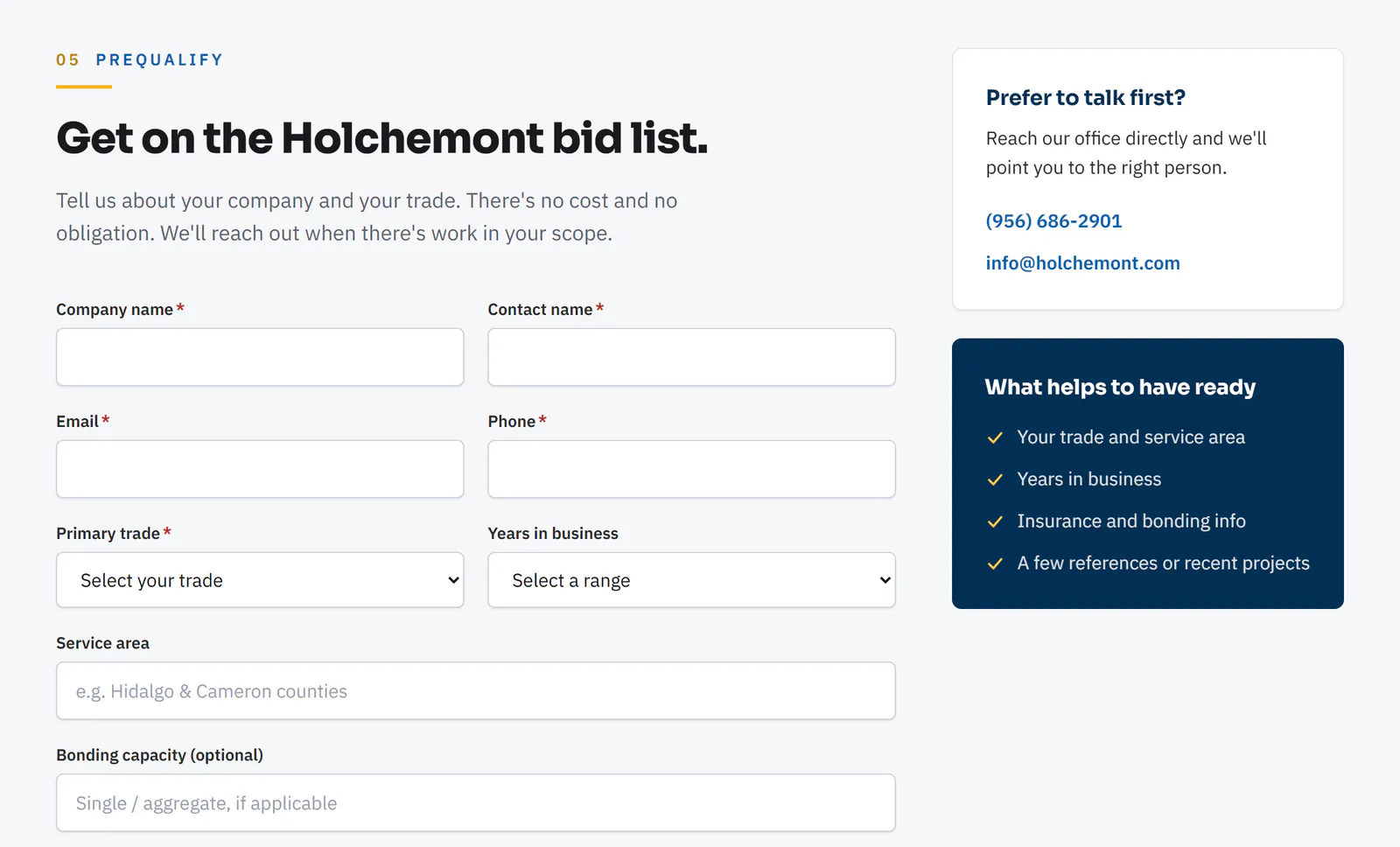
Holchemont's prequalification form collects the first layer of that information. It requires only what the office needs to reach a company and sort it by trade: a company and contact name, an email address and phone number, and a primary trade chosen from fifteen options that run from sitework and concrete to fire protection and landscaping, plus Other. Years in business, service area, and bonding capacity are optional, and a panel beside the form suggests having insurance and bonding information and a few references ready before starting. An estimator, the person at a subcontractor who prices jobs, can see what Holchemont will ask, what it checks, and what happens next before typing a word, and the form is short enough to finish between bids. The rest of the vetting happens in the review step, where Holchemont looks at references, insurance, and safety records.
The subcontractor page also makes room for open solicitations. When Holchemont has scopes out for bid (the pieces of a project that each trade prices), they appear there with the project, the trades needed, and the due date. Between solicitations, the section says so plainly, "No open solicitations at the moment," and points subcontractors to the form so they are on the list when the next job opens up. A page that stays accurate between jobs tells a trade partner the company behind it is organized.
A portfolio that speaks to owners and trade partners at once
Holchemont's Our Work page holds 21 projects, and a row of filters sorts them into healthcare, education, government and municipal, and recreation work, with a count on each filter. Every project has its own page with its location, a short description, and the full set of photos, and most pages name the owner as well.
For an owner, the Our Work page is a way to verify experience. As we wrote in Construction Portfolios RFP Committees Actually Read, the committees that review contractors' responses to a request for proposals (RFP) are looking for proof that a firm has built a project like theirs. A hospital facilities director who filters to healthcare finds work done inside hospitals that stayed open throughout, like the emergency department project at Rio Grande Regional Hospital in McAllen, carried out around a department that never stopped taking patients, and the third-floor remodel at Valley Regional Medical Center in Brownsville, built behind dust containment so the hospital could keep operating.
For a subcontractor, the same pages show the kind of work it would be bidding and the institutions behind it. Every project page ends the same way, with a blue band that asks, "Want your trade on the next one?" and a Bid on a project button beside it. The portfolio proves Holchemont's experience to one audience and recruits the other.
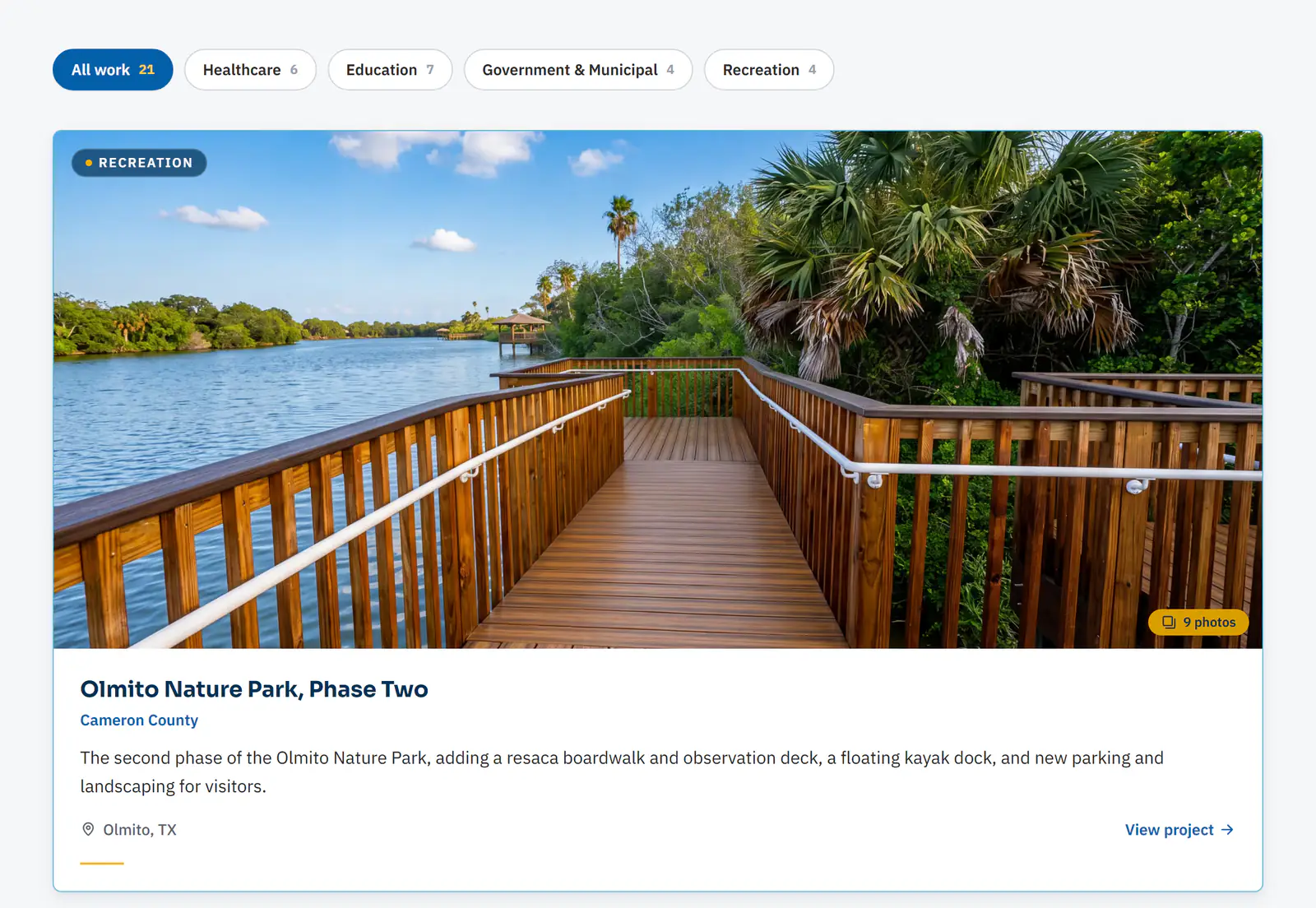
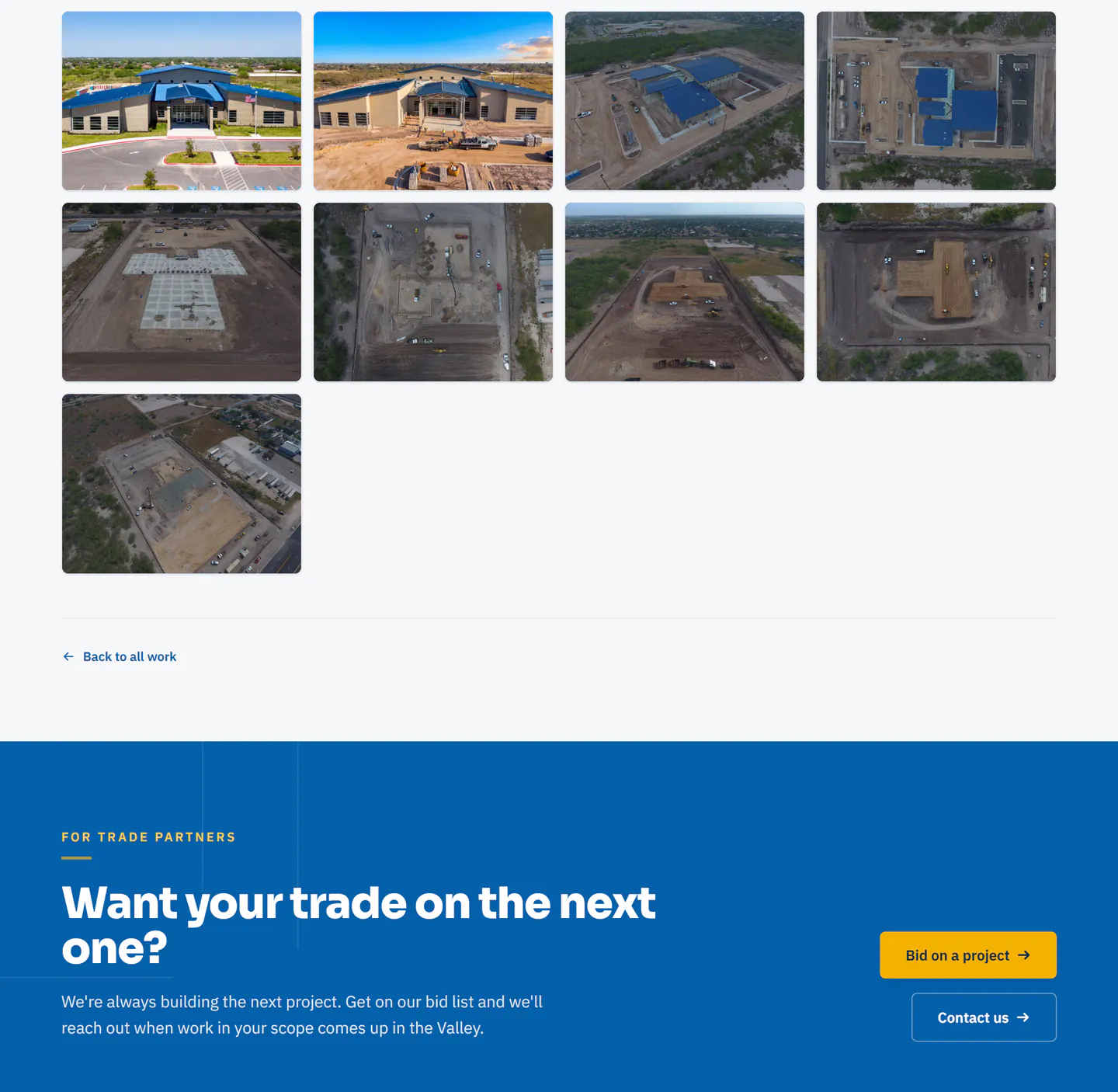
Some project pages tell the whole story of a build. The page for the City of Pharr's Development & Research Center moves from the finished entrance back through aerial photos of the building going up, all the way to the first earthwork on the site, the kind of construction-phase record our RFP piece recommends. The newest project in the portfolio opened to the public the day after the site did. On August 7, Cameron County opened the kayak launch at the center of Olmito Nature Park's second phase, set on a resaca, one of the old river channels that wind through the lower Valley. KRGV covered the opening that evening, and the county's announcement of the ceremony names Holchemont as general contractor for the phase.
The building that anchors both homepages
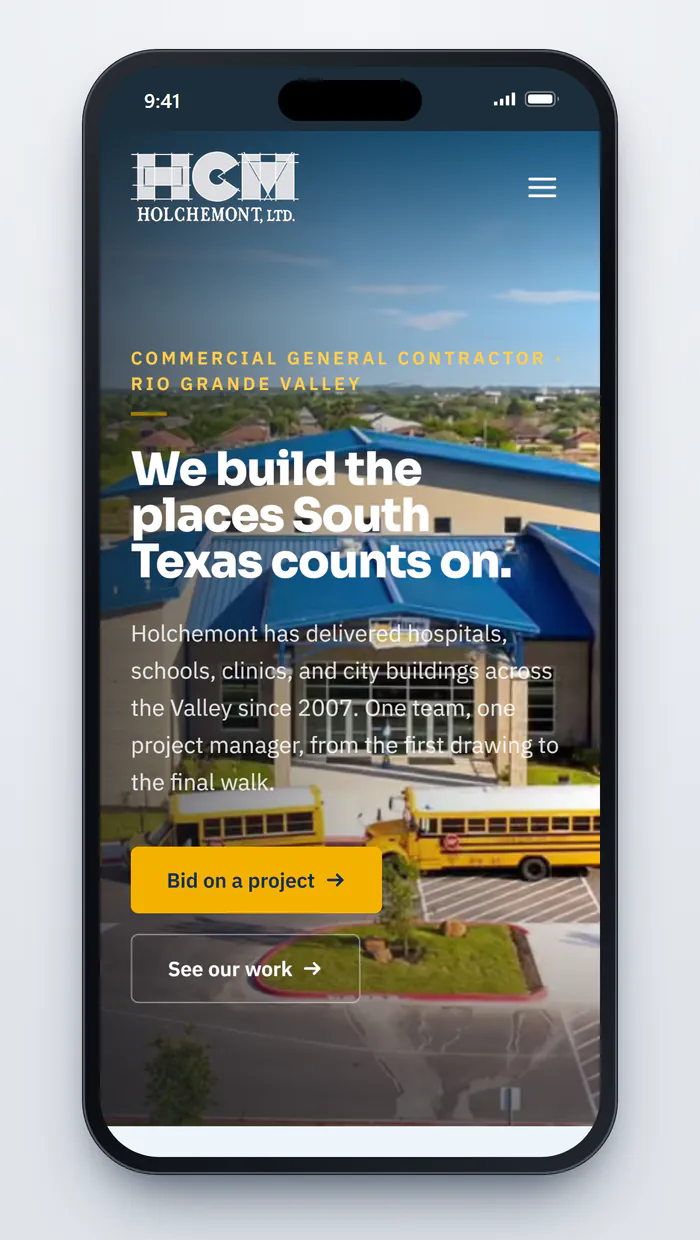
Holchemont's previous homepage opened on an aerial photo of the City of Pharr's Development & Research Center. The new homepage opens on the same building, this time in a video Holchemont supplied that follows the project from raw land through steel framing and roofing to the finished building. The first thing a visitor sees is Holchemont doing the work, and the headline over it, "We build the places South Texas counts on," says what the company does in eight words.
Much of Holchemont's brand carried over. The HCM logo and the blue and gold palette came from the previous site, along with the tagline "Reliable. Professional. Experienced." and the four pillars of the Holchemont Advantage, whose copy was tightened for the new design. The Reliability pillar still ends on a line Holchemont has used for years: "Our word is our bond." The new details come from the jobsite. A short gold line under each section heading is modeled on the survey and level lines marked on a construction site, a strip of ruler ticks divides sections, and a faint blueprint grid runs behind the dark blue page headers and the footer. Holchemont chose the typefaces itself, Sora for headlines and IBM Plex Sans for everything else.
The hero video is the heaviest file on the homepage, so it only loads on larger screens, and never for visitors who have asked their device to reduce motion. On a phone, a still photo of the finished building fills the first screen, which keeps the page quick on a cellular connection. Google's web.dev guidance says the largest image or block of text visible when a page opens should appear within 2.5 seconds, and a subcontractor checking the site from a truck between jobs is exactly the visitor that standard protects. On the two pages with forms, the spam check waits for a visitor's first tap, click, or keystroke before it loads, so it never slows down the first screen.
 Homepage
 Prequalification
Old bid links that still lead somewhere
In construction, some of the most important links to a contractor's website sit in other people's hands. Holchemont's previous site posted the plans, specifications, and addenda for projects it had out to bid (addenda are the changes issued during bidding), and links to those files are still in subcontractors' inboxes and in online plan rooms, the services where contractors post drawings and specifications for bidders. On the new site, each of those old document links forwards to the subcontractor page, so a sub who clicks one lands on the page with the bid list form.
The old Bid Opportunities address forwards to the new subcontractor page as well, old project pages forward to their new versions, and retired pages forward to the closest match. These are permanent redirects, a forwarding notice that tells search engines a page has moved for good, and Google treats them as a signal that the new address is the one to keep. The new site also kept the www address the old site used, so the links Google already knew still point to the same domain.
What other general contractors can take from Holchemont's site
Decide who the website is for, then say so on every page. Holchemont's answer was the subcontractor deciding whether to get on its bid list, and the site acts on that answer from the header down while still giving owners a clear path of their own. Most general contractors serve both audiences, and a site that gives each one its own door saves both of them time.
The second lesson is to explain the process before asking for anything. A subcontractor weighing a new general contractor is deciding whether the time it takes to apply will pay off, and Holchemont's page lays out the whole path before the first field, then stays honest about open bids between jobs. Contractors are already moving their recruiting online. In the same AGC survey, 55 percent of firms said they had added online strategies, such as social media and targeted digital advertising, to connect better with younger applicants, and a subcontractor page applies that thinking to the companies a contractor builds with.
Finally, keep what the old site earned. Holchemont's logo, its tagline, and the Pharr building that led its homepage all made the move, and so did the old links, including the bid documents trade partners still click from their email. A redesign can change nearly everything a visitor sees, and the pieces that customers and trade partners already recognize deserve the same care as the new ones.
Holchemont's website is live at holchemont.com. Built by MPC Studios.
Planning a website that has to win over project owners and trade partners alike? Let's talk.
Let's work together
Ready to take your
business further?
Tell us about your project and let's create something extraordinary together.