Website Design & Development
Five Clubs, One Front Door: Inside the Boys & Girls Club of Pharr-San Juan's New Website
September 28, 2026 · 9 min read · MPC Studios
A nonprofit's website has more jobs to do than most business sites. The same homepage has to help a family find the nearest location and its hours, show a donor where a gift goes, give a volunteer a place to sign up, and thank the local businesses that sponsor the big annual fundraiser. Most of those visitors arrive on a phone, and many arrive from a search. The M+R Benchmarks 2026 study, which tracks the online programs of 180 nonprofits, found that mobile devices accounted for 52% of nonprofit website visits, and that unpaid search still brought in 39% of all traffic.
An organization with several locations adds another layer to the job. Every site needs its address, phone number, and hours within easy reach, along with directions that open on a phone, and those details have to match everywhere they appear. The design has to stay readable, too. In its 2026 analysis of the top one million home pages, the web accessibility organization WebAIM found text with too little contrast against its background on 83.9% of them, the most common accessibility problem it detected.
The Boys & Girls Club of Pharr-San Juan serves youth and teens across Pharr, San Juan, Alamo, and the surrounding communities from five Club sites, including the new NextGen Opportunity & Career Center for teens and young adults, plus a program site inside Marcia R. Garza Elementary in Alamo. The Club's new website went live on September 25, 2026. MPC Studios built the Club's previous website as well, so we began this project with a site we knew well and a partner we have worked alongside for years.
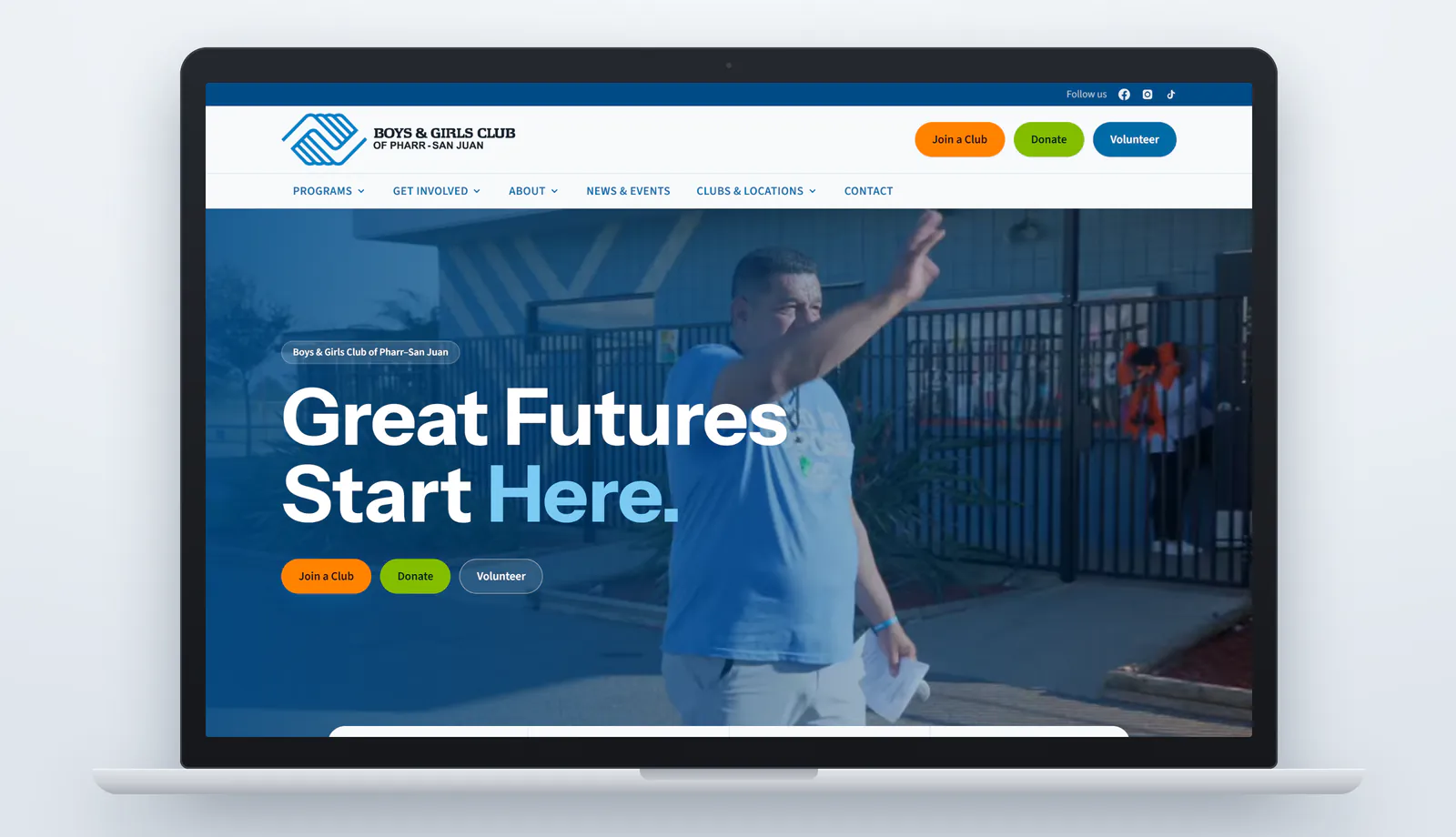
The project began with a modest request. In the spring, the Club's team asked about a new homepage video and fresh photos, and that conversation grew into a full redesign with a clear brief: keep the Club's content and its blue, orange, and green brand, give the site a warmer and more current feel that works on phones first, and make it easy for families to find a Club and enroll, and for supporters to give or volunteer. The Club had grown, too, with the NextGen center joining its locations this year.
MPC's creative director, Kate Hurry, designed and built the new site and presented the first homepage design to the Club's team in July. The words stayed the Club's own, and two rounds of notes from the Club's team shaped the final copy. At the Club's request, the site speaks of youth and teens, the phrase the Club uses for the young people it serves, and describes its service area as PSJA and surrounding areas, using the local shorthand for Pharr, San Juan, and Alamo.
A homepage that opens with three ways in
Visitors to a nonprofit's website usually arrive with one of a few goals, and the fastest way to serve all of them is to name those goals up front. Join a Club, Donate, and Volunteer sit in the header of every page in the Club's orange, green, and blue. The same three buttons appear again beneath the opening headline, Great Futures Start Here, which sits over a video of Club life.
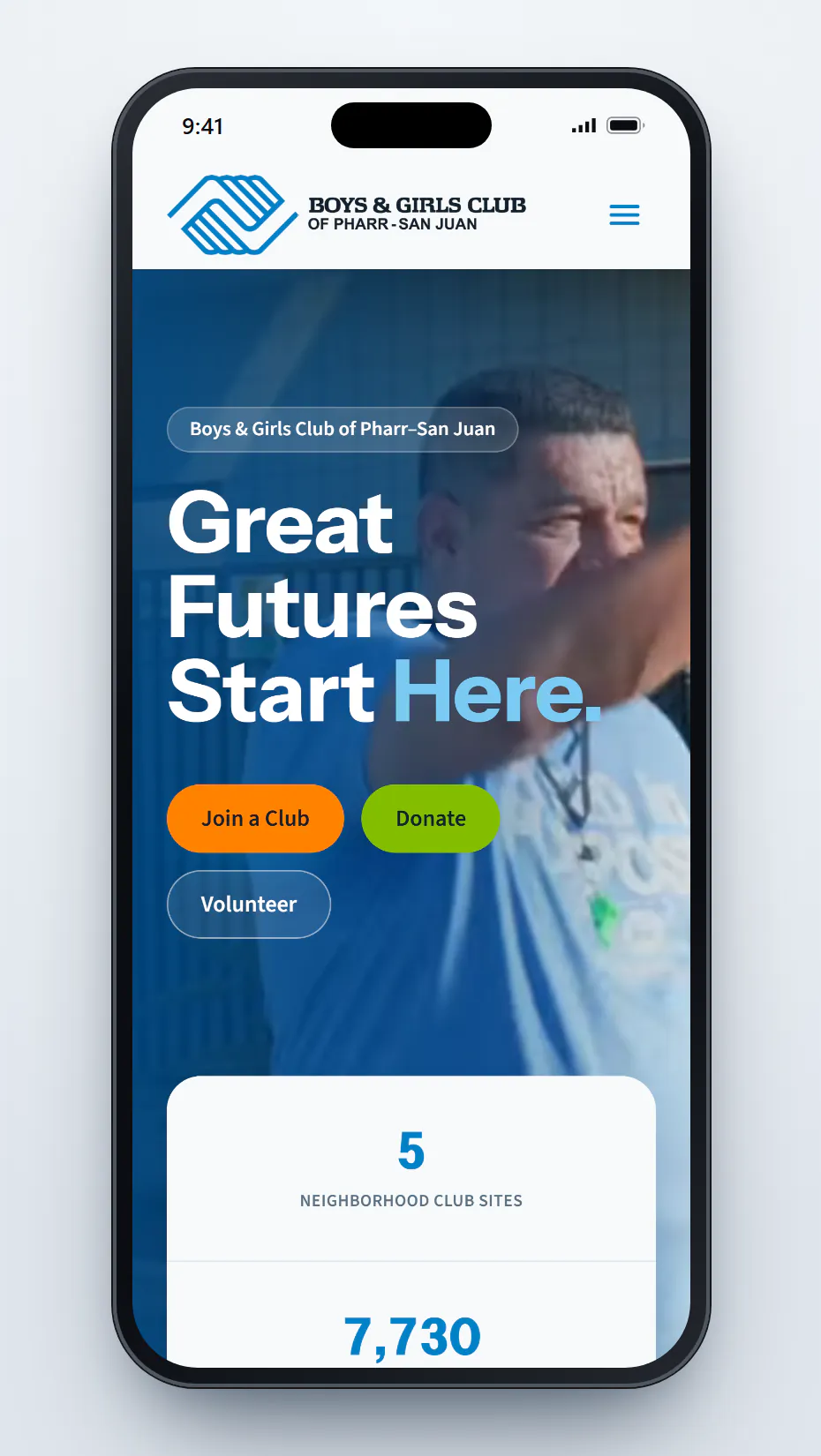
The rest of the homepage follows the order a first-time visitor tends to ask questions in. Just below the opening screen, a band of four numbers the Club chose to lead with, starting with its five neighborhood Club sites, counts up as it scrolls into view. The Club's program areas come next, each linking to a page of its own, followed by three cards under the heading Three ways to build great futures that explain the join, donate, and volunteer paths in a sentence each. The latest news and upcoming events follow, then the Club's community partners and sponsors, and the page closes with a card for every Club site.
Repeating the same three actions in the same colors on every page teaches visitors where to look. A donor who spots the green Donate button once will recognize it on the next page, and a parent looking to enroll can reach Join a Club from anywhere on the site. On a phone, the three buttons stay near the top of the homepage, and the menu repeats them as full-width buttons below the page links.
A menu that doubles as a directory
For an organization with several locations, the first practical question is usually which one is closest, and a website can answer it before a visitor clicks anything. The Clubs & Locations menu opens into a directory that shows the street address of every site, with the NextGen center and the school program site in Alamo listed alongside the Main, South Pharr, San Juan, and Valley View units.
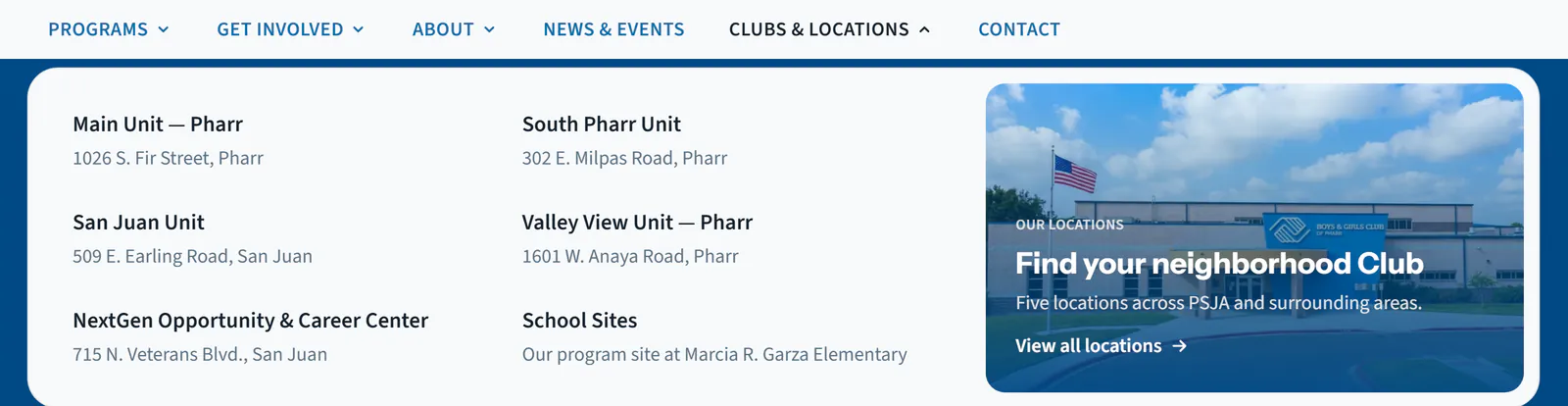
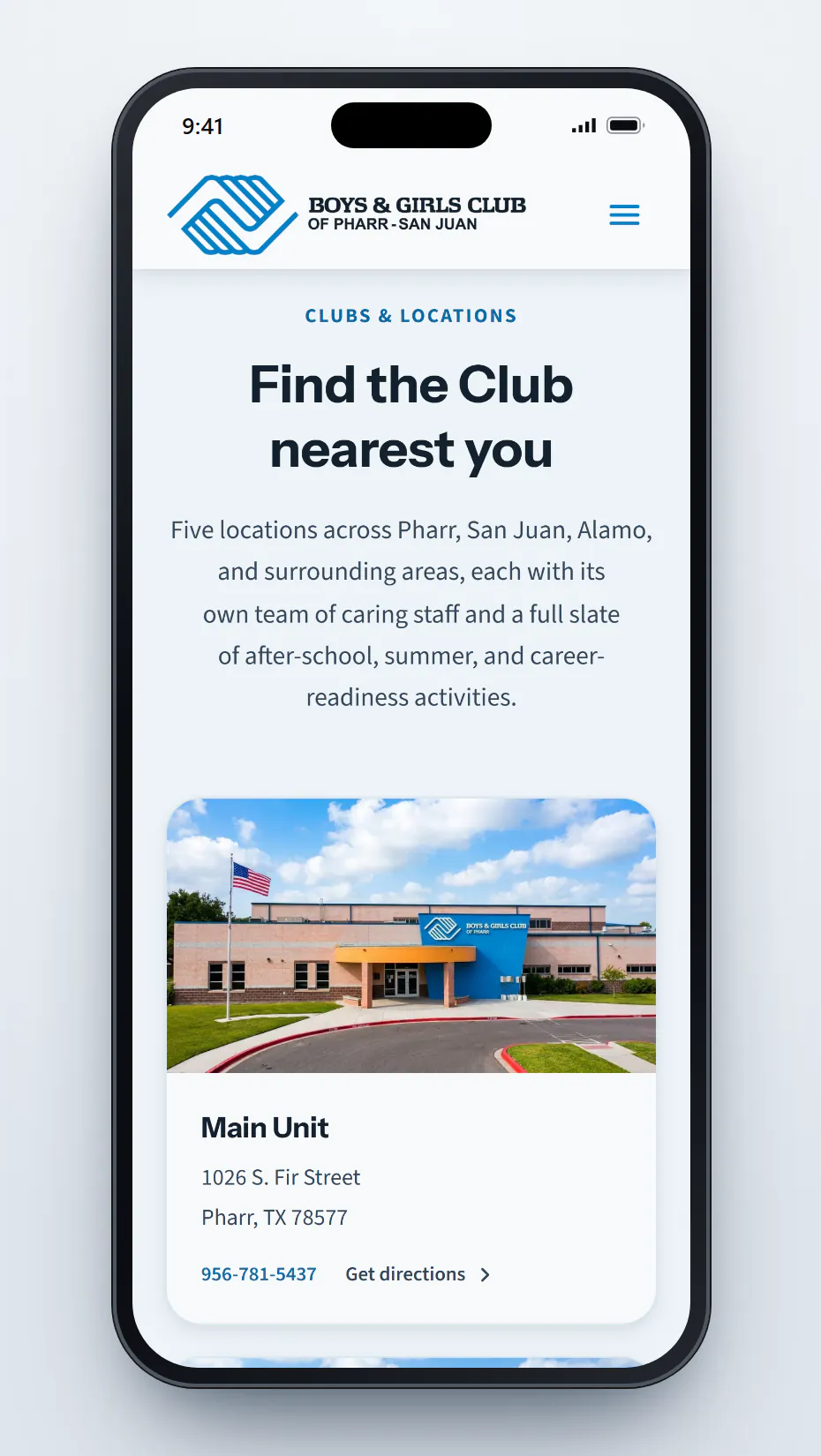
Every site also has a page of its own with its address, phone number, and an embedded Google map. Near the bottom of the homepage, a section titled Find the Club nearest you gives each site a card with a photo of the building, a phone number that starts a call with one tap, and a Get directions link that opens the address in Google Maps. The Contact page lists all five phone numbers beside a short message form.
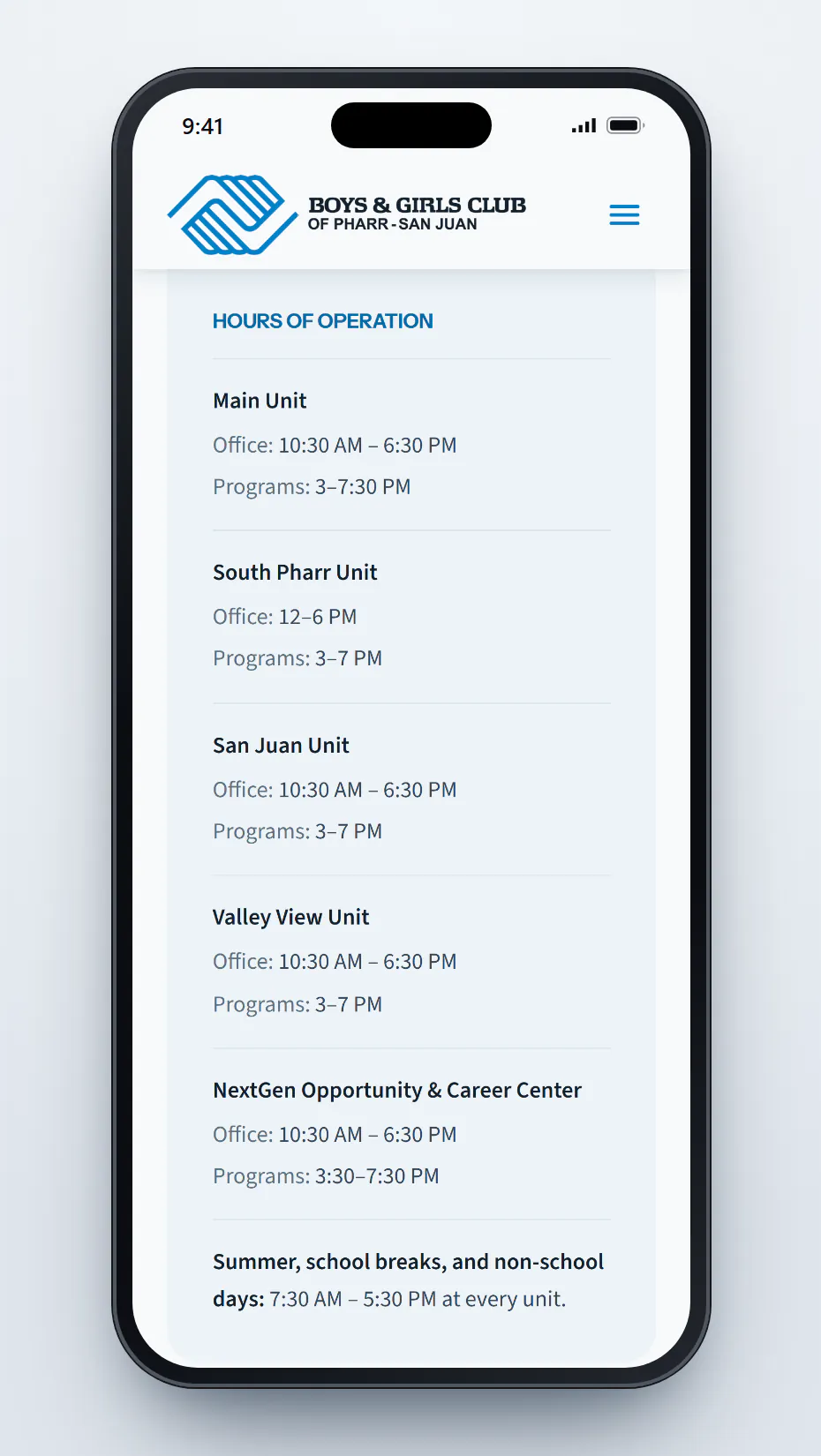
Hours live on the Join a Club page, which lists office hours and program hours for all five sites along with one schedule for summer, school breaks, and other days without school. The page also explains how enrollment works: a family prints the membership form from a Register now button and brings it to any Club to finish signing up. Under About, a Safety page sets out the Club's commitments in plain language and keeps its 24-hour hotline number in a box of its own.
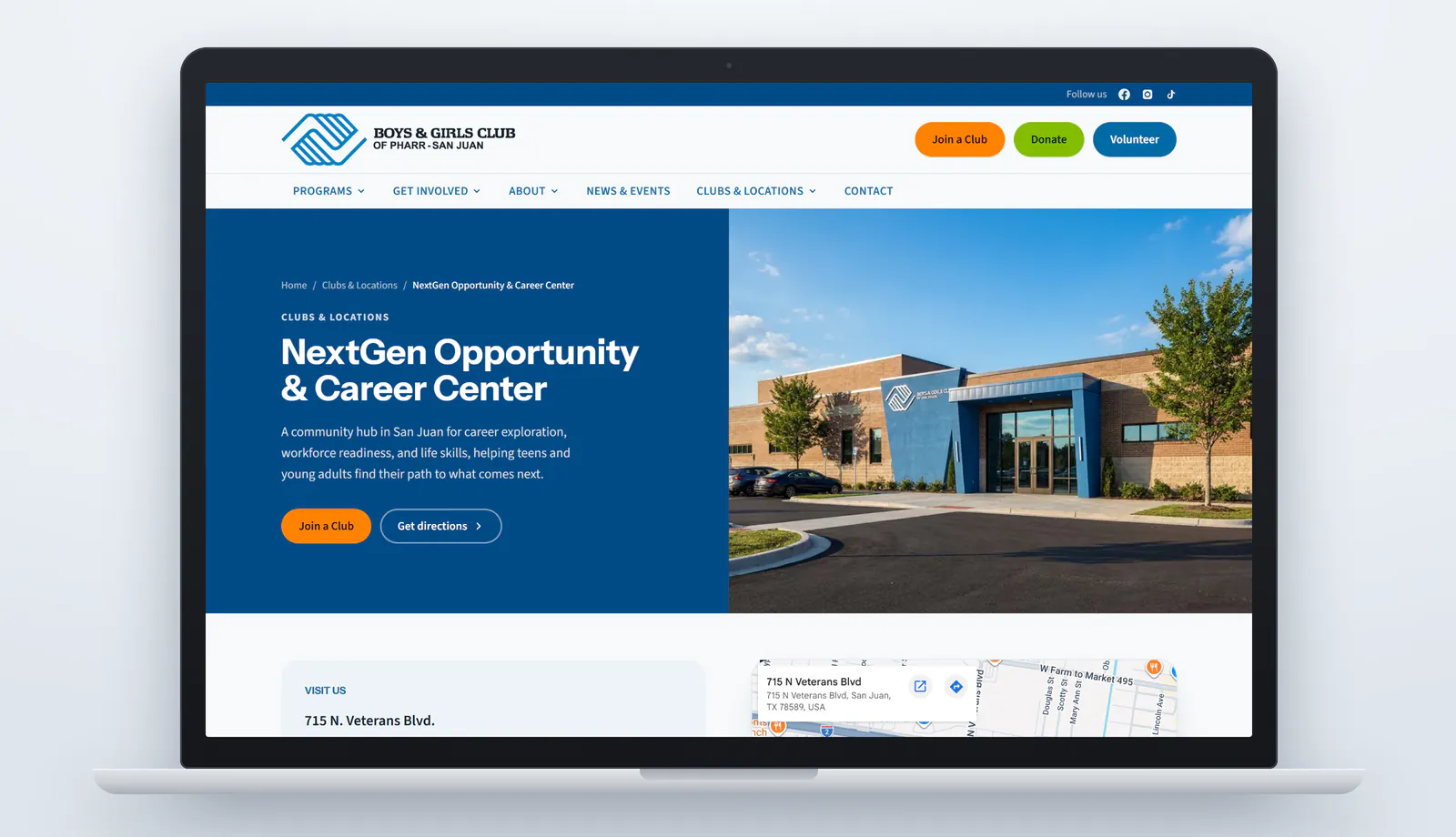
The newest site follows the same pattern. The NextGen Opportunity & Career Center page introduces the center as a community hub in San Juan for career exploration, workforce readiness, and life skills, with Join a Club and Get directions buttons beside a photo of the building and a map below. Building every location page on one layout means a family who has used one page already knows how the others work, and the next Club site can be added the same way.
Bright brand colors that stay easy to read
The Club's orange, green, and blue are bright, and bright colors take care. The Web Content Accessibility Guidelines, or WCAG, the international standard for accessible websites published by the World Wide Web Consortium, measure how strongly text stands out from its background as a contrast ratio. For regular text, the guidelines call for at least 4.5 to 1 so that people with low vision can read it comfortably.
White lettering on the Club's orange would measure only about 2.5 to 1, and on the green about 2.3 to 1, so the Join a Club and Donate buttons carry dark navy lettering, which raises them to about 6.6 and 7.2 to 1. Even the Club's signature blue comes in just under the line with white text, at about 4.2 to 1, so the Volunteer button in the header uses a deeper blue from the same family that reaches about 5.8 to 1. Where orange or green has to work as small text on a light background, the site switches to darker shades of the same colors, so labels stay readable and still look like the Club.
The buttons keep the Club's bright colors, and the lettering on them stays readable on a small screen, in afternoon sun, and for visitors with low vision.
Clear paths for donors, volunteers, and sponsors
Each of the three ways in leads somewhere useful. The Donate page carries a secure giving form right on the page for a one-time or monthly gift, notes that every dollar stays local, and ties gifts of different sizes to what each can make possible. The volunteer page lists ten ways to help, from mentoring to serving on an advisory committee, next to a downloadable application, and explains that every volunteer completes a short screening and orientation before starting. A Donate Goods & Services page covers the in-kind gifts that help, from books and educational games to sports and fitness gear and healthy snacks for the meal programs.
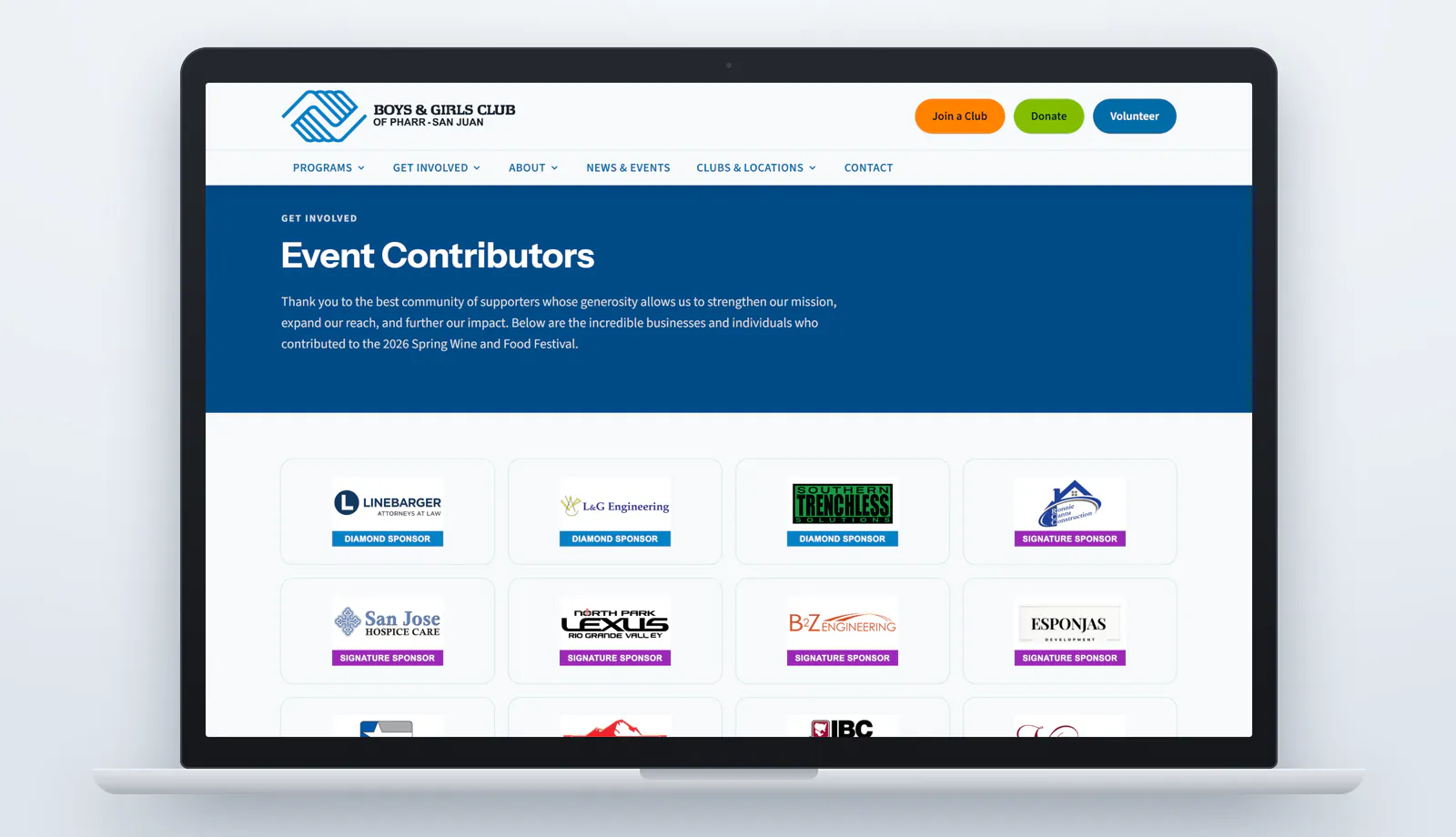
The Spring Wine and Food Festival is the Club's signature fundraiser, and the site makes room to thank the businesses behind it. On the homepage, a section titled Supporters Building Bright Futures shows the Club's 2026 sponsors, each logo marked with its sponsorship level. The Event Contributors page goes further, crediting every business and individual who contributed to the 2026 festival in order of sponsorship level, and it closes with a short form for any business that wants to support a future event.
Just above the sponsors, the homepage thanks the Club's community partners, from the national Boys & Girls Clubs of America to Hidalgo County and the City of San Juan, and every page's footer carries a Proud United Way Partner badge. A public, specific thank-you gives each sponsor something to share with its own customers, and it shows the next business owner the company they would be keeping.
A calendar and archive that keep themselves current
An events list only helps when it is current. Each event on the site carries its date, time, and location, and the homepage and the News & Events page show only the ones still ahead, soonest first. Once an event's date passes, it drops off the list on its own, so the next event is always the first one a visitor sees, and nobody at the Club has to remember to take anything down.
The Club's news archive made the move as well, with 26 posts going back to 2020 carried over under their original dates. The old site's web addresses are covered too. A redirect is a quiet instruction that sends anyone who follows an old address to its new home, and the new site has 57 of them, covering renamed pages, news posts that moved to shorter addresses, and past event pages that can still turn up in social media posts and saved bookmarks. Each one lands on the page that now covers the same thing, so a link to an old Spring festival page opens the 2026 festival, and an old Giving Tuesday link opens the Donate page.
Built to be found, and careful with visitors
Some of the most useful work on a website never shows on the screen. Behind its pages, the site carries structured data, labels in the code that tell search engines exactly what they are looking at. The Club is described as a nonprofit organization, each Club site is listed with its own address, phone number, and map, and each event carries its date, which gives Google accurate details to show when someone searches for a Club by name. With unpaid search still bringing in 39% of nonprofit website visits in the M+R study, that groundwork matters.
The site also asks before it tracks. A consent banner lets each visitor accept or reject analytics cookies, and the analytics tools load only after someone agrees to them. The three forms, for general contact, event sponsorship, and the newsletter, screen out spam with Google's reCAPTCHA check, a hidden field that only automated bots fill in, and a limit on repeated submissions, which keeps junk submissions out of the Club's inbox. Photos are delivered in modern image formats that load quickly on a phone connection.
What other nonprofits can learn from this site
Start with the questions visitors bring, and answer them where visitors already look. For a nonprofit with more than one location, that means addresses in the main menu, a page for every site with its phone number and a map, and one clear list of hours. Give each audience a path of its own as well, and keep those paths in the same place and the same colors on every page, so a donor, a volunteer, and a parent can each find the next step without having to learn the site first.
A brand's brightest colors can stay front and center as long as the text on them has enough contrast to read, and checking that takes minutes during design. The same care belongs in the parts of a site nobody sees, like structured data that describes each location to search engines, a consent banner that asks before tracking, and forms that keep spam out.
Finally, let the site keep itself current wherever it can. Events that drop off the calendar on their own and old links that forward to the right page keep a website accurate without adding work for a small staff whose time belongs with the organization's programs. For the Boys & Girls Club of Pharr-San Juan, the result is a website that works as a front door for every audience the Club serves and stays in order between updates.
The Boys & Girls Club of Pharr-San Juan's website is live at pharrkids.org. Built by MPC Studios.
Working on a website for a nonprofit with more than one location? Let's talk.
Let's work together
Ready to take your
business further?
Tell us about your project and let's create something extraordinary together.