If you run a professional membership organization, when was the last time a potential member visited your website and thought, “These people have it together”?
For a lot of associations, the answer is uncomfortable. The organization itself might be excellent, the events packed, the members loyal. But the website tells a completely different story if it looks like it hasn’t been updated since the early 2000s. And in a world where 76% of association members now expect a personalized, modern digital experience (according to the 2026 Membership Performance Benchmark Report from iMIS), that gap between what an organization actually is and what its website says about it is becoming a real problem.
The General Practice, Solo & Small Firm Section of the State Bar of Texas (GP Solo for short) is a perfect example. For over four decades, they’ve been the go-to community for solo practitioners and small firm attorneys across Texas, providing CLE programs, advocacy, networking, and practical resources to more than 500 members. Their reputation in the Texas legal community is solid. But their previous website didn’t reflect any of that. It looked dated, it was hard to navigate, and it wasn’t doing the organization justice when prospective members came looking.
We rebuilt the entire site on Webflow with a Brilliant Directories integration, and the project became a useful case study in what it takes to modernize a membership organization’s digital presence without losing the substance that makes it valuable.
The membership website problem nobody talks about
Here’s what makes association websites uniquely difficult: they have to do about five different jobs at once, and most of them are invisible to the people who run the organization.
A membership site needs to attract new members who are evaluating whether to join. It needs to serve existing members who log in regularly for resources and events. It needs to give leadership (in this case, the GP Solo Council) a way to manage communications and governance. And it needs to present a credible public face to the broader legal community. Most association websites were built to do one of these things passably and the rest not at all.
The 2026 Membership Performance Benchmark Report found that 62% of membership organizations are seeing increased new-member rates this year, but the organizations achieving that growth are the ones investing in their digital infrastructure, not just their programming. Member engagement is at 82% among organizations that prioritize digital experience, up from 67% just two years ago (iMIS, 2026). The website has become the front door, the member portal, and the recruitment tool all at once.

Start with what members actually need to do
The biggest mistake most association websites make is organizing content around the organization’s internal structure. You end up with navigation that mirrors the org chart instead of reflecting what visitors are actually trying to accomplish.
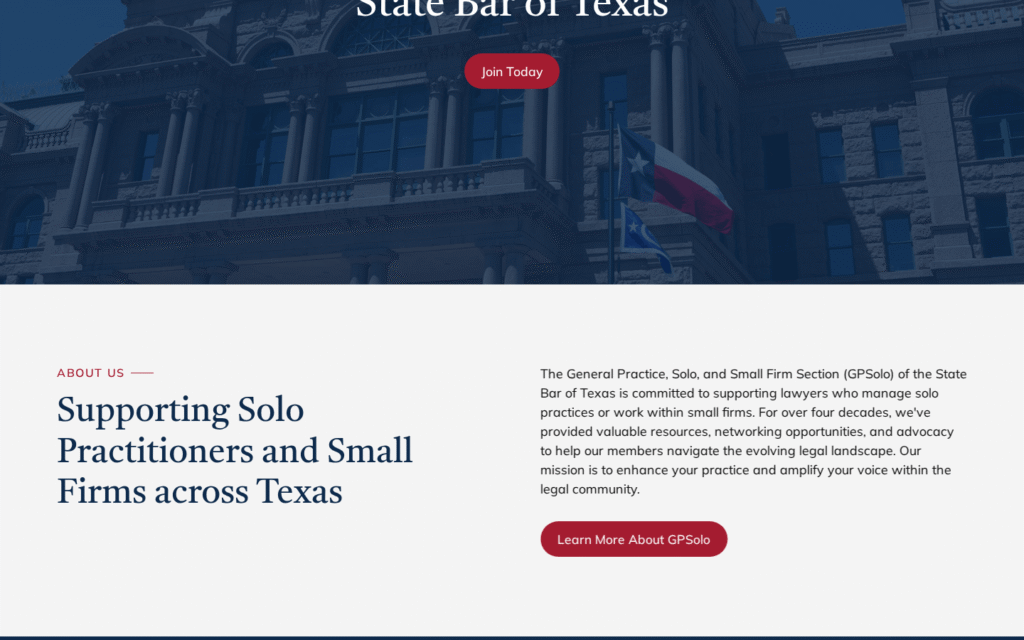
GP Solo’s new site leads with five clear navigation items: Home, About, Membership, Events, and The Docket (their blog/news section). A prominent “Join Today” button sits in the header on every page, and the homepage immediately gives visitors two clear paths: learn about the organization, or take action and join.
Below the hero, the About section provides a concise explanation of who GP Solo is, what they do, and who they serve. The language is straightforward: they support solo practitioners and small firms across Texas, and they’ve been doing it for over 40 years. No “synergizing legal practice management outcomes” anywhere in sight.
This clarity matters more than people realize. According to the same iMIS benchmark report, organizations that implement clear digital onboarding pathways see 10-15% better retention rates, in part because members who understand what they’re getting into from the start tend to stick around longer.
The member directory challenge
This was the most technically complex part of the project, and arguably the most important. GP Solo’s membership directory needed to let 500+ attorneys create and manage their own profiles, display their areas of practice and contact information, and be searchable by other members. It also needed to be password-protected so that member data stayed private.
We integrated Brilliant Directories into the Webflow site to handle this. Brilliant Directories is a platform built specifically for membership organizations, and it gave us the ability to create a searchable, filterable directory where members can manage their own profiles without needing the GP Solo team to update everything manually.
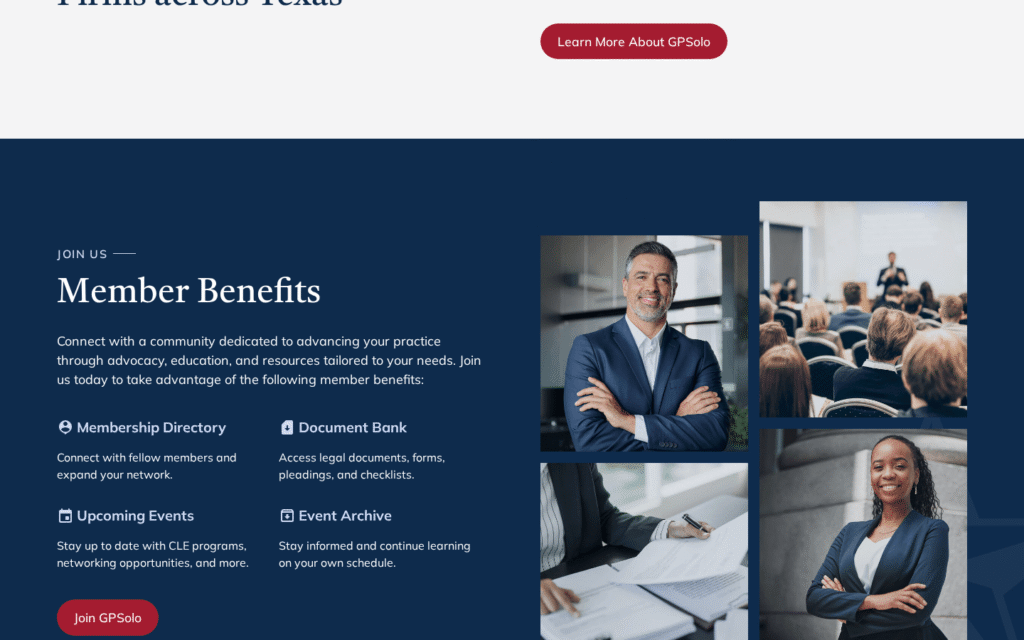
The directory also powers the members-only content area, where GP Solo hosts their Document Bank (shared legal documents, forms, and checklists contributed by members), their Resource Library, and their Event Archive. All of this content is gated behind a login, which means the value of membership is tangible and protected. A prospective member can see that these resources exist, but they need to join to access them.
For any membership organization considering a website rebuild, this is worth thinking about carefully. The member directory is often the single most valuable thing on a membership site, because it turns a passive website into an active professional network.
Events and continuing education front and center
For attorneys, Continuing Legal Education (CLE) is mandatory. The State Bar of Texas requires it. So for GP Solo, events and CLE programming are core to the entire value proposition.
The new site dedicates prominent homepage real estate to two things: Upcoming Events and the Event Archive. Current members can quickly find what’s coming up, and prospective members can browse past events to see the quality and relevance of the programming before they commit to joining.
This dual approach, showing both what’s next and what’s already happened, is something we recommend for any organization that runs regular programming. Upcoming events create urgency while past events create credibility. Together, they answer the question every potential member is asking: “Is this organization actually active, or is it just a name on paper?”
The Docket: content that builds community
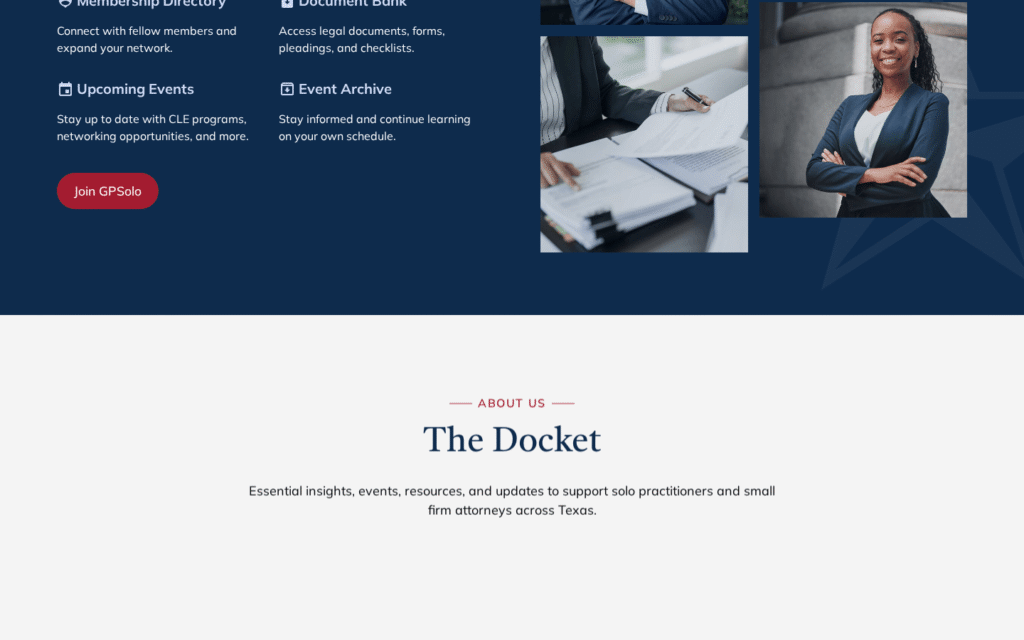
GP Solo’s blog section is called “The Docket,” which is a nice touch because it uses language attorneys already know. The section is positioned as a source of insights, events, resources, and updates for solo and small firm attorneys.
Content sections like this are where a lot of association websites fall flat. They either have no blog at all, or they have one that was last updated eight months ago. GP Solo has the infrastructure in place to publish regularly, and the CMS (powered by Webflow) makes it easy for their team to add new posts without needing a developer.
For SEO, this matters significantly. Google rewards websites that publish fresh, relevant content on a consistent basis. An association blog that covers real issues facing solo attorneys, whether it’s practice management, new regulations, or technology adoption, can become a genuine search engine asset over time. And every article that ranks well becomes a free recruiting tool, because it puts GP Solo in front of attorneys who might not have known the organization existed.
Council governance built into the site
One detail that’s easy to overlook but important for any organization with a governing board: GP Solo’s new site includes dedicated sections for their Council members and council-specific content. This gives leadership a professional digital home for governance materials, meeting resources, and section policies.
Most associations handle this through email chains or shared drives. Having it built into the website makes it more accessible and signals to members that the organization takes its governance seriously.
What other membership organizations can learn from this
The legal profession is going through a significant technology shift. The ABA’s 2025 Legal Technology Survey found that technology adoption among small firms has roughly doubled in the last two years, with 53% of small firms now using some form of generative AI in their practice. Attorneys are increasingly comfortable with digital tools, and they’re bringing those expectations to every organization they interact with, including their bar associations and professional sections.
Here’s what we took away from the GP Solo project that applies to any professional membership organization.
Your website is your strongest recruitment tool. 62% of membership organizations saw increased new-member rates in 2026, and the common thread among them is a modern, well-organized digital presence. If your site doesn’t clearly communicate what you offer and make it easy to join, you’re leaving members on the table.
For professional associations, the member directory is often the single biggest reason people join. The ability to find and connect with peers turns an abstract membership into something practical and worth renewing. Invest in making it searchable, up-to-date, and easy to use. Gated content (a Document Bank, a Resource Library, an Event Archive) reinforces this by giving members tangible benefits that non-members can see but can’t access.
If events are central to your value proposition, put them on the homepage. Don’t bury the calendar three clicks deep. And a blog or news section that gets updated regularly keeps current members engaged while attracting new visitors through search, which is one of the most cost-effective recruiting tools available to any association.
—
The GP Solo website is live at gpsolo.com. Built on Webflow with Brilliant Directories integration by MPC Studios, serving the General Practice, Solo & Small Firm Section of the State Bar of Texas.
Running a membership organization, bar association section, or professional community that needs a better digital home? Let’s talk