If you’re a manufacturer in the U.S. thinking about moving operations closer to home, your first interaction with a Mexican border city is almost certainly going to be a website. Not a phone call or a handshake at a trade show. A website.
That’s a problem for most economic development organizations, because their websites tend to read like government brochures: heavy on statistics nobody can verify, light on anything that helps a real decision-maker figure out what to do next. The result is a site that looks like it was built by a committee (because it was) and doesn’t give investors any reason to pick up the phone.
The nearshoring trend is real and significant. Mexico attracted over $40 billion in foreign direct investment in 2025, a 10.8% year-over-year increase, with border states like Tamaulipas accounting for a major share of manufacturing exports (Mexico Business News, 2026). But the organizations promoting these regions are often working with websites that were built for a different era, when “having a web presence” was enough.
CODEM (the Comité para el Desarrollo Económico de Matamoros) is an exception. We recently built their new website on Webflow, and the project became a case study in what it looks like when an economic development organization’s digital presence actually matches the scale of what it’s promoting.
The challenge: making a city credible to people who may never visit
CODEM is a membership-based nonprofit that’s been promoting Matamoros’ industrial development since 1989. Their members include industrial park operators, customs brokers, logistics companies, legal advisors, financial institutions, and manufacturing consultants across the Matamoros-Brownsville corridor.
The organization had a website before, but it wasn’t doing the one thing it needed to do: convince a site selector in Chicago or a manufacturing VP in Detroit that Matamoros deserves serious consideration alongside better-known nearshoring destinations like Monterrey or Querétaro.
This is a unique design challenge. Unlike a bank website or a law firm site where the visitor already knows what industry they’re looking at, an economic development website needs to answer a much bigger question: “Why here?” And it needs to answer that question for audiences ranging from Fortune 500 logistics directors to local businesses considering CODEM membership.
Live data that proves the site is alive
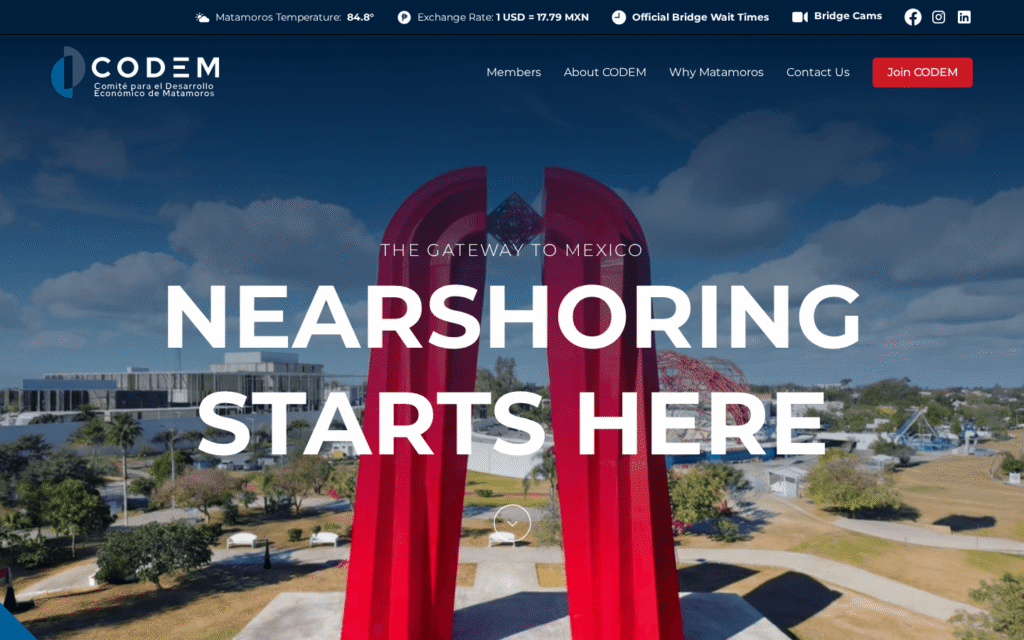
The most distinctive feature on CODEM’s homepage is the live data bar across the top of every page. It shows the current temperature in Matamoros, the real-time USD to MXN exchange rate, official bridge wait times, and links to live bridge cameras.
This might seem like a small detail, but it’s doing something important. For anyone evaluating a border city for manufacturing or logistics operations, these are the daily realities of doing business there. Bridge wait times affect supply chain planning, and exchange rates affect labor cost calculations. By putting this information front and center, the site communicates something that a static brochure never could: this region is active, connected, and transparent about the practical details that matter.
It also solves a credibility problem that plagues many economic development websites. When a site shows live, real-time data, visitors know the organization is paying attention and keeping things current. A site with data from 2022 tells a very different story.
The Gran Puerta: turning a local landmark into a brand anchor
The hero section features a striking image of the Gran Puerta de México, a monumental red sculpture that serves as a gateway symbol for Matamoros. The headline “NEARSHORING STARTS HERE” is bold and specific, which is exactly the right approach for this kind of site.
Most economic development websites try to say everything at once: “We have great infrastructure AND low costs AND a skilled workforce AND quality of life AND government support AND…” The result is that nothing lands. CODEM’s homepage leads with a single, clear positioning statement and a single visual anchor, and then expands into supporting content below.
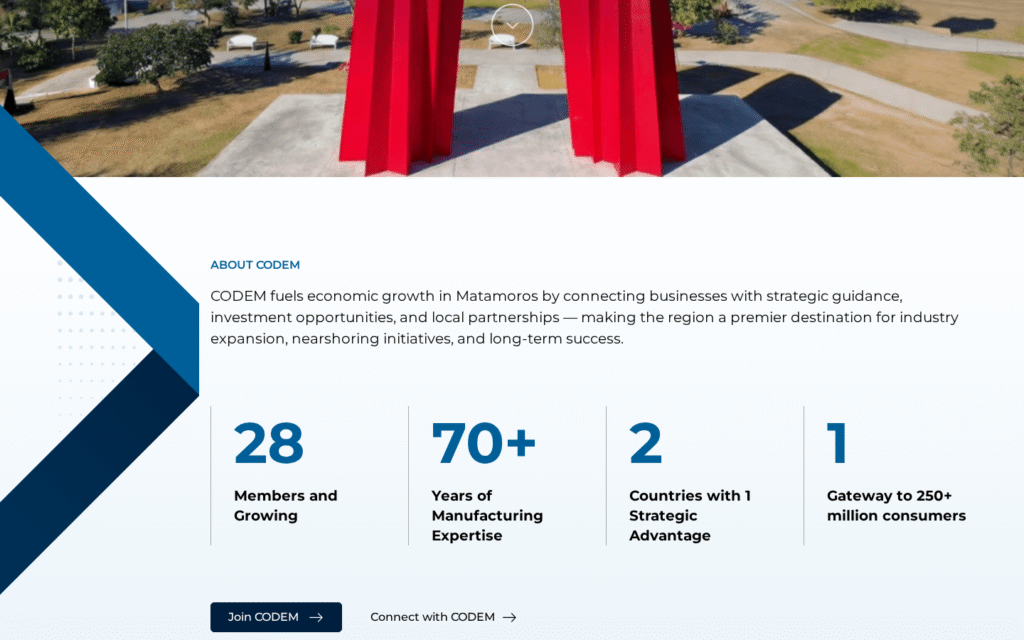
The About CODEM section beneath the hero provides context without overwhelming. The stats bar (28 members, 70+ years of manufacturing expertise, 2 countries with 1 strategic advantage, 1 gateway to 250+ million consumers) gives visitors concrete numbers to hold onto. These are specific enough to be meaningful, which is rare for this kind of site.
Why Matamoros: making the case without a data dump
One of the early challenges in this project was that CODEM originally wanted to include extensive regional economic data, the kind of detailed manufacturing statistics, workforce breakdowns, and infrastructure inventories that you’d find in a traditional economic development report. That content is valuable, but it wasn’t realistic to gather and maintain, and it’s not what a first-time visitor needs to see.
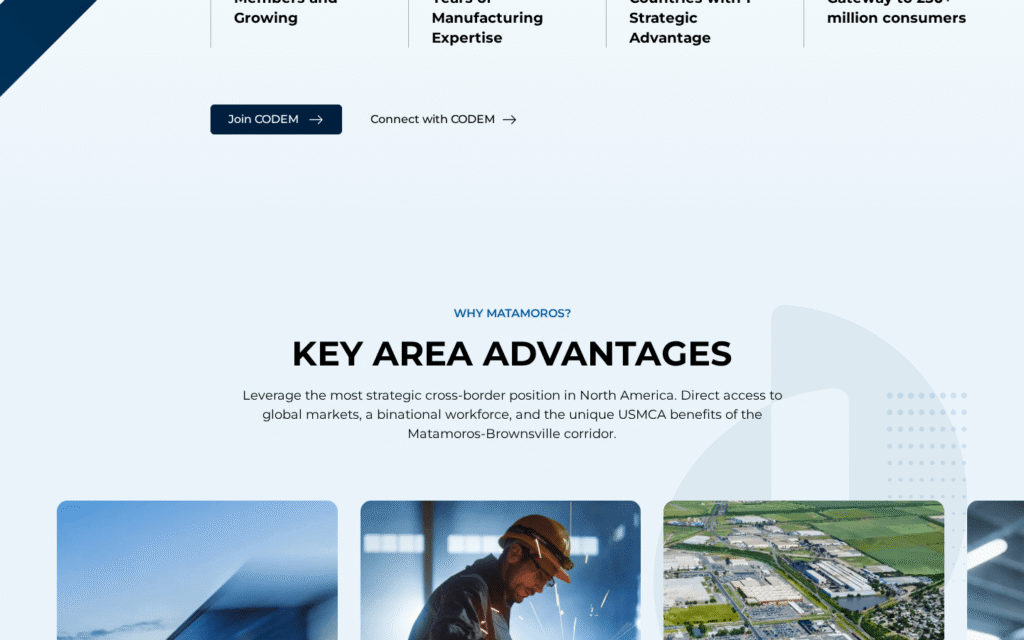
Instead, we built a “Why Matamoros?” section that presents the region’s advantages through a visual carousel of cards: Strategic Nearshore Location, Skilled and Competitive Workforce, Industrial-Ready Infrastructure, and Pro-Business Environment. Each card uses a strong image and a concise explanation.
This approach respects how people actually evaluate locations. A site selector doesn’t need to see every data point on the homepage. They need to quickly understand the headline-level value proposition, and then have a clear way to learn more or get in touch. The detailed conversations happen over email and in meetings, not on a web page.
The member directory as the product
CODEM’s members are the real value proposition. These are the industrial park developers, customs brokers, logistics companies, and professional service firms that actually make manufacturing in Matamoros work. The member directory is the centerpiece of the entire site.
The homepage displays member logos in a clean grid with a “View Membership Directory” button leading to the full directory. Each member gets their own profile page with company information, services, photos, contact details, and social media links. The profiles are searchable and filterable by industry sector, so a site selector looking specifically for logistics partners or industrial park operators can find what they need quickly.
This design decision came out of a practical realization during the project: CODEM’s greatest asset is the network of experienced professionals who have been operating in this market for decades. Any city can compile statistics, but not every city has this kind of established, connected business community. The website’s job is to put that network on display in a way that makes it easy for investors to connect with the right people.

Designing for an international audience
A detail that’s easy to overlook but critical for this kind of site: CODEM’s audience is genuinely international. The primary visitors include American manufacturers, international site selectors, Mexican business owners, and government officials on both sides of the border.
This affected design decisions in several ways. The visual design uses a clean, corporate aesthetic that reads as professional in both U.S. and Latin American business contexts. The language is in English (since the primary target audience is U.S.-based companies evaluating Mexico for nearshoring), but the organization name and key cultural elements remain in Spanish to maintain authenticity. The navigation is stripped down to five items (Members, About CODEM, Why Matamoros, Contact Us, and Join CODEM) to minimize confusion for visitors who may not be familiar with Mexican economic development structures.
The “Join CODEM” button appears prominently in the header as a red call-to-action on every page. For a membership-based organization, recruitment is always happening, and the website needs to make joining feel accessible regardless of whether the visitor is a Matamoros-based business or a Houston-based logistics firm.
What economic development organizations can learn from this
The nearshoring trend isn’t slowing down. Mexico’s product exports are projected to grow 6-6.5% annually through 2026, and border manufacturing regions are seeing sustained demand (Mexico Business News). But the organizations promoting these regions are competing for attention against dozens of other cities and states with their own websites and their own pitch decks.
Here’s what we took away from this project.
Live data builds instant credibility. Showing real-time bridge wait times and exchange rates is a small technical investment, but it communicates currency, relevance, and transparency in a way that static content can’t match. For economic development organizations especially, proving your site is alive and current goes a long way with decision-makers who’ve seen too many stale government pages.
A single clear positioning statement (“Nearshoring Starts Here”) does more than ten bullet points about infrastructure, workforce, and incentives. And the member directory is often more persuasive than anything else on the site, because it shows investors who they’d actually be working with on the ground. Invest in making those profiles rich, searchable, and prominent.
Finally, keep the calls to action simple. “Join CODEM” and “Connect with CODEM” are low-friction entry points that start conversations rather than trying to close deals. Economic development websites are often designed by committees of stakeholders who each want their section front and center. The best sites cut through that and focus on what the investor actually needs: a reason to believe, and a clear way to reach out.
—
CODEM’s new website is live at codem.org. Built on Webflow by MPC Studios, serving the Matamoros Economic Development Committee and the Brownsville-Matamoros industrial corridor.*
Building a website for an economic development organization, international nonprofit, or membership-based business group? Let’s talk