When someone in Canonsburg, Pennsylvania wants to plan a Friday night out, a kid’s birthday party, or a Tuesday family outing, they’re going to pull out their phone and start searching. They’ll look at a few options, skim a few websites, and make a decision in about 90 seconds. That’s the reality for any family entertainment center in 2026: your website is usually the first impression, and for a lot of potential customers, it’s the only one you get before they choose somewhere else.
According to Mordor Intelligence, the global bowling center market is expected to grow steadily through 2031, driven largely by venues that combine bowling with arcades, food, and social experiences. The standalone bowling alley is giving way to the multi-activity entertainment destination, and the venues winning that shift are the ones whose digital presence communicates the full experience before anyone walks through the door.
Paradise Pike in Canonsburg, PA is one of those venues. A family-owned bowling center, arcade, and party destination with a full bar and kitchen, Paradise Pike has been a fixture in the community since 1999. Until recently, the business was operating under a different name, on an older web platform, with a digital presence that was ready for an upgrade to match everything the venue had become. The new site, built on Webflow by MPC Studios, launched on March 31, 2026, the same day as the physical rebrand.

From West Pike Bowl to Paradise Pike
Paradise Pike is the sister property of Paradise Island Bowl on Neville Island, both owned and operated by Ian McWilliams and Richard Cardimen. When the ownership team decided to rebrand their Canonsburg location from West Pike Bowl to Paradise Pike, the website was a central piece of the rollout. The existing website ran on DNN (DotNetNuke), a platform from an earlier era of web development, and the rebrand was the right moment to build something new from the ground up.
MPC Studios had already built the Paradise Island Bowl website in Webflow, and the relationship actually traces back further than that. All American Bowling Equipment, a long-time MPC client that builds custom bowling lanes and duckpin lanes for homes and businesses, originally referred Paradise Island Bowl to MPC. When the results were strong enough that the owners came back for a second website for their second location, it was the kind of referral chain that speaks for itself.
The project moved fast. From the initial kickoff meeting on March 4 to launch day on March 31, the MPC team designed, developed, and delivered a complete Webflow website in under four weeks, timed precisely to the physical rebrand so that the new name, the new look, and the new digital presence all went live together.
Organizing the fun so visitors don’t have to
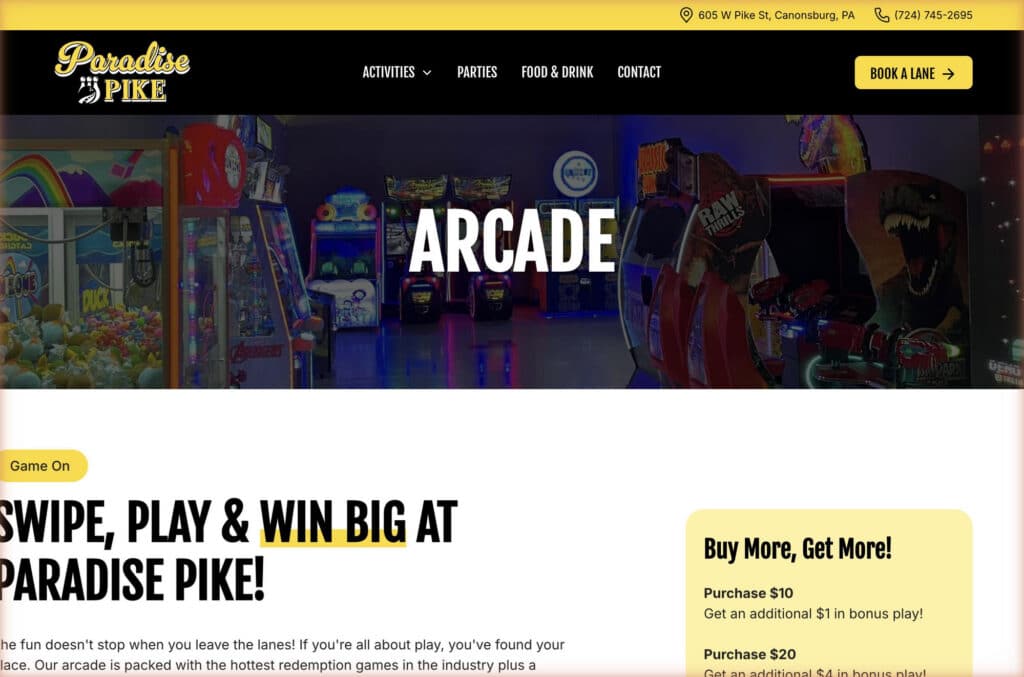
One of the trickiest parts of building a website for a multi-activity entertainment center is information architecture (the way content is organized across pages so that different visitors can find what they need quickly). Paradise Pike has 20 bowling lanes where league players compete multiple nights a week, an arcade packed with games from Marvel Avengers to Jurassic Park and a redemption counter where kids trade in their tickets, a full bar with craft cocktails and beer on tap, a kitchen serving everything from wings to pizzas, birthday party rooms that host kids’ celebrations every weekend, group event packages for corporate outings, and even field trip programs for schools. Each of those offerings appeals to a different person with a different reason for visiting, and the website needs to serve all of them without feeling overwhelming.
The site handles this by giving each activity its own dedicated page under a clean Activities dropdown in the navigation. Bowling, Leagues, and Arcade each live on their own page with dedicated content, pricing, and calls to action. Parties get a separate top-level navigation item with sections for birthday parties, group events, and field trips. Food and drink gets its own page too. The result is that a parent planning a birthday party, a league bowler checking schedules, and a couple looking for Friday night Cosmic Bowling all have clear paths to exactly what they need.
This matters more than it might seem. According to research from the family entertainment center software industry, the venues that convert website visitors into paying guests most effectively are the ones that present clear pricing and a frictionless path to booking. When a visitor has to dig through a cluttered page to find whether the arcade has the games their kid wants or what a birthday package actually includes, they leave. Paradise Pike’s site structure eliminates that friction.
Pricing that answers questions instead of creating them
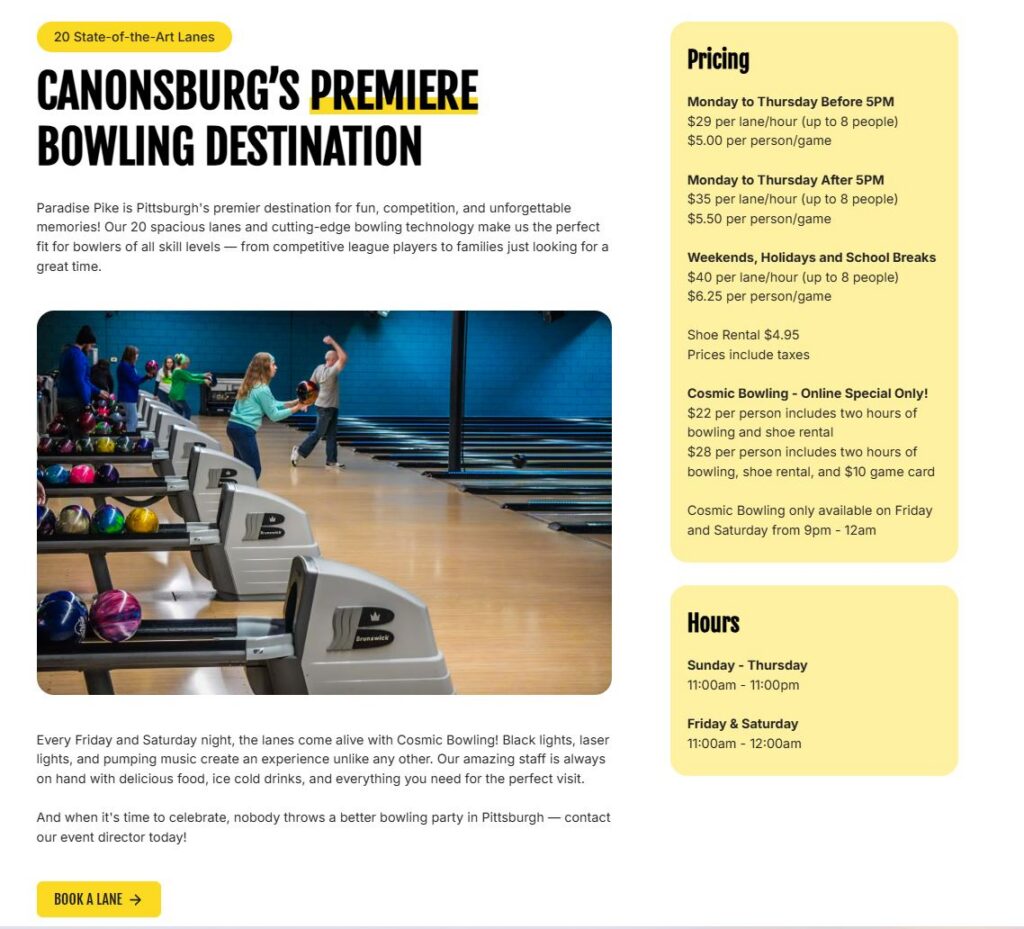
The bowling page is a good example of how the site handles pricing. Rather than burying rates in a PDF or making visitors call to ask, the page lays out pricing in clearly labeled tiers: weekday daytime rates, weekday evening rates, and weekend rates, each showing the per-lane and per-person options. Shoe rental cost is listed separately. Cosmic Bowling specials have their own section with package details and booking links.
This is the kind of transparency that builds trust with first-time visitors. Someone comparing Friday night options between Paradise Pike and a competitor doesn’t want to call two places to ask about pricing. They want to see it, compare it, and book it. The site makes all three of those steps possible without leaving the page.
Making party planning feel easy
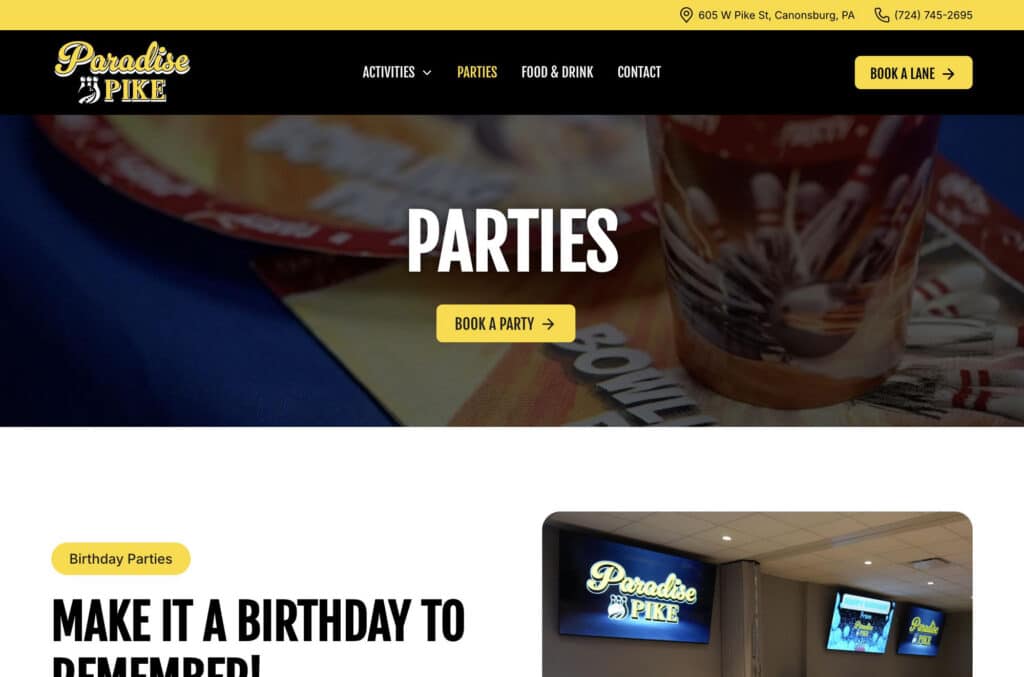
For a family entertainment center, party bookings are a significant revenue stream, and the decision-maker is almost always a parent who is already overwhelmed. Paradise Pike’s party page addresses this by breaking the experience into three clear categories: birthday parties, group events, and field trips. Each section has its own description, a link to downloadable package details, and a direct booking button.
The page also includes a thorough FAQ section that answers the practical questions parents actually ask: Can I bring a cake? Do I need to decorate? When do I need to finalize my package choice? How do I give a headcount? These questions might seem small, but answering them upfront removes the hesitation that keeps a parent from hitting the “Book Now” button. Every unanswered question is a reason to put it off, and every answered one is a reason to commit.
Cross-location navigation that ties the brand together
The footer of every page on the Paradise Pike site includes the Paradise Island Bowl logo with a link to the sister location’s website. The navigation bar also shows the Neville Island address and phone number alongside the Canonsburg details. This cross-location awareness serves two purposes: it signals to visitors that this is a multi-location business with an established presence in the Pittsburgh area (which builds credibility), and it gives anyone who lands on the wrong location’s site an easy path to the right one.
The two sites were deliberately kept on separate domains rather than being merged into one. That’s a smart decision for local search visibility. Google treats each domain as its own entity, which means Paradise Pike can rank independently for searches like “bowling in Canonsburg” while Paradise Island Bowl ranks for “bowling Neville Island.” Combining them into a single site with location pages would have diluted both.
The “Book A Lane” button that follows you everywhere
Online booking through My Bowling Passport, a reservation platform used by bowling centers to let customers reserve lanes and purchase packages online, is integrated throughout the site. The primary call to action appears in the header navigation on every page. Whether a visitor is reading about Cosmic Bowling specials, browsing the arcade page, or checking party packages, the option to book a lane is always one click away.
This persistent booking presence is important because people don’t always follow the path you expect. Someone might land on the party page, decide they’d rather just book lanes for a casual outing, and want to do it immediately. If the booking button only lived on the bowling page, that impulse would get lost. Having it in the global navigation means the site captures intent wherever it happens.
What entertainment venues can learn from this project
The entertainment industry is increasingly competitive in a way that goes beyond the physical experience. A venue can have the best lanes, the newest arcade games, and the friendliest staff, but if the website makes it difficult to find hours, understand pricing, or book a visit, potential customers will end up somewhere that makes those things easier. Paradise Pike’s site works because it treats each audience segment as a distinct visitor with distinct needs and gives each one a clean path from curiosity to commitment.
The rebrand timing is worth noting too. Launching a new website on the same day as the physical rebrand meant that the digital identity and the physical identity arrived together. There was no awkward gap where the building said “Paradise Pike” but the website still said “West Pike Bowl.” For any business going through a rebrand, that coordination between the physical and digital rollout matters more than most people realize. The first impression should be cohesive, and customers who hear about the new name and go looking for it online should find exactly what they expect.
The referral chain behind this project also tells a story about what consistent quality produces over time. A bowling equipment manufacturer refers an entertainment venue. That venue’s website performs well enough that the same owners come back for a second build at a second location. That kind of organic growth, where the work itself generates the next opportunity, is what happens when the first project genuinely delivers results.
Paradise Pike’s website is live at paradisepike.com. Built on Webflow by MPC Studios.
Working on a website for an entertainment venue, bowling center, or multi-activity business? Let’s talk.